MONTREAL – François Legault and his Coalition Avenir Québec (CAQ) party will form the province’s next government after a convincing electoral win last night. Though Legault committed several missteps on his way to a second majority, his opposition was unable to counter the CAQ’s nationalist message, which combined an economy-first message with nationalistic, some say fear-mongering rhetoric about immigrants and the survival of the French language. Here is a look at what the election outcome means for the innovation economy.
Skip to content


News
Legault gets his second majority—and a chance to help Quebec’s tech sector
Coalition Avenir Quebec Leader François Legault gives a thumbs-up during an election campaign stop at a market in Magog, Que., on Oct 2. Photo: The Canadian Press/Graham Hughes
MONTREAL – François Legault and his Coalition Avenir Québec (CAQ) party will form the province’s next government after a convincing electoral win last night. Though Legault committed several missteps on his way to a second majority, his opposition was unable to counter the CAQ’s nationalist message, which combined an economy-first message with nationalistic, some say fear-mongering rhetoric about immigrants and the survival of the French language. Here is a look at what the election outcome means for the innovation economy.
The tech sector: On paper, at least, the Legault government championed the province’s tech sector during the election, referring to Quebec as the “leader of the digital economy” and promising in its platform to spend $3.9 billion to attract, train and retain 170,000 additional workers in the health and social services, education, child care, construction, information technology and engineering sectors. In terms of infrastructure, the government has fulfilled a promise to deliver high-speed internet to all Quebec homes, and says cellphone coverage for the entire province will be completed by 2026.
Talking Point
François Legault and the Coalition Avenir Québec won a resounding majority in Monday’s provincial election. While Legault has championed Quebec’s tech sector, his statements and positions on immigration and language policy during the campaign raised concern among business leaders keen to recruit talent from abroad.
The Council of Canadian Innovators (CCI), a tech-industry group, said the province has nonetheless made it harder for companies and institutions to attract and retain smart people through its French-language law—particularly, the requirement that new arrivals learn French within six months. More than 170 executives of Quebec companies signed an open letter calling for the lessening of the French-language provisions. “We need to see much more progress on Frenchification,” said CCI government and public affairs director Pierre-Philippe Lortie. “We need to sit down with the government and try to find a way to collaborate and see how we can make the pill a little bit easier to swallow.”
Related Articles
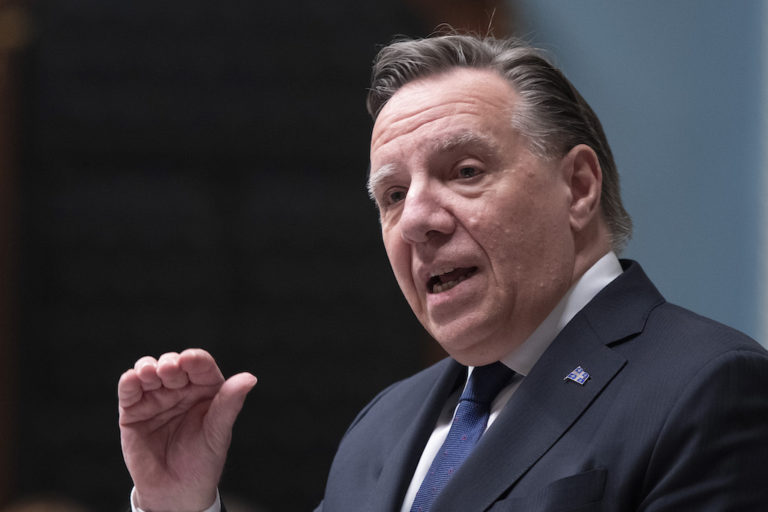

Meanwhile, the province’s protracted labour shortage continues to plague the tech sectors in Montreal, Quebec City and beyond, leading companies to look abroad for talent. No surprise, then, that immigration dominated parts of the campaign, with Legault seeming to suggest that immigrants are inherently violent (for which he later apologized) and saying an increase to Quebec’s current immigration target of 50,000 a year would be “suicidal” for the French language. Immigration Minister Jean Boulet went further, stating that 80 per cent of immigrants to Quebec “go to Montreal, don’t work, don’t speak French or adhere to Quebec society’s values.” (Needless to say, none of this is true.) Boulet also apologized, and in all likelihood won’t be immigration minister in the new government.
“Increasing the number of immigrants [and] economic immigration in Quebec is a must,” Lortie said. “So we will be louder if there is less collaboration, less listening mode and less working mode. We need to find a solution.”
The CCI says it will pressure the new government for adjustments to the province’s system of R&D credits to favour local companies over foreign-owned conglomerates—the issue of foreign-owned conglomerates benefiting from Quebec’s fiscal largesse has long been a sore point in the tech industry—as well as push for “more local content in procurement.”
Troisième Lien: In 2018, Legault made a show of supporting the construction of the “troisième lien” (“third link”), a $7-billion, eight-kilometre tunnel between Quebec City and its southern suburbs. Legault doubled down on building it during the election, despite criticism that it will hasten urban sprawl and increase carbon emissions. He did so in large part to solidify his electoral base around the capital, according to longtime Quebec City mayor Régis Labeaume, who retired in 2021. “The project will never be built, in any case. During the next mandate, [Legault] will say it costs too much and the federal government doesn’t want to contribute. That will be his main talking point,” Labeaume predicted to The Logic recently.
Environment: Though many Quebecers themselves denounced what they saw as the CAQ’s insufficient environmental action, the party has nonetheless moved forward on several key areas. Through its Plan vert, the government will ban the sale of new gas-powered cars by 2035. (The New York Times recently lauded the province’s network of fast chargers, which is nearly twice the size of New York State’s.)
In April, Quebec’s National Assembly unanimously adopted (with 10 abstentions) a law putting an end to oil and gas exploration and production within the province—the first North American jurisdiction to do so. Legault has also effectively ruled out further pipeline construction on Quebec territory. Still, while the environmental movement has hailed the province, analysts say the war in Ukraine and subsequent energy crisis in Europe, which have led to a massive increase in natural-gas prices, will put political pressure on a province that is richer in fossil fuels than many Canadians know. “First and foremost, people want to have jobs, and they want to have reasonable prices for their energy. And that’s what leads to likely some potential for change,” said Fractal Systems chief commercial officer Richard Masson, an executive fellow of the University of Calgary’s School of Public Policy and an oil-industry executive.



Loading...
Thanks for sharing!
You have shared 5 articles this month and reached the maximum amount of shares available.
CloseThis account has reached its share limit.
If you would like to purchase a sharing license please contact The Logic support at [email protected].
CloseGift the full article!
You have gifted 0 article(s) this month and have 5 remaining.
Recipients will be able to read the full text of the article after submitting their email address. They will not have access to other articles or subscriber benefits.
Photo: The Canadian Press/Graham Hughes
Most Popular This Week



In-depth, agenda-setting reporting
Great journalism delivered straight to your inbox.
Commentary
Carmichael: Canadian ignorance about India is a strategic weakness
Briefing
Aritzia shares pop after earnings rise 204%
First Nation in Alberta goes to court over fast-tracked oil pipeline
Chinese EV maker Geely Auto Group to launch in Canadian market in 2027
Best business newsletter in Canada
Get up to speed in minutes with insights and analysis on the most important stories of the day, every weekday.
Exclusive events
See the bigger picture with reporters and industry experts in subscriber-exclusive events.
Membership in The Logic Council
Membership provides access to our popular Slack channel, participation in subscriber surveys and invitations to exclusive events with our journalists and special guests.