In the summer of 2022, at the Prospectors and Developers Association of Canada conference, the country’s largest annual mining event, Natural Resources Minister Jonathan Wilkinson awarded a $5-million prize to a promising technology that reduces the emissions of an energy-intensive step of the mining process.
Skip to content
 Crush It was one of six NRCan contests run through Impact Canada, a federal initiative that operates innovation challenges for federal departments. Photo: Rethink Mining | Screengrab

News
Crushed: Insiders ask where $5M in federal prize money went after mining project cancelled
Shutdown highlights lack of conditions attached to taxpayer-funded awards
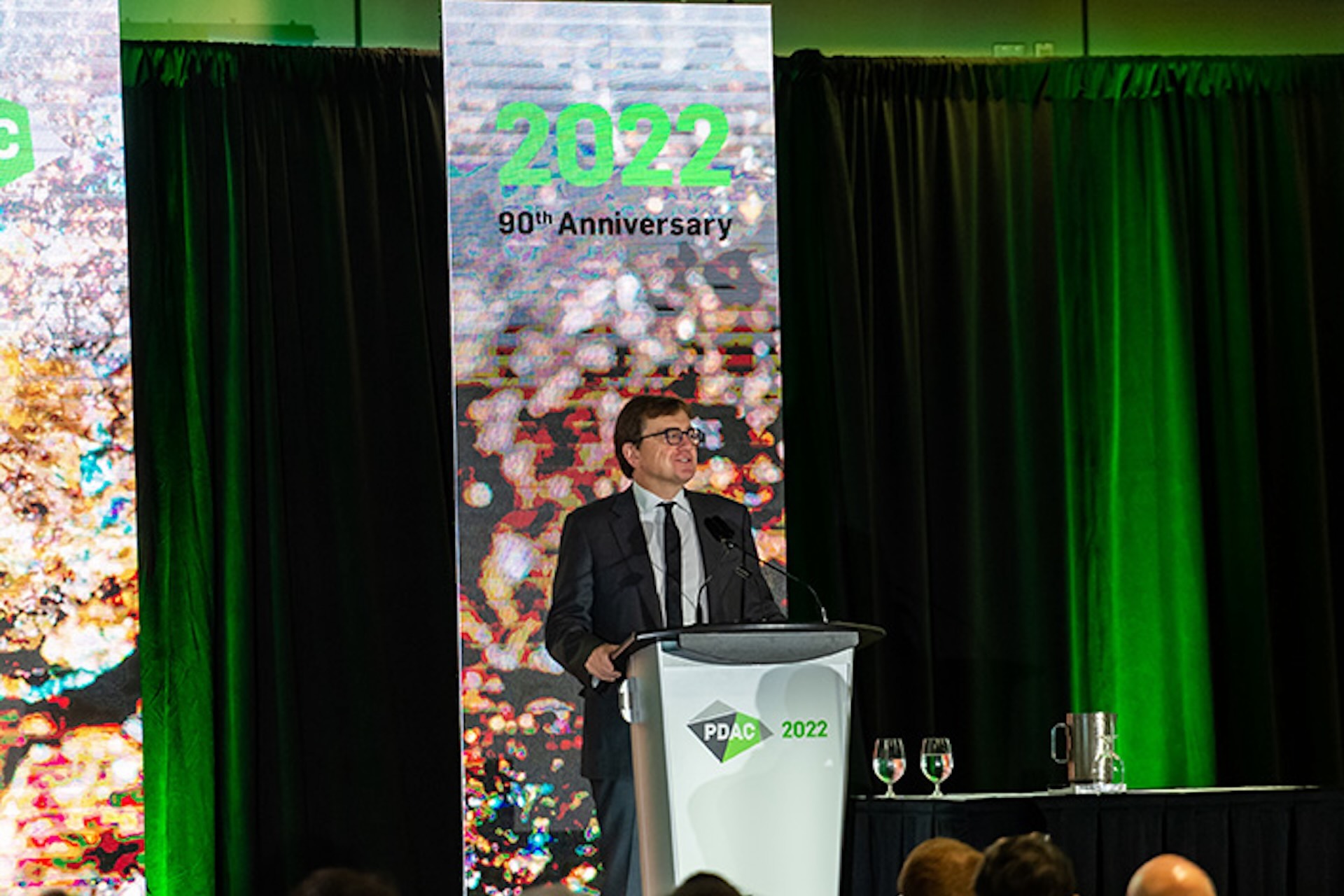
At the PDAC conference in 2022, federal Natural Resources Minister Jonathan Wilkinson awarded a $5-million prize to the Canada Mining Innovation Council. Photo: PDAC Convention | Handout
In the summer of 2022, at the Prospectors and Developers Association of Canada conference, the country’s largest annual mining event, Natural Resources Minister Jonathan Wilkinson awarded a $5-million prize to a promising technology that reduces the emissions of an energy-intensive step of the mining process.
A year and a half later, Sepro Mineral Systems, the Langley, B.C.-based company charged with advancing and commercializing the technology, quietly cancelled the winning project, and two former project participants are raising questions about how the majority of the government prize money was spent.
Talking Points
- A project that won a $5-million federal challenge to process ore with fewer emissions has been shut down by the B.C.-based company that was running it and was part of the winning group
- The cancellation has drawn questions from people who worked on the project after the prize was awarded, who say they had only spent about $700,000 developing the system when the project was shuttered
“It’s not so much the amount of money but it’s more so the principle,” said John Forster, the former technical lead for the microwave processing division at Sepro. Forster’s role was eliminated shortly after the project was cancelled. (The company offered him another position, but he declined.)
“The point of the challenge was to use this money to commercialize something, and it’s government money,” Forster said. “It’s taxpayer money.”
NRCan’s Crush It Challenge, launched in 2018, was meant to accelerate the development of technologies that lower the carbon footprint of comminution—the crushing and grinding of rocks necessary to extract valuable minerals from ore. The process is often the largest use of energy at mine sites.
Crush It was one of six NRCan challenges run through Impact Canada, a federal government initiative housed under the Privy Council office that operates innovation challenges for federal departments. Impact Canada was first announced in the 2017 federal budget, and NRCan said in a June 2022 press release that it had invested $75 million in the challenges.
Related Articles

Sepro, a mineral processing company, was part of a winning application that was led by a not-for-profit innovation group called the Canada Mining Innovation Council (CMIC) and included academics from three universities. Their system combined microwave technology and ore sorting to reduce the level of crushing and grinding required to extract minerals. Mining giant Glencore also participated, supplying ore for research and testing.
Housed at Sepro’s headquarters, the pilot plant included a 150-kilowatt microwave system that ore passed under on a conveyor belt. The system processed five-tonne samples of nickel, copper, gold and silver ores during the challenge.
The consortium reached 35 per cent or more energy savings in processing nickel, copper and silver ores during the challenge period, which NRCan said in a news release exceeded the contest’s requirements.
The prize money was first awarded to CMIC, and then CMIC transferred the funds to Sepro to lead its commercialization.
Forster worked on the initial challenge application while completing his PhD at the University of Toronto, and was hired by Sepro after the prize was awarded to be technical lead of microwave processing. He and a colleague worked for a year to develop the technology. But after the team recorded lower energy savings than during the challenge, he said, management told him in December it was shuttering the project and that all the funds had been used.
Forster said he and his colleague kept a spreadsheet of their research expenses—including equipment, hiring a consultant and their own salaries—and by their own estimates had only spent around $700,000. He said he asked multiple times how the rest of the funds had been spent, but didn’t receive a clear answer.
At one point, Forster said, management suggested some of the funds had gone to covering the cost of running the project before the consortium won the challenge and received the prize.
Carl Weatherell, executive director and chief executive officer of CMIC, said in an email to The Logic that while the project “held great promise,” Sepro decided to discontinue it “after expending the awarded prize” due to insufficient interest from potential clients and having determined the technology was too far from commercialization.
In subsequent emails, Weatherell confirmed CMIC had a contract with Sepro that included specific terms for how the funds should be spent and reporting requirements, but didn’t provide details.
Mark Van Kleek, Sepro’s CEO, said in an email that after receiving just under $4.9 million from CMIC—the prize total minus the innovation council’s expenses—Sepro paid over $1.225 million in taxes on the award. The remainder of the funds, he said, was spent on “various essential, eligible expenditures over the course of the project,” including salaries, equipment, overhead, consulting fees, operating costs, and research and analysis. “There are additional costs to be incurred associated with demobilizing the plant and transporting it to its next destination,” he said.
The project was cancelled as Forster was working with Christopher Pickles, a Queen’s University professor of mining engineering who was part of the consortium, on an application to the Natural Sciences and Engineering Research Council of Canada for additional funding for the project.
“The point of the challenge was to use this money to commercialize something, and it’s government money. It’s taxpayer money.”
Pickles said he too sought answers from CMIC and Sepro on how the rest of the prize funds were spent, to no avail, and met virtually in January with members of NRCan’s office of energy research and development.
NRCan told The Logic in emails that it is aware of claims about the prize funds, while noting that the prize is a retrospective award that goes to the winner after the results have been achieved. “Officials have spoken with other parties involved, in addition to CMIC who, as the recipient of the prize grant agreement, is the only CanMicro consortium member with which NRCan has a legal relationship,” wrote spokesperson Michael MacDonald. “The department is satisfied that CMIC met the terms of the agreement.”
The sparsity of those terms, though, has shone a light on how few controls the department exacts once its innovation prizes are given. NRCan’s award contract with CMIC, obtained by The Logic, did not include clauses for how the money should be spent, other than that the project can’t break existing laws; nor were there requirements to provide updates on the project’s development. It did include a section on defaults, which allows the government to retract the funds if the recipient misrepresented itself in its application or ceases to meet eligibility requirements. The challenge applicant guide required participants to be a legal entity incorporated and “validly existing” in Canada.
Dan Breznitz, the University of Toronto’s Munk Chair of Innovation Studies, said contracts like it are typical for innovation prize competitions, where there are “not a lot of strings attached.” But “a smart country would attach a few,” he added, including requirements for the intellectual property and eventual commercial production to remain in Canada.
Jeanette Jackson, the CEO of the Foresight Cleantech Accelerator Centre, said she’s seen no standard policy across government ministries around how funds are disbursed. Still, she said, “usually there’s a mechanism where follow-on reporting is required.” When Foresight has distributed federal dollars to startups, her organization has required spending reports from recipients for up to two years.
That can help program administrators learn about a challenge’s strengths and weaknesses, its economic benefits and whether recipients face struggles reaching the next development milestone or securing additional investment, Jackson said.
Michele Lajeunesse, senior vice-president of government relations and policy at Technation, describes herself as a “firm believer” in innovation challenges, but doubts federal departments are capturing enough data on their results. “They just spend the money and move on to the next,” she said.



Loading...
Thanks for sharing!
You have shared 5 articles this month and reached the maximum amount of shares available.
CloseThis account has reached its share limit.
If you would like to purchase a sharing license please contact The Logic support at [email protected].
CloseGift the full article!
You have gifted 0 article(s) this month and have 5 remaining.
Recipients will be able to read the full text of the article after submitting their email address. They will not have access to other articles or subscriber benefits.
Photo: PDAC Convention | Handout
Crush It was one of six NRCan contests run through Impact Canada, a federal initiative that operates innovation challenges for federal departments.
Most Popular This Week




In-depth, agenda-setting reporting
Great journalism delivered straight to your inbox.
Commentary
Carmichael: Canadian ignorance about India is a strategic weakness
Briefing
Aritzia shares pop after earnings rise 204%
First Nation in Alberta goes to court over fast-tracked oil pipeline
Chinese EV maker Geely Auto Group to launch in Canadian market in 2027
Best business newsletter in Canada
Get up to speed in minutes with insights and analysis on the most important stories of the day, every weekday.
Exclusive events
See the bigger picture with reporters and industry experts in subscriber-exclusive events.
Membership in The Logic Council
Membership provides access to our popular Slack channel, participation in subscriber surveys and invitations to exclusive events with our journalists and special guests.





