Auto-parts manufacturer Magna International has found an unlikely partner it hopes will lend it a competitive edge: Epic Games, maker of popular video games like Fortnite, Fall Guys and Rocket League.
Skip to content

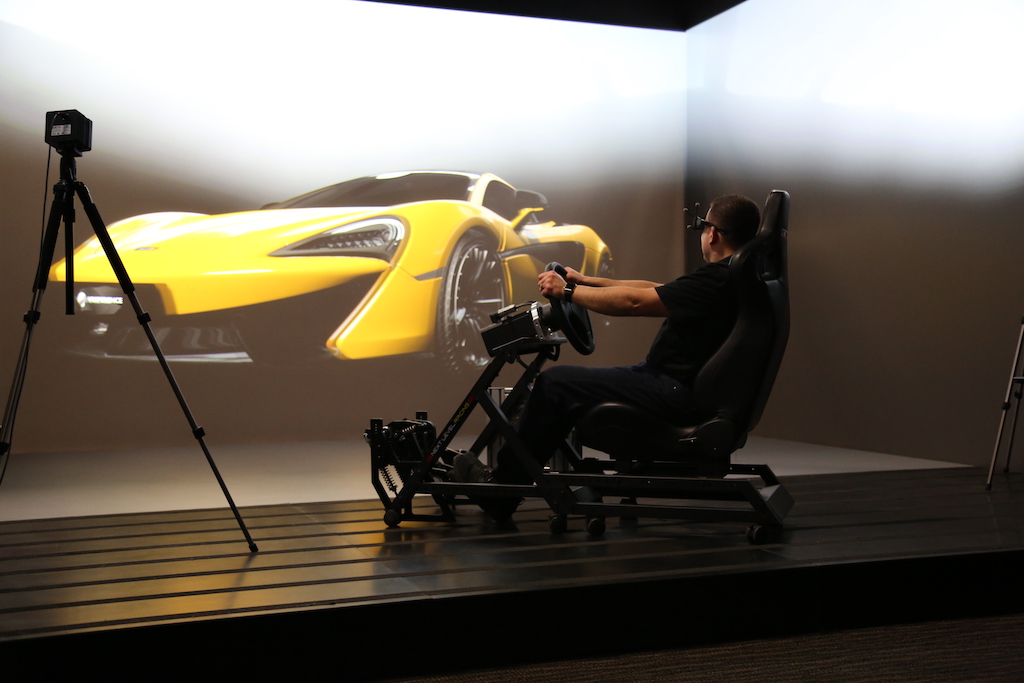 A driving simulator at the Invest WindsorEssex VR CAVE in Windsor, Ont. Photo: WindsorEssex VR CAVE | Handout

News
How car companies like Magna are using the technology behind Fortnite to get a competitive edge
Epic Games has been expanding its work with automakers, including helping them make mock-ups, after opening a Detroit lab in 2019. Photo: Epic Games | Handout
Auto-parts manufacturer Magna International has found an unlikely partner it hopes will lend it a competitive edge: Epic Games, maker of popular video games like Fortnite, Fall Guys and Rocket League.
It’s part of a trend taking hold in the auto industry. Technology created for video games—which uses particularly powerful and precise physics, eliminates lag when simulating movement and works across platforms—is uniquely suited for use by car companies, which make products whose function can’t be fully captured by still images or static prototypes.
Talking Point
Technology created for video games—which are all about precise, powerful and predictable interaction with a digital world—is becoming uniquely helpful for car companies that make products whose function can’t be fully captured by still images or static prototypes. Aurora, Ont.-based Magna International is one of the founding companies behind the Augmented Reality Center at Oakland University in Rochester, Mich., alongside General Motors, where they use the technology of Epic Games, maker of popular video games like Fortnite.
“Your part comes alive. Everything—as simple as a door mechanism that opens and closes to the inner workings of an electric motor—you can see the motion of those in 3-D,” said Magna research and development director Jim Quesenberry.
North Carolina-based Epic opened a lab in the auto-industry centre of Detroit in 2019, part of its effort to serve the growing number of car companies—now including Aurora, Ont.-based Magna—finding industrial uses for its Unreal game-design engine, with its advanced graphics and physics capabilities.
The key, said Heiko Wenczel, head of Epic Games’ Detroit lab and the company’s director for human-machine interface and automotive, is that gaming companies by definition must be able to create a virtual object that moves and interacts with the virtual world around it in real time.
Magna is also one of the founding partners behind the Augmented Reality Center at Oakland University in Rochester, Mich., alongside General Motors, Siemens and the U.S. Army, as well as other companies in the robotics, automotive and VR industries. The centre, which celebrates its one-year anniversary Thursday, is funded in part by a grant from Epic.
For Magna, it’s part of a broader experiment with augmented and virtual reality. It has a virtual reality centre in Graz, Austria that it has said would be part of its “smart-factory” strategy. The company currently has two projects in the early stages. Using virtual reality, it is creating “digital twins” of its parts, which it can share with automakers earlier in the design process than was possible with physical prototyping. The digital technology lets Magna get feedback from automakers and make design changes to its parts quickly, without having to first manufacture them. It’s a chance that could have a big impact on the sector, given the company’s parts were in as many as two out of every three new vehicles as of 2019.
A second project is focused on training and optimizing Magna’s factories. With augmented reality, the company aims to display information for workers using tablets or AR glasses on the factory floor, like instructions that “light up” different parts at the assembly line. A line worker’s station can have 10 to 15 bins containing different parts that need to be assembled, Quesenberry said, and the worker may need different combinations of parts for different products. With AR, the workers could see the bins light up in a certain order, or see how the parts screw together in a particular way.
Over time, he hopes Magna could improve its processes by studying data gathered from workers’ movements. “When you do this millions of times over months and years, you start to get trends,” said Quesenberry. “It’s a virtual or digital twin of your product, of your assembly line, of your entire operation.”
Wenczel said Epic Games’ Unreal Engine platform is free to use and its grants to educational institutions do not require any IP transfer. The grants are a win for both Epic and the institutions that use the platform, he said, because projects like the one at Oakland University teach students who are about to enter the workforce how to use the tool, potentially seeding its use in the industry.
“The base principle in the automotive industry is that a lot of things have moved toward digital IP-asset creation,” said Wenczel.
“How to create your services, how to display them—there is a whole visual computing element in everything that the automotive industry does.”
Oakland University plans to launch courses this fall that will provide more students an introduction to using the Augmented Reality Center, said Khalid Mirza, the ARC’s founding director. The centre was a “no-brainer” for the university, Mirza said, preparing students for potential metaverse jobs with equipment to which they wouldn’t otherwise have access while at the same time helping local businesses collaborate while separated by travel bans and work-from-home mandates.
“Europe is already ahead of us in this area—the industrial use of immersive technologies—so we are trying to make sure all the North American companies are also up to par,” said Mirza. “And standardizing the way we use it, so everyone isn’t off doing their own thing, but are collaborating.”
There are similar efforts underway in Canada. In a separate project across the border from Detroit, Akash Charuvila, the engineering lead of VR and optics at Invest WindsorEssex’s VR CAVE, has offered free services to local businesses since 2019, in part through the Autonomous Vehicle Innovation Network.
“You could just be in the VR space and see if the rearview mirrors are showing everything properly…. ‘Is there too much glare on the infotainment screen when I move my head?’” said Charuvila, contrasting the experience of evaluating an immersive digital model of a car to the traditional physical mockup of a pre-production vehicle sculpted out of clay. “Those things are very quickly evaluated using VR, you could tweak it and again put on the glasses to see if it works properly.”
The Automotive Parts Manufacturers’ Association is using the CAVE as part of Project Arrow, a car for which every part will be made by a Canadian business. One of the technologies used at the VR CAVE is Unity, which Charuvila said also has roots as a gaming engine, but is now popular for industrial applications.
“The software and the hardware together in the VR CAVE costs close to $4.6 million. That is something [small- and medium-sized enterprises] or startups cannot afford. So we want to give them the tools that help them … come up with Canadian-made solutions,” said Charuvila.



Loading...
Thanks for sharing!
You have shared 5 articles this month and reached the maximum amount of shares available.
CloseThis account has reached its share limit.
If you would like to purchase a sharing license please contact The Logic support at [email protected].
CloseGift the full article!
You have gifted 0 article(s) this month and have 5 remaining.
Recipients will be able to read the full text of the article after submitting their email address. They will not have access to other articles or subscriber benefits.
Photo: Epic Games | Handout
A driving simulator at the Invest WindsorEssex VR CAVE in Windsor, Ont.
Most Popular This Week




In-depth, agenda-setting reporting
Great journalism delivered straight to your inbox.
News
Canada faces a satellite-launch crunch as SpaceX retires its workhorse rocket
Briefing
Cohere says it caught an Alibaba model trying to send data to a server in China
Feds and First Nations to work on sharing resource revenue, with a sovereign wealth fund one option
Zafin buys U.S. fintech Naehas in nine-figure deal
Best business newsletter in Canada
Get up to speed in minutes with insights and analysis on the most important stories of the day, every weekday.
Exclusive events
See the bigger picture with reporters and industry experts in subscriber-exclusive events.
Membership in The Logic Council
Membership provides access to our popular Slack channel, participation in subscriber surveys and invitations to exclusive events with our journalists and special guests.