Honda Canada said its manufacturing facility in Alliston, Ont., “will operate at full capacity for the foreseeable future” and “no changes are being considered at this time,” despite a report that the Japan-based automaker is considering moving production of the CR-V SUV and Civic sedan to the U.S.
Skip to content


News
Honda denies it’s planning to move Canadian vehicle production to U.S.
Automaker pushes back on report it could shift operations, saying Ontario plant will keep running ‘at full capacity’
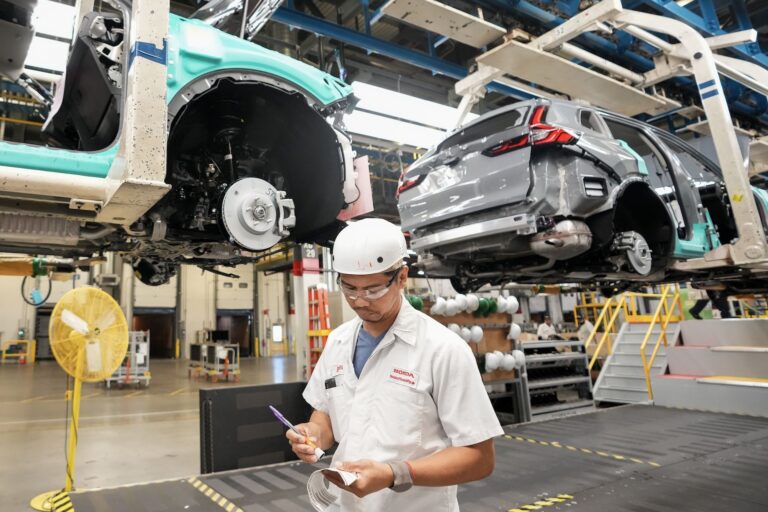
Honda Canada's assembly lines in Alliston, Ont., turn out about 400,000 vehicles a year. Photo: The Canadian Press/Cole Burston
Honda Canada said its manufacturing facility in Alliston, Ont., “will operate at full capacity for the foreseeable future” and “no changes are being considered at this time,” despite a report that the Japan-based automaker is considering moving production of the CR-V SUV and Civic sedan to the U.S.
The statement came after Japan-based news outlet Nikkei Asia reported the automaker is reviewing its North American structure in response to tariffs imposed by U.S. President Donald Trump.
Talking Points
- Honda said its Canadian plant is operating at full capacity thanks to domestic sales, despite a report indicating it was considering moving production to the U.S. to offset tariffs
- The Liberal government said it will limit tariff relief to automakers if they fail to follow through on Canadian production plans
While both Honda and Canadian politicians downplayed the report, it has added urgency to questions about how Canada will maintain its manufacturing sector amid pressure on automakers to move production stateside. Honda Canada employs about 4,200 people and promised last year to hire about 1,000 more.
The statement sent Tuesday by Honda Canada spokesperson Ken Chiu said the company couldn’t comment on the report, but added: “We constantly study options for future contingency planning and utilize short-term production shift strategies when required.”
The report heard ‘round the sector: Nikkei’s report said tariffs imposed by the White House could cost Honda about US$4.57 billion a year, noting that about 300,000 of the half-million cars Honda sells in the U.S. are from Canada. To mitigate that, Honda could move about 90 per cent of its U.S.-bound vehicle production to the U.S., according to the report. The company could also cut back on exports from the U.S. to Canada to deal with retaliatory tariffs, and examine “gradually shifting to local production” here as well, said the report.
Related Articles
Honda Canada said about 69 per cent of Honda vehicles sold in Canada are already built domestically, and the company maintains flexibility to send cars to “various regions and potentially new markets.”
“Canadian production will remain at full capacity thanks to domestic sales,” it said.
The backdrop: Canada’s federal Finance Department announced on Tuesday that it would cut tariff relief if automakers don’t keep producing vehicles in Canada and complete planned investments. Liberal Leader Mark Carney said he’s preparing to negotiate with the U.S. on auto tariffs after this month’s election, adding that the government has been in contact with global automotive CEOs.
Meanwhile, U.S. policy remains in flux. Trump said yesterday he was considering giving automakers time to move supply chains to the U.S., which was widely interpreted as a suggestion he would delay the administration’s planned tariffs on parts.
The reaction: Ontario Premier Doug Ford said Tuesday that Honda has assured his government that the reports about Canada were not accurate, even as the company aims to increase U.S. production due to low capacity there. Ford cited a conversation with Dave Jamieson, who took over as Honda Canada’s CEO on April 1.
“We’re going to keep Honda here, and I’ll do everything I can to protect the people and their jobs,” Ford said.
Federal Industry Minister Anita Anand said in an X post that she was set to meet with the company on Tuesday, and echoed Honda’s statement that it isn’t currently considering production changes.
Honda’s Canadian presence: Honda, like many automakers, is highly exposed to tariffs. It has capacity to manufacture 400,000 vehicles in Canada annually, but as of 2023, only sold about 100,000 of them domestically.
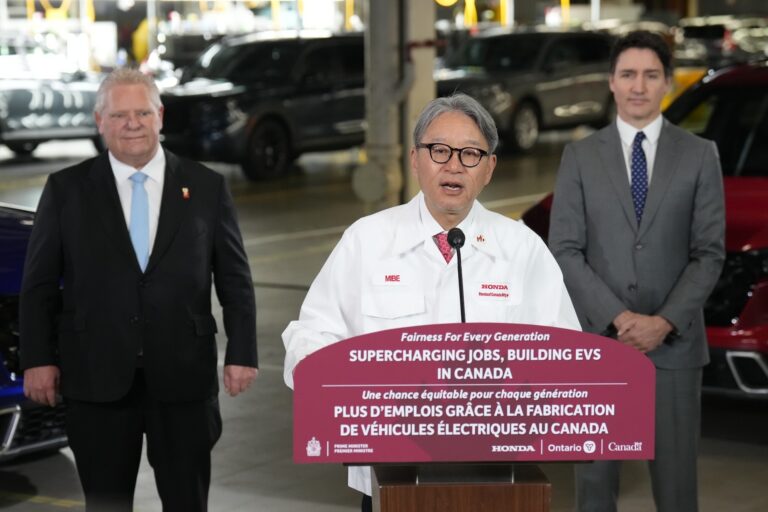
Still, any production cuts would be a stunning reversal less than a year after Honda announced a $15-billion investment in Canadian manufacturing, expanding the factory it has operated in Alliston for nearly 40 years. It was the biggest EV manufacturing investment in Canada, more than double that of Volkswagen and about triple that of Stellantis and LG. Honda was offered $5 billion in public money for the project.
Since then, though, Honda has been searching for new ways to stay competitive, leading it to consider—then scrap—a merger with Nissan. It has plants in the U.S. that already make its two flagship Canadian products, the Civic and CR-V.
The company came under particular scrutiny after Reuters reported in March it rolled back plans to move Civic production to Mexico, earning praise from U.S. President Donald Trump. Honda Canada did not confirm that report, and said on March 3 that its dedication to its Canadian operations was steadfast.
With files from Joanna Smith



Loading...
Thanks for sharing!
You have shared 5 articles this month and reached the maximum amount of shares available.
CloseThis account has reached its share limit.
If you would like to purchase a sharing license please contact The Logic support at [email protected].
CloseGift the full article!
You have gifted 0 article(s) this month and have 5 remaining.
Recipients will be able to read the full text of the article after submitting their email address. They will not have access to other articles or subscriber benefits.
Photo: The Canadian Press/Cole Burston
Most Popular This Week




In-depth, agenda-setting reporting
Great journalism delivered straight to your inbox.
Commentary
Carmichael: Canadian ignorance about India is a strategic weakness
Briefing
Aritzia shares pop after earnings rise 204%
First Nation in Alberta goes to court over fast-tracked oil pipeline
Chinese EV maker Geely Auto Group to launch in Canadian market in 2027
Best business newsletter in Canada
Get up to speed in minutes with insights and analysis on the most important stories of the day, every weekday.
Exclusive events
See the bigger picture with reporters and industry experts in subscriber-exclusive events.
Membership in The Logic Council
Membership provides access to our popular Slack channel, participation in subscriber surveys and invitations to exclusive events with our journalists and special guests.