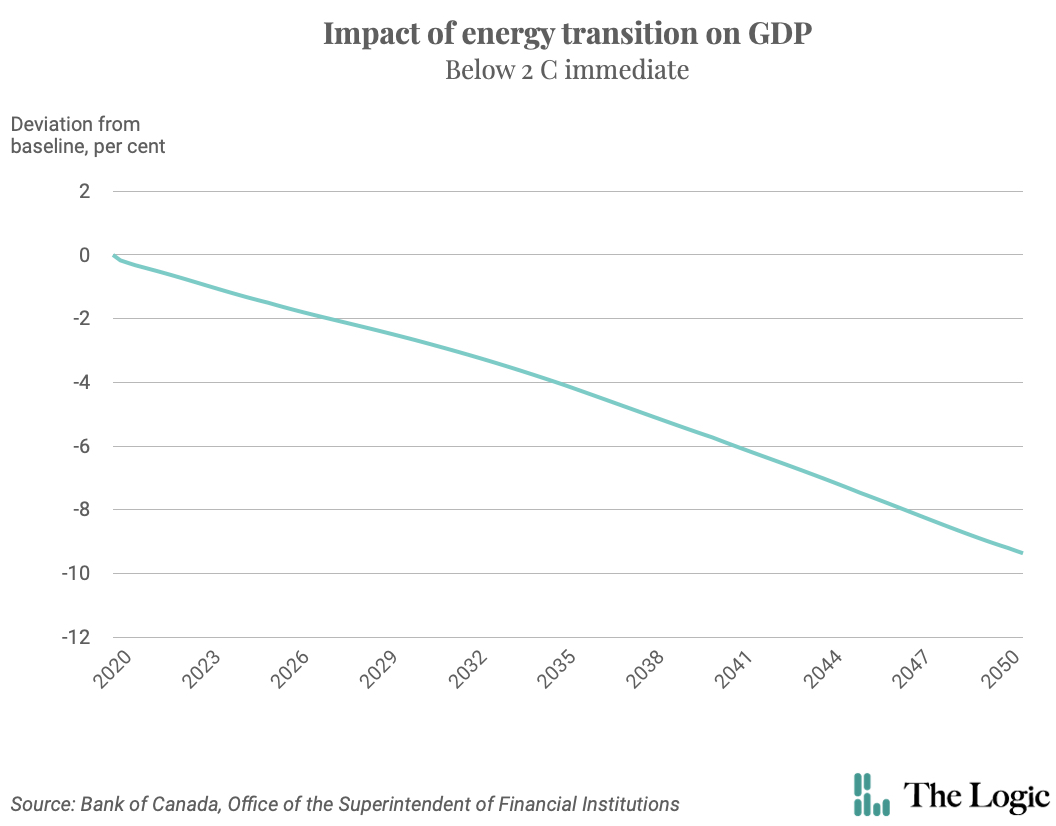
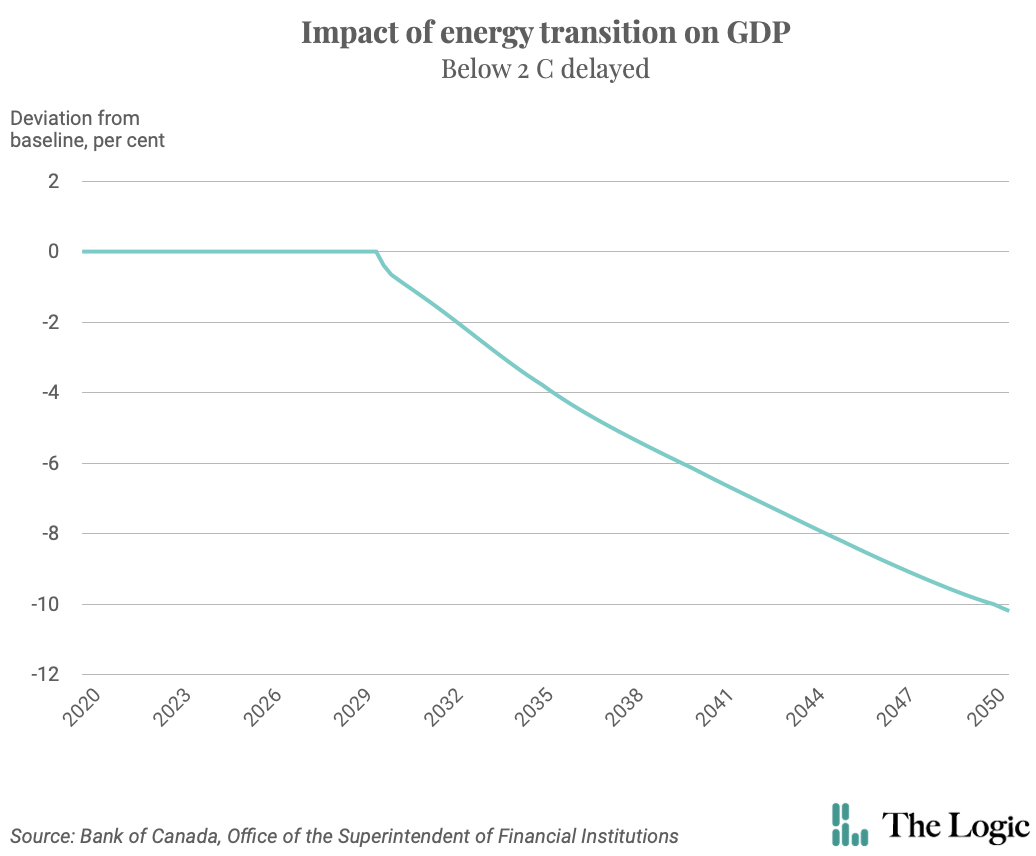
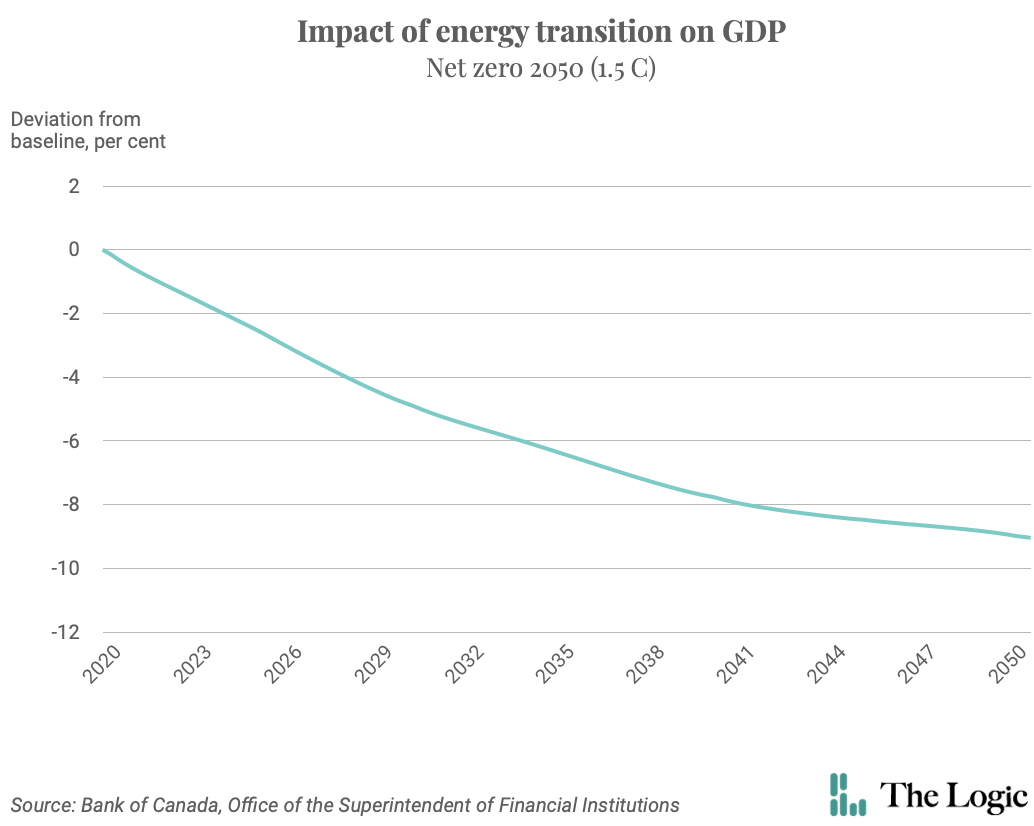
The Bank of Canada and the Office of the Superintendent of Financial Institutions (OSFI) just concluded more than a year of consultations on climate-change risks to the financial sector. They found that, under every approach tested, transitioning to a low-carbon economy will increase the likelihood of companies defaulting on loans across key industries and reduce Canada’s GDP by about 10 per cent.
Skip to content


News
Here’s how the Bank of Canada says the energy transition could affect GDP, in charts
Bank buildings are photographed in Toronto's Financial District in June 2018. Photo: The Canadian Press/Tijana Martin
The Bank of Canada and the Office of the Superintendent of Financial Institutions (OSFI) just concluded more than a year of consultations on climate-change risks to the financial sector. They found that, under every approach tested, transitioning to a low-carbon economy will increase the likelihood of companies defaulting on loans across key industries and reduce Canada’s GDP by about 10 per cent.
The organizations consulted six financial institutions in Canada—TD Bank, RBC, Sun Life, Manulife, Intact Insurance and Co-operators—and had them analyze their exposure to the 10 most emissions-intensive sectors under three different transition scenarios.
Each one forecasts a threat to the financial system. Here’s what they look like:
Immediate 2 C scenario: In the event Canada immediately starts working to limit warming to 2 C, GDP will steadily decline between now and 2050.
Delayed 2 C scenario: If Canada delays additional climate action until 2030, the economy will take a steeper hit when it does begin the transition and will ultimately decline more by 2050.
Net-zero scenario: In the event Canada works to the net-zero target of limiting warming to 1.5 C by 2050, GDP would drop immediately, but declines would soften closer to 2050. The economic impact under the net-zero scenario would also be the least severe.
Grains of salt: The report notes that “innovation and technological progress play a key role in easing the transition.” However, the scenarios assume that climate tech will remain frozen in 2019. While that’s virtually impossible, the regulators said it’s exceedingly difficult to forecast how technology to curb emissions will develop and scale over the next 30 years.
The report also leaves out physical risks associated with climate change, like economic damage from flooding and fires. While addressing physical risks will be an added cost, the report notes that “the benefits of avoided physical risks to the global economy have typically been shown to exceed the costs associated with the low-carbon transition.”
What’s next: The report doesn’t offer policy recommendations, but serves as a model for other financial institutions to test how the shift to a green economy will impact their operations. That work so far has been slow, the report found, with pilot participants citing lack of good and consistent data as a major barrier to quantifying risk and setting targets. The OSFI also announced Friday that it will issue draft guidance for consultation later this year on how financial institutions should manage climate risk.



Loading...
Thanks for sharing!
You have shared 5 articles this month and reached the maximum amount of shares available.
CloseThis account has reached its share limit.
If you would like to purchase a sharing license please contact The Logic support at [email protected].
CloseGift the full article!
You have gifted 0 article(s) this month and have 5 remaining.
Recipients will be able to read the full text of the article after submitting their email address. They will not have access to other articles or subscriber benefits.
Photo: The Canadian Press/Tijana Martin
Most Popular This Week




In-depth, agenda-setting reporting
Great journalism delivered straight to your inbox.
Commentary
Carmichael: Canadian ignorance about India is a strategic weakness
Briefing
Aritzia shares pop after earnings rise 204%
First Nation in Alberta goes to court over fast-tracked oil pipeline
Chinese EV maker Geely Auto Group to launch in Canadian market in 2027
Best business newsletter in Canada
Get up to speed in minutes with insights and analysis on the most important stories of the day, every weekday.
Exclusive events
See the bigger picture with reporters and industry experts in subscriber-exclusive events.
Membership in The Logic Council
Membership provides access to our popular Slack channel, participation in subscriber surveys and invitations to exclusive events with our journalists and special guests.