TORONTO — A Toronto judge has found Hamed Abbasi, the co-founder and former CEO of fintech scaleup Plooto, not guilty of sexually assaulting a woman following a 2023 tech industry event.
Skip to content


News
Former Plooto CEO Hamed Abbasi acquitted of sexual assault charge
Abbasi, who stepped down as CEO in 2024, faced up to 10 years in prison if convicted
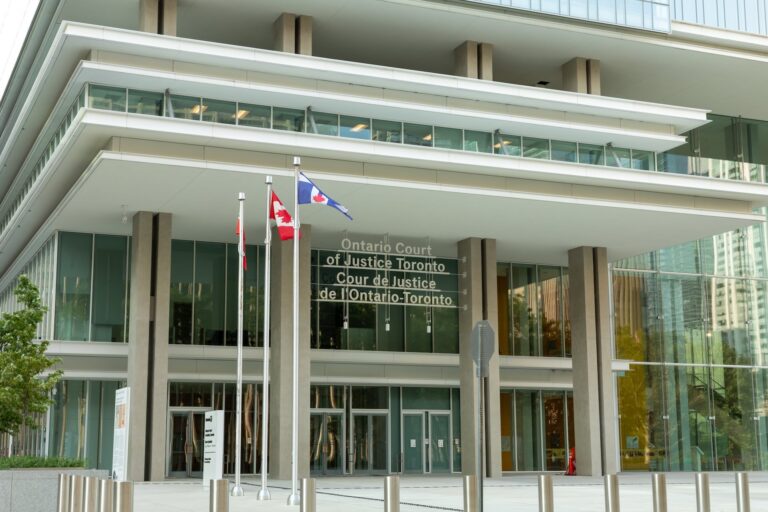
The Ontario Court of Justice courthouse in downtown Toronto in August 2023. Photo: The Canadian Press/Colin N. Perkel
TORONTO — A Toronto judge has found Hamed Abbasi, the co-founder and former CEO of fintech scaleup Plooto, not guilty of sexually assaulting a woman following a 2023 tech industry event.
Abbasi had been on trial since Jan. 13 on one charge of sexual assault. He faced up to 10 years in prison had he been convicted.
“After a fair trial in which all of the evidence was heard and very carefully considered by the court, he’s been completely vindicated,” said Abbasi’s lawyer Gerald Chan outside the courtroom. “He’s innocent, and he looks forward to being able to return some normalcy to his life and restore his standing in the community, both professionally and otherwise.”
Talking Points
- Hamed Abbasi, co-founder and former CEO of Toronto-based fintech firm Plooto has been found not guilty of a sexual assault charge related to an incident in November 2023
- Abbasi has been on trial since January and was facing up to 10 years in prison
Abbasi co-founded Plooto in 2015, but stepped down as CEO in March 2024. The company told BetaKit later that year that Abbasi had left for “personal reasons,” but that it was not in a position to elaborate. Chan said Tuesday he couldn’t comment on whether Abbasi will return to Plooto.
During the trial Justice Jennifer Strasberg heard evidence about a sexual encounter between Abbasi and an acquaintance who claimed the incident was not consensual. The identity of the woman who filed the lawsuit is protected under a publication ban.
The incident began at a tech-industry meetup in Toronto on the evening of Nov. 21, 2023, where Abbasi and the woman—who had interacted with him previously at a handful of other tech events—each had multiple drinks. The woman testified that it ended with her waking up in a hotel room alone, naked and in pain, and largely unaware of what had happened in the preceding hours.
Strasberg said in court Tuesday morning that the Crown had not proven beyond a reasonable doubt that the woman lacked the capacity to consent to sexual activity with Abbasi.
Related Articles
Video evidence and testimony from Abbasi and the woman show the two went to Marbl, a restaurant on King Street West, after the industry event where they had another drink. The woman said she expected others from the event to join, but they did not.
Surveillance videos presented as evidence in the trial showed the woman and Abbasi sitting closely at a booth in the restaurant and kissing at some points throughout the night, which the woman said she doesn’t recall. The judge ruled that the kissing was consensual, based on video evidence and testimony from Abbasi and restaurant staff who said it appeared the woman and Abbasi were enjoying each other’s company.
Abbasi—who said he and his wife agreed to allow “casual encounters” with other people under certain circumstances—said he and the woman agreed while at the restaurant to get a hotel room where they would have sex.
The Crown attorney argued the complainant was too intoxicated to consent. The lawyer pointed to surveillance videos taken prior to the woman and Abbasi leaving the restaurant showing the woman slumped forward at the restaurant booth and staff asking them to leave the establishment because the woman was drunk and looked as if she might throw up. As Abbasi and the woman prepared to leave, staff brought a bucket to the table in case she got sick.
Seeing how intoxicated she was, Abbasi said he changed his mind about going to a hotel, and decided the two would head to their respective homes. Outside the bar, while waiting for an Uber, the woman threw up. Abbasi said she began feeling better after that and she insisted they stick with their plan to get a hotel room. The woman said she vaguely recalled getting sick but didn’t remember agreeing to go to a hotel.
The judge said she believed Abbasi and the woman had both agreed to go to a hotel, based on the timing of his search history for booking a room and video surveillance showing he and the woman were together and at times looking at his phone while he made the booking.
The two eventually walked to the Hyatt hotel where they checked into a room Abbasi had booked. They had sex without a condom, which Abbasi said the woman was clear about wanting to do. The woman, however, testified that she had no memory of consenting and had only vague recollections of what happened in the hotel room.
Early the next morning, the woman texted Abbasi asking why she was naked in a room at the Hyatt. She said the last thing she recalled was having lychee martinis at the restaurant. Abbasi texted back saying that she had been very drunk. He said she “fell down a bunch of times” and that she got sick after leaving the restaurant. “The Uber arrived but you didn’t want to get in,” he texted. “I just found the closest place to leave you where you’d be safe.”
Abbasi suggested they meet for lunch to talk more, saying he was concerned she didn’t remember anything. He did not mention in his texts that they had sex. When asked by his lawyer and the Crown why he left that information out, he said he didn’t think there was any way the complainant would not recall that they had had sex. He also claimed he worried the woman’s boyfriend may see the texts and get upset.
Abbasi’s lawyer argued that it’s reasonable for the accused to have omitted the information in text messages, possibly out of panic, embarrassment or fear of false accusation. The Crown, however, argued the texts were evidence of guilt and that Abbasi was an unreliable witness.
The judge agreed that Abbasi’s reason for not being forthright in the texts was plausible.
Staff at the Hyatt called the police that morning, after the woman, who appeared confused and in shock, got sick in the lobby. Police took her to the station for questioning and later to a hospital for a sexual assault exam.
Abassi was arrested four days later on Nov. 26.
In closing arguments, the Crown said the complainant was confused throughout the night and in a “stuporous state,” intoxicated beyond the capacity to consent. Because her client had no memory of much of the night, she argued the judge should reject accounts of events that were based solely on Abbasi’s testimony, including that the woman consented to sexual activity.
The Crown declined to comment on the verdict Tuesday.
Abbasi’s lawyer, meanwhile, said the trial evidence did not prove beyond a reasonable doubt that the woman lacked the capacity to consent to sexual activity. He pointed to case law showing that capacity to consent doesn’t require a high level of consciousness. The participants need to understand the risks, but they don’t need to have a clear mind to assess those risks, he argued.
The judge said she believed both Abbasi and the woman were credible witnesses, but said the Crown failed to prove her client did not have the capacity to consent. The bar to reach a verdict of sexual assault in such cases is high, the judge said, noting that even extreme intoxication, loss of motor skills and memory don’t necessarily mean someone is incapable of consenting to sexual assault.
Abbasi told BetaKit in 2024 that he no longer held a seat on Plooto’s board and was no longer involved in the company’s operations, but said that he still attended board meetings and got regular updates on the business. Chan, Abbasi’s lawyer, told The Logic in January that Abbasi had “relinquished complete control over Plooto’s operations and is not currently involved in any way.”
The company did not immediately respond to a request for comment Tuesday.
This is a breaking story. Please check back for updates.
With files from Aimée Look



Loading...
Thanks for sharing!
You have shared 5 articles this month and reached the maximum amount of shares available.
CloseThis account has reached its share limit.
If you would like to purchase a sharing license please contact The Logic support at [email protected].
CloseGift the full article!
You have gifted 0 article(s) this month and have 5 remaining.
Recipients will be able to read the full text of the article after submitting their email address. They will not have access to other articles or subscriber benefits.
Photo: The Canadian Press/Colin N. Perkel
Most Popular This Week




In-depth, agenda-setting reporting
Great journalism delivered straight to your inbox.
Commentary
Carmichael: Canadian ignorance about India is a strategic weakness
Briefing
Aritzia shares pop after earnings rise 204%
First Nation in Alberta goes to court over fast-tracked oil pipeline
Chinese EV maker Geely Auto Group to launch in Canadian market in 2027
Best business newsletter in Canada
Get up to speed in minutes with insights and analysis on the most important stories of the day, every weekday.
Exclusive events
See the bigger picture with reporters and industry experts in subscriber-exclusive events.
Membership in The Logic Council
Membership provides access to our popular Slack channel, participation in subscriber surveys and invitations to exclusive events with our journalists and special guests.