The revolution might not be televised, but apparently it will be livestreamed, with so many posts from the revolutionaries about what they’re thinking and planning that the hard part is keeping track of it all.
Skip to content
News
Finding what matters in oceans of convoy protesters’ streams
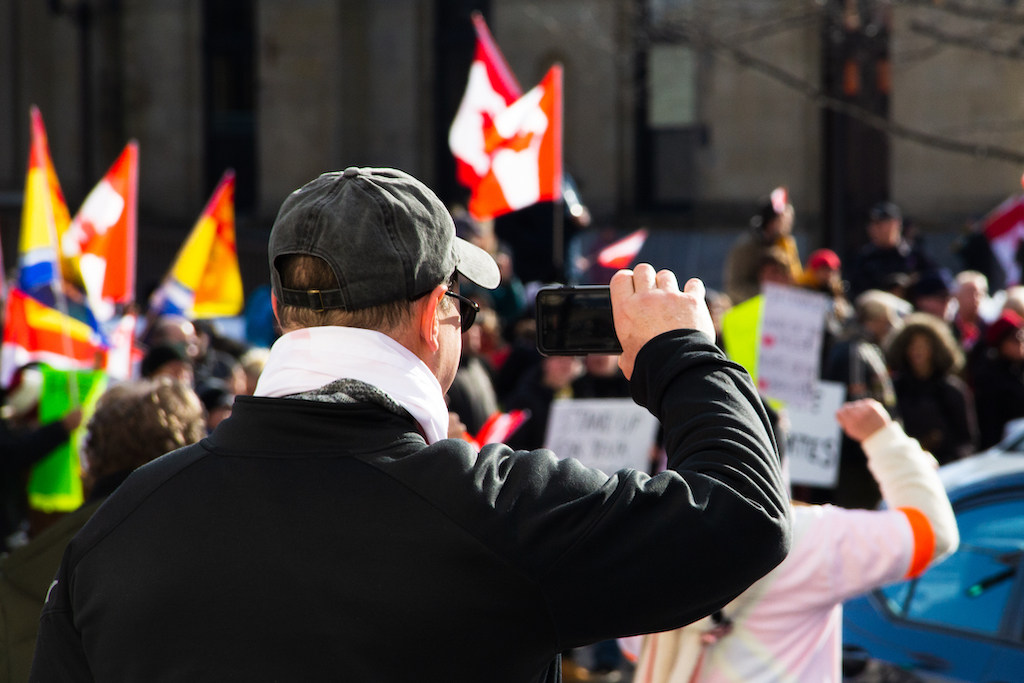
A man uses a phone to make images as truckers and supporters assemble to protest COVID-19 restrictions, in Fredericton in February 2022. Photo: Aaron Sousa/The Canadian Press
The revolution might not be televised, but apparently it will be livestreamed, with so many posts from the revolutionaries about what they’re thinking and planning that the hard part is keeping track of it all.
The convoy protests centred on Ottawa have generated oceans of recordings: Twitter broadcasts, YouTube streams and shows, Facebook Lives and Rumbles, both on the scene and not, at all hours. Zello, a voice-chat app, has been an important organizing tool.
It can be messy even for participants. About 37 minutes into one stream recorded today, organizer BJ Dichter lamented the confusion online over who’s in charge—people announcing news conferences he’s not a part of, taking positions that the lead organizers don’t necessarily share.
“We’ve been dealing with, half our time, just getting people on board with messaging,” Dichter told YouTuber David Freiheit on his Viva Frei channel.
For security services and those who monitor extremism, it’s a vast resource—if they can separate the good stuff from the noise.
How to keep eyes and ears on it all: Telegram, the encrypted messaging service, is a popular medium for participants. “Just on the trucker-convoy stuff, I have almost 300 channels on Telegram I’m looking at,” said Marc-André Argentino, who studies the relationship between radicalism and technology at Concordia University in Montreal. “I’m getting thousands of messages [every] hour from the chats and the channels.”
In normal times, he has accounts organized by group and theme: one for monitoring conspiracy theorists, for instance, and others for neo-Nazis, for “accelerationists” who want to bring on race war, for general anti-government advocates, and so on.
He uses natural-language-processing tools to extract meaning from more video and audio than anybody could watch, social media analytics to spot terms that signal changes in attitudes and focus, and a certain Spidey sense developed from long exposure, he said.
Tricks of the trade: Avoiding repetition is key for people monitoring the material, Argentino said. “It’s trying to get the ones that more often than not [are] the originators of this content, over those that just amplify it.”
“I try to focus on chats over just channels because the broadcast channels, more often than not, are the propaganda that they want people to spread. What I find value in is how communities or the ecosystems of individuals are engaging with each other,” he said.
What to look for: Mere intensity of emotion isn’t enough, Argentino said—you can be a rabid sports fan without ever considering violence. Sharpening of tone and an increase in talk about violent acts, confrontation and civil war are danger signs.
In other news related to blockades and protests:
Prime Minister Justin Trudeau has a news conference scheduled at 4:30 p.m. ET, where he’s expected to announce the use of the Emergencies Act to deal with ongoing blockades and protests. The premiers of Quebec, Alberta and Saskatchewan have all said they oppose the move; Trudeau will have the support of the NDP in the House of Commons.
Border posts at Emerson, Man., and Coutts, Alta., remain closed. The RCMP in Alberta announced they had raided what they called “a small organized group” within the border blockade in Coutts, arresting 11 and confiscating guns, body armour and ammunition.
An Ontario judge granted the City of Ottawa an injunction that gives police more power to enforce city bylaws related to traffic, noise and litter.
The Ambassador Bridge between Windsor, Ont., and Detroit reopened late Sunday. General Motors and Ford said their plants affected by the blockades there are back to normal, while Toyota is still recovering.
Business leaders said the border blockades have damaged Canada’s international reputation.



Loading...
Thanks for sharing!
You have shared 5 articles this month and reached the maximum amount of shares available.
CloseThis account has reached its share limit.
If you would like to purchase a sharing license please contact The Logic support at [email protected].
CloseGift the full article!
You have gifted 0 article(s) this month and have 5 remaining.
Recipients will be able to read the full text of the article after submitting their email address. They will not have access to other articles or subscriber benefits.
Photo: Aaron Sousa/The Canadian Press
Most Popular This Week



In-depth, agenda-setting reporting
Great journalism delivered straight to your inbox.
News
National Bank CEO warns AI alone won’t give banks a lasting edge
Briefing
Canada and Ontario commit over $5B to support tariff-hit steel sector
Hackers will see cars as major targets in next 3 years, 83% of car-tech workers say
EA shutting down Edmonton studio BioWare
Best business newsletter in Canada
Get up to speed in minutes with insights and analysis on the most important stories of the day, every weekday.
Exclusive events
See the bigger picture with reporters and industry experts in subscriber-exclusive events.
Membership in The Logic Council
Membership provides access to our popular Slack channel, participation in subscriber surveys and invitations to exclusive events with our journalists and special guests.





