A day after Finance Minister Chrystia Freeland announced new emergency moves to try to cut off the money supply for people blocking border crossings and occupying streets in downtown Ottawa, the finance industry is still waiting to be told what rules it’s supposed to be following.
Skip to content

News
Feds announced crackdown on blockade financing without the measures
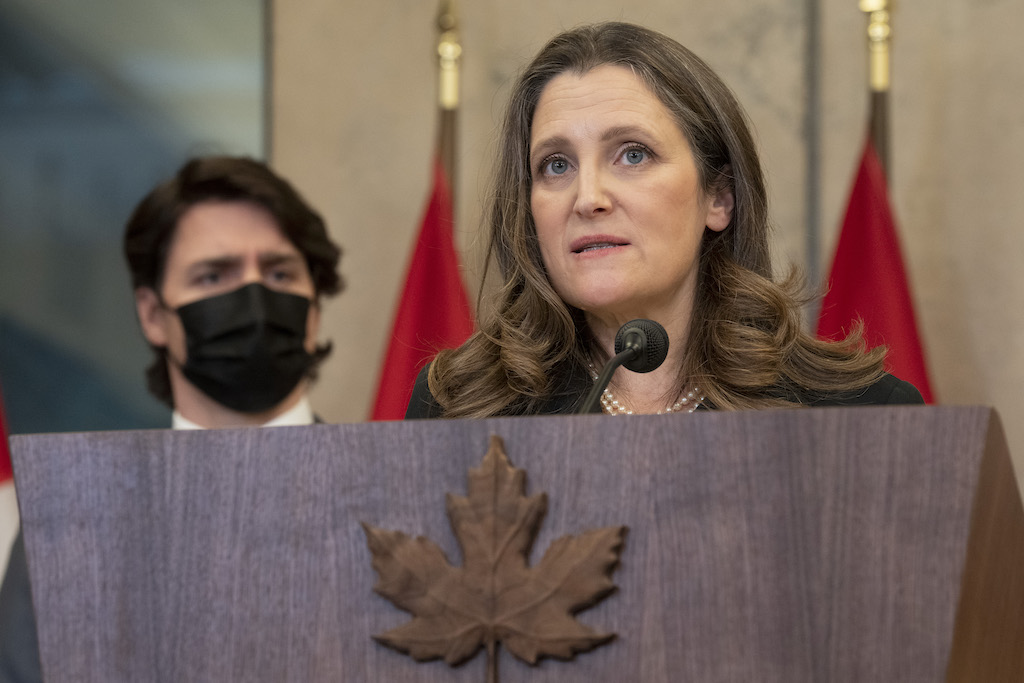
Deputy Prime Minister and Finance Minister Chrystia Freeland speaks during a news conference in February 2022 in Ottawa. Photo: Adrian Wyld/The Canadian Press
A day after Finance Minister Chrystia Freeland announced new emergency moves to try to cut off the money supply for people blocking border crossings and occupying streets in downtown Ottawa, the finance industry is still waiting to be told what rules it’s supposed to be following.
What happened: On Monday, Freeland stood with Prime Minister Justin Trudeau as he announced the government would make unprecedented use of the Emergencies Act to increase police powers, forbid protests in certain places and order tow-truck drivers to drag blockade vehicles out of the way, then took over to talk about the money-related measures.
“As of today, all crowdfunding platforms and the payment service providers they use must register with [the money-laundering watchdog] FINTRAC and must report large and suspicious transactions to FINTRAC,” Freeland said.
The changes would “cover all forms of transactions including digital assets such as cryptocurrencies,” she said, though she didn’t say how.
Another order, “with immediate effect,” allowed financial institutions to review customers’ files for suspected links to blockades. “As of today, a bank or other financial-service provider will be able to immediately freeze or suspend an account without a court order.”
That included personal accounts, she said—so a financial institution could cut people off from their money on a suspicion, and be immunized from liability if its suspicion was unfounded.
Why it matters: When TD Bank froze two accounts linked to blockades on the weekend, it had to convince a judge first. Even the Ontario government had to go to court to freeze money raised for convoy protests through crowdfunding platforms.
The declaration of the emergency—in the form of an “order-in-council,” the technical term for a proclamation by the federal cabinet—wasn’t released until today. It’s needed to allow the specific new orders, but doesn’t include them.
When The Logic asked Freeland’s office Monday where the new rules could be found, spokesperson Adrienne Vaupshas referred the question to Justice Minister David Lametti’s office.
They would be released in the coming days, and would not take effect until they were published, Lametti’s spokesperson Chantalle Aubertin said.
Was what Freeland said Monday about the immediate efficacy of those orders true? Aubertin sent that question back to Vaupshas, who did not reply.
Uncertainty remains: Spokespeople for RBC, TD and Scotiabank all referred to the Canadian Bankers Association questions about what they were doing. (CIBC and BMO didn’t reply.)
“We haven’t seen the regs, haven’t seen the order-in-council,” said Mathieu Labrèche, a spokesperson for the industry group.
Michelle Rempel Garner, a Calgary Conservative MP with a private member’s bill that seeks to encourage crypto-assets in Canada, issued a statement calling the uncertainty about the new rules “unacceptable.”



Loading...
Thanks for sharing!
You have shared 5 articles this month and reached the maximum amount of shares available.
CloseThis account has reached its share limit.
If you would like to purchase a sharing license please contact The Logic support at [email protected].
CloseGift the full article!
You have gifted 0 article(s) this month and have 5 remaining.
Recipients will be able to read the full text of the article after submitting their email address. They will not have access to other articles or subscriber benefits.
Photo: Adrian Wyld/The Canadian Press
Most Popular This Week




In-depth, agenda-setting reporting
Great journalism delivered straight to your inbox.
News
Panel decries Canada’s chaotic way of funding world-class science
Briefing
AI is pushing insurers to become asset managers, Canadian CEOs say
Trump administration faces lawsuit over 50% tariffs on Canadian goods
Canada-U.S. trade war to reduce real GDP by 1.4% over 2024 levels after five years: PBO
Best business newsletter in Canada
Get up to speed in minutes with insights and analysis on the most important stories of the day, every weekday.
Exclusive events
See the bigger picture with reporters and industry experts in subscriber-exclusive events.
Membership in The Logic Council
Membership provides access to our popular Slack channel, participation in subscriber surveys and invitations to exclusive events with our journalists and special guests.





