Skip to content

Canada's Business and Tech Newsroom

  • Professional Subscription
  • Partnerships & Advertising
  • Licensing & Syndication
Log In Subscribe
Welcome,
  • My Account
  • Log Out
  • Business
  • Tech
  • National
  • The Big Read
  • Briefings
  • Commentary
Search
Log In Subscribe
Welcome,
  • My Account
  • Log Out
News

Federal disaster-preparedness funding on hold awaiting official announcements

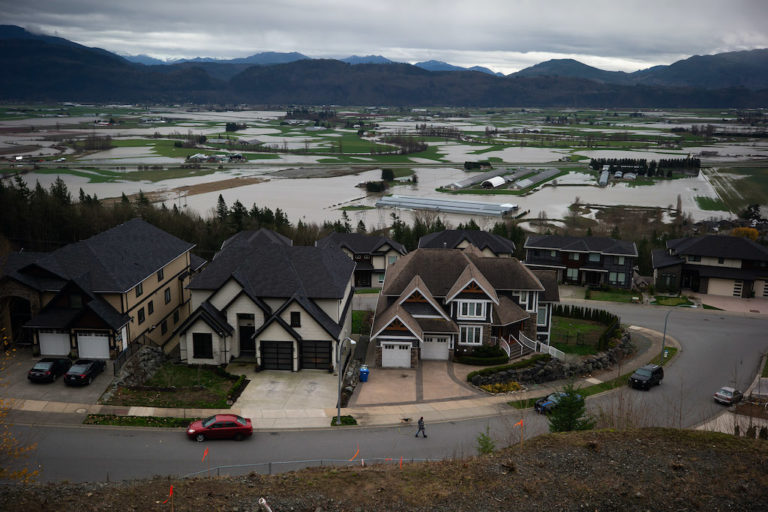
OTTAWA — A year after flooding from successive “atmospheric rivers” cut highways and rail lines in the Fraser Valley, the federal government is holding up money for disaster-mitigation measures until it can organize announcements to tout the funding.

The delayed funds could amount to hundreds of millions of dollars.

News

Federal disaster-preparedness funding on hold awaiting official announcements

Hundreds of millions wait in ‘oversubscribed’ fund meant to protect communities, transportation

By David Reevely
A truck swallowed up by rising water in Abbotsford, B.C., in November 2021. Photo: The Canadian Press/Jonathan Hayward
Dec 9, 2022
A A
A Small A Medium A Large
Share

Gift

Share

OTTAWA — A year after flooding from successive “atmospheric rivers” cut highways and rail lines in the Fraser Valley, the federal government is holding up money for disaster-mitigation measures until it can organize announcements to tout the funding.

The delayed funds could amount to hundreds of millions of dollars.

Raising defences against climate-related disasters is partly about protecting lives (the atmospheric-river disaster is believed to have killed five people and the earlier fires that swept through the Interior killed two), partly about protecting property from multibillion-dollar damage, and partly about reinforcing supply chains that keep Canadians working.

Talking Points

  • The federal Liberals have promised nearly $1.4 billion to prepare for climate-related disasters through measures like flood and fire protection
  • Although Infrastructure Minister Dominic LeBlanc signed off on a list of projects last summer, they haven’t been announced—which a senior official warned him would hold up progress 

According to Infrastructure Canada, the federal Disaster Mitigation and Adaptation Fund (DMAF) is for “structural and natural infrastructure projects to increase the resilience of communities that are impacted by natural disasters triggered by climate change.”

Launched in 2018 and meant to last 10 years, the fund quickly burned through much of its $2-billion endowment on projects like strengthening coastal flooding protection south of Vancouver, improving highway culverts in New Brunswick and making Toronto’s “tree canopy and waterfront shoreline structures” more resilient against floods and storms.

A federal briefing document from early 2022 said the fund got $6 billion worth of applications for that first $2 billion in funding. In practice, the document said, the program has overwhelmingly been for anti-flood measures, with smaller outlays against storm and erosion damage (like that Hurricane Fiona caused in Atlantic Canada) and wildfires.

The Liberal government gave the fund a $1.375-billion boost in 2021 and invited applications from provincial and local governments, as well as public bodies like universities.

Related Articles

Broken Links: Preparing Canada’s supply chains for climate-change damage

By David Reevely

The adaptation gap: While money pours into emissions reduction, it’s proving harder to find the billions needed to get ready for a changing climate

By David Reevely

In an emergency House of Commons discussion of the B.C. flooding a year ago, Prime Minister Justin Trudeau suggested there will be more top-ups.

“We will continue to increase funding as we help communities and Canadians get through these difficult times,” he said. The Infrastructure Department was then beginning to pore over the new applications it received by the deadline of Oct. 15, 2021.

By last summer, according to documents The Logic obtained through an access-to-information request, the department was ready to put several large-scale projects—ones whose proponents were seeking at least $20 million in federal funding—on Infrastructure Minister Dominic LeBlanc’s desk.

“A decision is requested at your earliest convenience,” the department’s briefing note said, putting the last words in bold type. If LeBlanc approved them, it said, the department would inform the would-be recipients, secretly.

“As outlined in the [approval-in-principle] letters, the approval of the project must remain confidential until a joint project announcement has been completed,” the document said. “It is important to note that until projects have been announced, project proponents will be limited in moving forward with project implementation, such as proceeding with request for proposals and signing contracts.”

An assistant deputy minister, Gerard Peets, signed the note July 14; LeBlanc approved it and the list of projects a month later, on Aug. 15.

Much of the document was redacted before being released, including separate lists of projects that met the disaster fund’s criteria but “did not pass merit,” and ones that were deemed ineligible.

The unredacted portion includes mention of previous approval for a $214-million effort to clean up Iqaluit’s water supply. The government plucked that from the queue last spring, amid a crisis over fuel contamination not connected to climate change or natural disasters, though the Nunavut capital also has a longer-term water-shortage problem.

It also has a copy of a letter to Mayor Drew Dilkens of Windsor, Ont., promising just over $32.7 million in federal money for upgrades to that city’s sewage-treatment plant.

The three-page letter was dated Aug. 15 and has LeBlanc’s signature on it. On Aug. 31, Dilkens and Windsor MP Irek Kusmierczyk announced the federal funding.

If all the letters are three pages long, the redactions in the document released to The Logic suggest LeBlanc was presented with about nine additional large-scale projects to approve.

LeBlanc’s ministerial spokesperson Jean-Sébastien Comeau passed an inquiry about why more projects haven’t been announced to Infrastructure Canada’s communications department. 

“Departmental officials are working with proponents on future announcements,” spokesperson Zoltan Csepregi wrote in an email. He pointed to three recent announcements from the disaster-mitigation fund’s stream for smaller projects:

  • $5.92 million for a stormwater pond in Selkirk, Man.
  • $12 million for flood protection in Saint John, N.B.
  • $21.7 million for separate flood-protection projects on First Nations on Vancouver Island

Counting one other funding announcement—a wildfire resilience program in the Northwest Territories given just under $20 million in April—the small-projects stream has promised less than $60 million out of its $670-million top-up.

The Windsor and Iqaluit projects account for about $246.7 million of the $705-million funding stream for large-scale projects pledged in the 2021 boost.

The department’s information page on the fund says a “second assessment period” for applications has been postponed but does not say why. Comeau and Csepregi did not address The Logic’s questions about that.

Csepregi also said that “under the DMAF program, once federal funding is approved for a project and all approval conditions are met, work can begin right away”—contrary to what Gerard Peets, the assistant deputy minister, warned LeBlanc. Csepregi didn’t respond to a follow-up email about the discrepancy.

That federal briefing document prepared last winter said municipal governments accounted for 73 per cent of the approved projects as of September 2021.

Gift the full article

“There is an urgent need to rapidly scale up investment in disaster mitigation and climate resilient infrastructure for communities of all sizes,” the Federation of Canadian Municipalities (FCM) said in a September statement on climate adaptation. The disaster fund was one “proven delivery mechanism” for doing it quickly, the group said.

On Dec. 5, as the federation’s big-city mayors had a meeting with LeBlanc, the FCM declined to say whether the lack of spending through the fund has any effect on its members’ plans.

#British Columbia #climate change #Dominic LeBlanc #fires #flooding #supply chains

Loading...

Thanks for sharing!

You have shared 5 articles this month and reached the maximum amount of shares available.

Close
This account has reached its share limit.

If you would like to purchase a sharing license please contact The Logic support at [email protected].

Close
Want to share this article?

Upgrade to all-access now

Close
Gift the full article!

You have gifted 0 article(s) this month and have 5 remaining.

Copy link and gift
Copy Link
Email to a friend
Send Email
Gift on Social Media

Recipients will be able to read the full text of the article after submitting their email address. They will not have access to other articles or subscriber benefits.

Photo: The Canadian Press/Jonathan Hayward

Most Popular This Week

A yellow ambulance is pictured outside of a hospital in Montreal. A red sign in the foreground reads, “Urgence / Emergency.”
Commentary: Quebec Ink

Quebec just found out what not having digital sovereignty really means

By Martin Patriquin
An image of Mark Carney standing in front of a red podium with the words "AI for All / L'IA pour tous." He is wearing a suit and tie. In the background, people wearing scrubs and white coats are visible.
Special Report

Canada’s new AI strategy sets lofty goals for adoption and growth

By Murad Hemmadi and Laura Osman
Exclusive

Canada’s new AI strategy includes $500M fund to back key firms

By Murad Hemmadi and Catherine McIntyre
The Big Read

Canada’s AI boom is about to collide with a major labour shortage

By Catherine McIntyre

In-depth, agenda-setting reporting

Great journalism delivered straight to your inbox.

News

Bay Street backs Canada’s AI strategy, but warns the devil is in the details

By Anita Balakrishnan and Chaimae Chouiekh

Briefing

Mortgage fintech Nesto raises $302M at a $1.47B valuation

By Claire Brownell   |   Jun 10, 2026 | 12:39 PM ET

Kneat.com to leave TSX in $650M Thoma Bravo takeover

By Chaimae Chouiekh   |   Jun 9, 2026

Teachers’-backed Databricks in fundraising talks that could lift its valuation above US$165B

By Catherine McIntyre   |   Jun 9, 2026

Best business newsletter in Canada

Get up to speed in minutes with insights and analysis on the most important stories of the day, every weekday.

Exclusive events

See the bigger picture with reporters and industry experts in subscriber-exclusive events.

Membership in The Logic Council

Membership provides access to our popular Slack channel, participation in subscriber surveys and invitations to exclusive events with our journalists and special guests.

Recent Popular Stories

Commentary: Quebec Ink

Quebec just found out what not having digital sovereignty really means

By Martin Patriquin   |   Jun 8, 2026
A yellow ambulance is pictured outside of a hospital in Montreal. A red sign in the foreground reads, “Urgence / Emergency.”
News

Canada’s surprise plan to buy Saab command jets leaves competitors seeking answers

By David Reevely   |   May 29, 2026
A closeup of a scale model of a jet covered in pixellated camouflage, with sensor equipment attached to the top of its fuselage. There are civilians and uniformed military personnel milling in the background.
Exclusive

Canada’s new AI strategy includes $500M fund to back key firms

By Murad Hemmadi and Catherine McIntyre   |   Jun 3, 2026
The Big Read

We found every data centre in Canada

By Murad Hemmadi, David Reevely, Aleksandra Sagan, Chaimae Chouiekh, Martin Patriquin and Catherine McIntyre   |   Apr 8, 2026
Four vertical slices of aerial view photos. From left, a building in downtown Toronto housing several data centres, a picture of the Albertan wilderness where the proposed Wonder Valley data centre would go, a lit-up QScale data centre in Quebec, and a data centre at a Hydro-Quebec dam.
The Big Read

ApplyBoard faces a reckoning as Canada’s immigration boom turns into a bust

By Claire Brownell and David Reevely   |   May 27, 2026
News

A Canadian leader in nuclear fusion comes home—with big plans to make power

By David Reevely   |   Jun 4, 2026
A selfie taken by Spencer Pitcher inside a nuclear fusion facility. He is wearing a blue hardhat with the ITER logo on it, and is standing in front of a cavernous chamber full of fusion reactor equipment.

Canada's most influential executives and policymakers are reading The Logic

  • CPP Investments
  • Sun Life Financial
  • C100
  • Amazon
  • Telus
  • Mastercard
  • bdc
  • Shopify
  • Rogers
  • RBC
  • General Motors
  • MaRS
  • Government of Canada
  • Uber
  • Loblaw Companies Limited
logic-logo

Canada's Business and Tech Newsroom

100% human-crafted journalism

Newsroom

  • News Tips
  • AI Policy
  • Editorial Disclosures
  • Story Pitches

Company

  • About Us
  • Terms of Service
  • Privacy Statement
  • Corporate Information

Contact

  • Contact Us
  • Advertise
  • FAQs
  • Work at The Logic

© 2026 The Logic Inc. All Rights Reserved.

Trusted by leaders

Error

Account creation failed.

Please email us at [email protected].

Create Account

[wppb-register form_name=”cozmo-registration-form-for-modal”]

I do have an account
Login
or

[wppb-login]

I don’t have an account