CALGARY — Mary Moreau, chief justice of the Court of King’s Bench of Alberta, will fill the vacant Western seat on the Supreme Court of Canada, Prime Minister Justin Trudeau announced on Thursday. The appointment adds a second Alberta judge to the country’s highest court, which has ruled on several recent constitutional disputes between the province and the federal government.
Skip to content

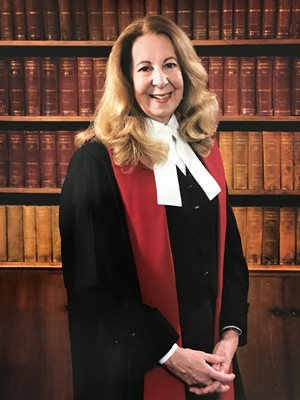 Mary Moreau was the first woman to serve as Alberta’s chief justice. (Screenshot via Canadian Bar Association)
Exclusive
Trudeau nominates Alberta Chief Justice Mary Moreau to Supreme Court
PM’s sixth appointment to backlogged top court comes after four-month search
The building housing the Supreme Court of Canada, under construction in Ottawa, in October 2023. Photo: The Canadian Press/Sean Kilpatrick
CALGARY — Mary Moreau, chief justice of the Court of King’s Bench of Alberta, will fill the vacant Western seat on the Supreme Court of Canada, Prime Minister Justin Trudeau announced on Thursday. The appointment adds a second Alberta judge to the country’s highest court, which has ruled on several recent constitutional disputes between the province and the federal government.
The Logic, citing a government source, was first to report that Moreau would be nominated Thursday morning.
Talking Points
- Prime Minister Justin Trudeau has nominated Mary Moreau, chief justice of the Court of King’s bench of Alberta, to the Supreme Court of Canada
- The nomination fills the vacancy for a representative of Western Canada opened by the June resignation of justice Russell Brown
Moreau, the sixth judge Trudeau has appointed to the nine-person Supreme Court, will fill the vacancy created when Justice Russell Brown resigned from the court in June amid allegations that he got into an altercation with a U.S. Marine veteran at an Arizona hotel earlier this year.
Moreau, who has practised constitutional law, business law, criminal law and family law, is an Albertan francophone and the first woman to serve as the province’s chief justice.
Her nomination holds to the long-time custom that reserves two of the SCC’s nine seats for justices from Western Canada. Sheilah Martin, the other Western Canadian Supreme Court judge, spent the majority of her career in Alberta though she was born in Montreal. The other sitting judges represent Ontario and Quebec, with the exception of Justice Malcolm Rowe, who is from Newfoundland and Labrador and previously served on that province’s supreme court.
Moreau’s nomination comes four months after the resignation of Brown—who then-prime minister Stephen Harper appointed to the top court in 2015 and who was considered one of its more conservative judges—and more than two weeks after the court began its fall session. The Globe and Mail reported in September that few judges from Western Canada’s appeal courts had applied to fill the vacancy left by Brown’s exit. Trudeau has imposed a requirement that Supreme Court appointees be bilingual in English and French at the time of their appointment, potentially narrowing the field of Western candidates. Moreau would be the first francophone Supreme Court justice from the West.
Moreau served for 29 years on the Court of King’s Bench of Alberta, and was appointed chief justice in 2017.
Before becoming a judge, Moreau litigated cases involving minority language rights under the Canadian charter, including a constitutional case over Albertans’ rights to jury trials in French. She co-founded the Association des juristes d’expression française de l’Alberta, a charitable organization that promotes the use of French in the Alberta court system.
In 2014 she was appointed to Ottawa’s Advisory Committee on Judicial Ethics, which offers legal opinions on ethical matters to federal judges.
Related Articles

It is not yet clear when Moreau will officially join the SCC, which is working through a backlog and hearing cases this fall on issues including Indigenous treaty rights and school teachers’ rights to privacy. She will join a court that has ruled recently on several constitutional disputes between Alberta and the federal government, from carbon taxes to Ottawa’s environmental impact assessment regime.
In a majority decision earlier this month, the court ruled that Ottawa’s Impact Assessment Act (IAA)—the law that details the review process for major projects like oil pipelines and hydro dams—had “plainly overstepped its constitutional competence.”
Alberta Premier Danielle Smith, who said the IAA was an environmentally motivated encroachment on Alberta’s right to develop natural resources, viewed the decision as a major win for the province. Former premier Jason Kenney referred to the law—which made its way through Parliament as Bill-C-69—as the “no more pipelines act,” and threatened a constitutional challenge.
In 2021, the Supreme Court ruled against Kenney’s constitutional challenge to Ottawa’s carbon tax, while Smith’s recent proposal to establish an Alberta pension fund outside of the Canada Pension Plan could also spark a constitutional ruling.
In a candidate questionnaire that she completed as part of her application process, Moreau listed several cases she heard as a judge or argued as a lawyer that have informed the development of her thinking. They involve everything from language rights to parental abuse to a ruling on Omar Khadr, the Canadian citizen who was detained in Guantanamo Bay and pleaded guilty to killing a U.S. Army medic.
Khadr was granted an interim release in 2015 by a judge of what was then called the Court of Queen’s Bench. Moreau said she later reduced Khadr’s interim release period to a single day, given that he had spent four years under “restrictive” interim release conditions while his conditional supervision period was only meant to be 3.5 years long. It was a “creative approach that was nonetheless grounded in the principles governing sentencing,” she said in the questionnaire.
In 2017, Trudeau awarded Khadr $10 million to compensate him for the time spent in the U.S. military prison.
In the questionnaire, Moreau also said that growing up francophone in Alberta significantly influenced her approach to minority language laws.
“French Canadian music, literature, traditional songs and festivals enriched my life growing up in the West,” she said. “I learned the importance of my language in giving a voice to my culture, and of my culture in instilling in me a sense of belonging and identity. I also experienced the challenges that come with belonging to a minority group in a majority anglophone province.”
In an undated questionnaire published on the website of the Canadian Bar Association, Moreau said her approach to law is grounded in her previous philosophy studies, which led her to question broader assumptions around social norms and their purpose in society.
“I think the most useful tools I developed as a lawyer then as a judge came from my experience as an undergrad philosophy student,” she said. “The discipline of philosophy helped channel that curiosity into a critical thinking framework of sorts—that a problem is like a prism to be turned and viewed from all its facets.”
The House of Commons justice committee will hold a special hearing on Nov. 2 to hear the reasons for Moreau’s nomination, the government source said. Moreau will also face questions from a panel of parliamentarians as part of the nomination process.



Loading...
Thanks for sharing!
You have shared 5 articles this month and reached the maximum amount of shares available.
CloseThis account has reached its share limit.
If you would like to purchase a sharing license please contact The Logic support at [email protected].
CloseGift the full article!
You have gifted 0 article(s) this month and have 5 remaining.
Recipients will be able to read the full text of the article after submitting their email address. They will not have access to other articles or subscriber benefits.
Photo: The Canadian Press/Sean Kilpatrick
Mary Moreau was the first woman to serve as Alberta’s chief justice. (Screenshot via Canadian Bar Association)
Most Popular This Week




In-depth, agenda-setting reporting
Great journalism delivered straight to your inbox.
Commentary
Carmichael: Being boxed in will help Canada focus on what matters
Briefing
Rio Tinto gets nearly $165M in additional federal funds for Quebec aluminum
U.S. to lift tariffs on some Canadian products crucial to Maine: Collins
Carney warns of tech dependence after Starlink disruptions in Ukraine
Best business newsletter in Canada
Get up to speed in minutes with insights and analysis on the most important stories of the day, every weekday.
Exclusive events
See the bigger picture with reporters and industry experts in subscriber-exclusive events.
Membership in The Logic Council
Membership provides access to our popular Slack channel, participation in subscriber surveys and invitations to exclusive events with our journalists and special guests.






