This is part seven of The Logic’s in-depth series exploring how Canada is faring in the global competition for tech talent, as economies reopen and companies and governments jockey for advantage in a remote-work world. Read the rest of the series here.
OTTAWA — As the province faces a severe shortage of technology workers, Quebec employers have been the biggest users of a federal fast-track program to bring in engineers, developers and other technical staff from abroad. The provincial government itself is among them, with Revenu Québec having sought to fill dozens of positions via the program, The Logic’s exclusive analysis shows.
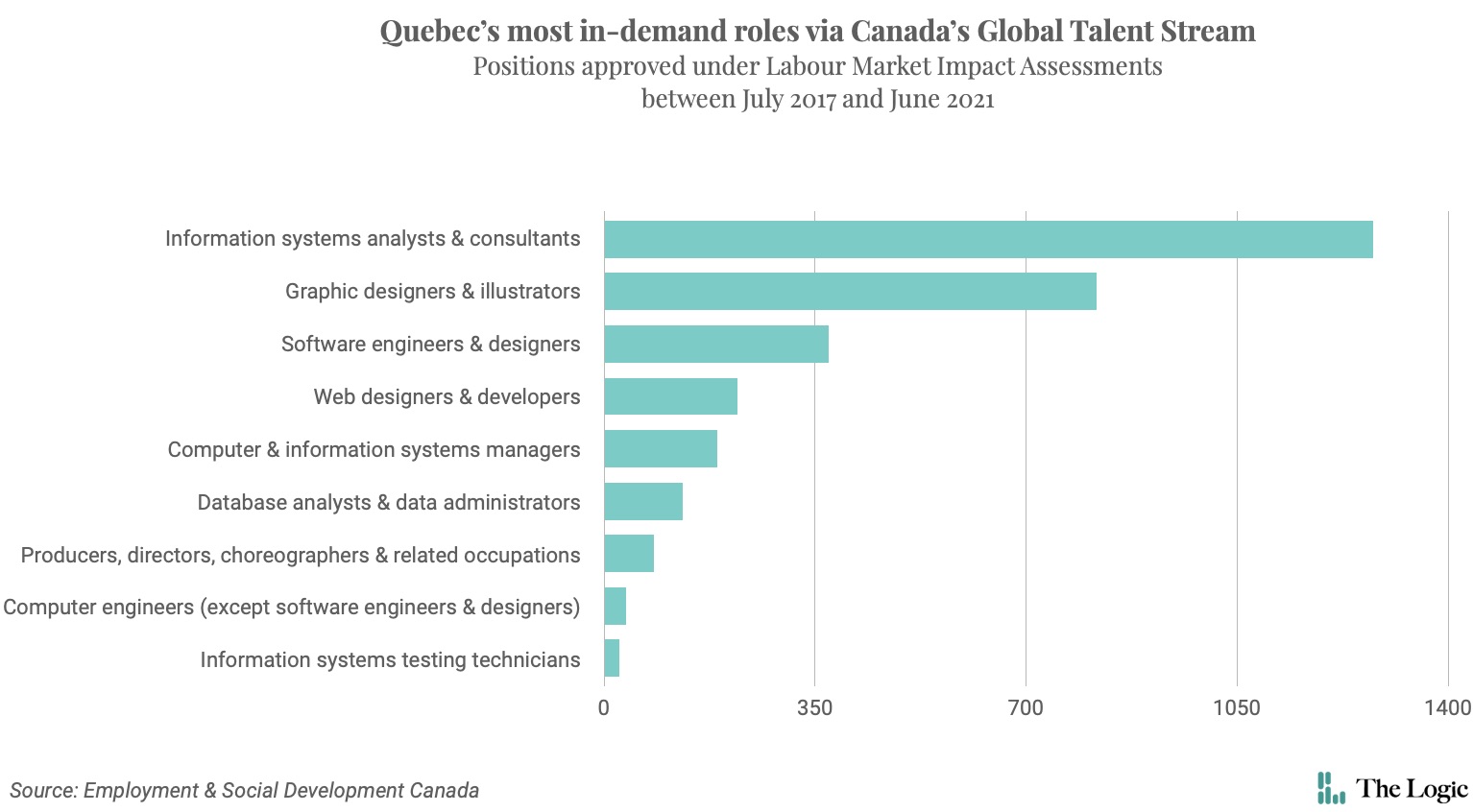
The federal government introduced the Global Talent Stream (GTS) in June 2017 to help fast-growing firms fill in-demand roles like software engineers, web developers and database analysts. By the end of June 2021, employers had received approval to fill a total of 12,837 positions through the program, with over a third or 4,824 of those postings in Quebec, according to The Logic’s analysis of data released by Employment and Social Development Canada (ESDC).
Talking Point
Quebec employers are finding it difficult to fill tech positions, with the provincial government estimating 10,000 new roles will open annually for the next five years. Companies are turning to the federal fast-track program to bring in skilled foreign workers. So is Revenu Québec, the provincial tax agency, which has been approved to fill dozens of positions via the Global Talent Stream, The Logic’s exclusive analysis shows.
Business groups say the province has long lacked enough technical workers, and the accelerated pace of digitization in the wake of COVID-19 has only increased the gap. Quebec’s tech sector will have 10,000 new openings for each of the next five years, up from 6,500 annually pre-pandemic, according to the Coalition Avenir Québec (CAQ) government’s March budget.
Startups, scale-ups and foreign subsidiaries have used the GTS to fill some of the gaps with temporary foreign workers. Quebec employers have been approved to fill the most positions under the program in 10 of 16 quarters so far, according to the ESDC data. By far its most frequent user is Montreal-headquartered CGI, an IT consulting firm. Paris-based video-game giant Ubisoft, which has a major Montreal presence, is fourth.
The provincial tax department is another major GTS client. The Agence du revenu du Québec, its official name, has received approval to fill 83 positions through the program between July 2019 and June 2021. More than two-thirds were for information systems analysts and consultants, along with database analysts and software and other computer engineers.
Labour shortages are “a significant issue in certain sectors” in the province, said Revenu Québec spokesperson Martin Croteau in an email, in French. The agency “must deal with this reality like many other employers.” Croteau said Revenu Québec prefers to hire locally. But he noted that its governing legislation was amended in 2011 to allow it to hire temporary foreign workers, that it has publicly disclosed doing so, and that it follows immigration rules.
The agency has run several recruitment missions abroad “to respond to the scarcity and challenges of manpower in the IT sector,” and began using the temporary foreign-worker program in 2019 to avoid processing delays. Revenu Québec currently employs 61 staff brought in through the GTS, Croteau said; it has more than 11,000 full time-equivalent employees in total, with over 1,560 in IT.
Revenu Québec turned to the GTS as other employers expressed concern about the CAQ’s immigration policies. After taking office in October 2018, Legault’s government lowered Quebc’s annual intake of permanent residents, citing integration and French-language proficiency. It also enacted a values test and a laïcité law, the latter of which the UN human rights commissioner condemned. Following lobbying by tech firms, the provincial government has since raised permanent-resident arrival levels and reversed some program changes.
“Immigration is the last [of] the possibilities” to address labour shortages for the Legault administration, behind regulatory changes, requalification, automation and retaining retiring workers, said Karl Blackburn, president of the Conseil du patronat du Québec (CPQ), the province’s largest employers’ group. While the CAQ cites concerns about integration, this is “a political point of view for the government, and it’s not economically logical,” he said.
While the IT worker shortage is “quite intense” right now, the problem goes back a decade, said Pierre-Philippe Lortie, director of government and public affairs at the Council of Canadian Innovators (CCI), a scale-up lobby association with 27 members in Quebec. Along with the growth of local tech ecosystems, he cited the rapid aging of the existing labour force and relocation of immigrants to other parts of the country as contributing factors.
Domestic startups and scale-ups also face growing competition from larger foreign companies, which, post-pandemic, are increasingly willing to hire staff in Canada to work remotely. “The poaching effect is being felt across the board,” said Lortie, noting that multinational firms “inflate salaries quite dramatically.” Local tech leaders have criticized successive provincial governments for providing funding and tax credits to some of those companies, particularly Ubisoft.
The CAQ government has signalled it’s trying to address the labour shortage. In April, it launched a pilot program to give permanent residence to 550 workers annually in AI, visual effects or IT. In May, it announced $39.6 million in retraining grants and $18.8 million in work-study placement subsidies. And in his opening speech of the new session of the National Assembly last month, Premier François Legault cited IT—along with construction and engineering—as a priority sector in which the province would work to help businesses find workers.
While some universities have sought to bring in administrators and professors using the GTS, Revenu Québec is the only provincial department to use it. “Other orders of government are permitted to apply” to the program, said ESDC spokesperson Saskia Rodenburg. In exchange for using the GTS, Croteau said Revenu Québec has committed to hire and train citizens and permanent residents, set up co-op and internship programs, and develop policies to recruit from underrepresented groups.
The GTS is “not in itself a miracle solution” to Quebec’s labour shortage, “but it’s a good program,” said Nicolas Simard-Lafontaine, executive director of Galileo Partners, a Montreal-based immigration-law firm. “It’s very efficient [and] quite flexible.”
French-language proficiency is not a requirement for temporary foreign workers arriving via the GTS. But those who don’t speak the language face more challenges when trying to stay long term, according to Simard-Lafontaine. Even through programs designed to fill businesses’ talent needs, “we’re looking at two, three, even four years” to get permanent residence, he said, noting that in other provinces it typically takes 12 or 18 months. Still, firms are willing to put up with the added complexity of Quebec’s immigration system in order to grow in the province.
Many scale-up employees who’ve arrived via the GTS are looking to stay in Canada. Croteau said Revenu Québec supports its temporary foreign workers’ permanent-residence applications.
Immigration is a “quickie solution to extend the number of available workers,” said Blackburn. But the CPQ is also proposing that the province promote IT training programs for young people, encourage mid-career residents to reskill and switch into the sector, and incentivize older professionals to remain in the labour force longer.
The CCI, meanwhile, is calling for Quebec post-secondary institutions to offer co-ops for science, technology, engineering and math students to help close the talent gap long term. It also wants the provincial government to create a fast-track immigration stream for workers that can fill IT sector needs, and to compensate domestic scale-ups affected by subsidies to foreign firms.