OTTAWA and TORONTO — The federal government’s translation bureau is rushing to devise an AI-based tool for public servants after being spooked by the use of free services on potentially sensitive materials.
Skip to content


Exclusive
Ottawa rushes to build its own AI translator as government use of free tools soars
Demand for official translation services is falling despite a rise in content creation. As public servants turn to free online tools, the government is racing to build its own AI translator.
A stop sign in both English and French in Kingston, Ontario. The federal government employs 1,300 people to translate a range of documents. Photo: The Canadian Press Images/Lars Hagberg
OTTAWA and TORONTO — The federal government’s translation bureau is rushing to devise an AI-based tool for public servants after being spooked by the use of free services on potentially sensitive materials.
“Industry is moving at lightning speed and the bureau needs to accelerate the cadence to transform its services,” says a presentation deck produced by the bureau last December, which The Logic obtained through an access-to-information request.
Talking Points
- The federal government plans to roll out a single, AI-based tool for all public servants. Some departments have already built their own tools, while staff are also using insecure free online products on potentially sensitive documents.
- Demand within the government for the translation bureau’s services is falling, but workers face pressure to handle larger workloads with the use of AI, according to their union
Starting in June, the federal department that houses the government translation service, Public Services and Procurement Canada (PSPC), is planning a trial run of an in-house tool it’s calling PSPC Translate, departmental spokesperson Jeremy Link told The Logic by email.
If PSPC Translate works for staff in the department of about 19,000 people, the tool will be used more widely. It’s the first “lighthouse project” under the federal government’s artificial intelligence strategy, meant to help the public service learn how to build and implement new AI tools and create something that can be scaled across government.
Related Articles

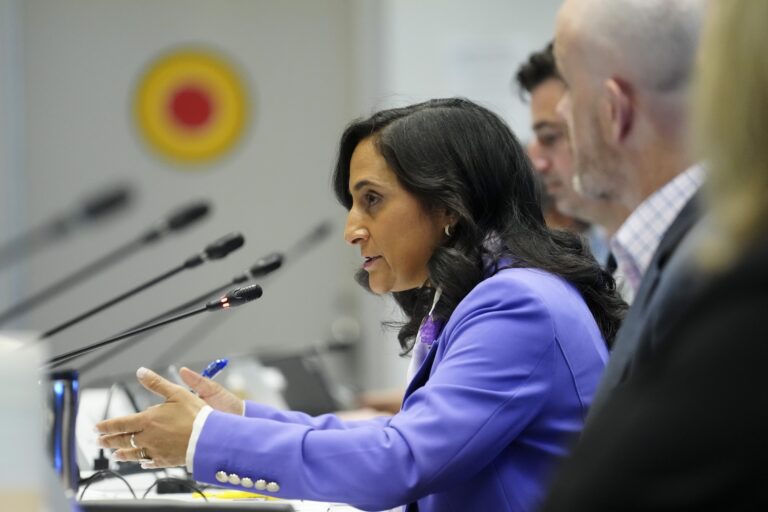
Although this effort long pre-dates Prime Minister Mark Carney’s run for office, he’s pinning a lot on PSPC Translate and projects like it, promising to use artificial intelligence to make the government more productive so the Liberals can spend less on operating expenses.
Translation is one area where public servants are already using AI to transform their own work—if not always for the better.
The 1,300 workers in the bureau translate between English and French, but also into Indigenous languages, foreign languages and sign languages when the government, or contractors doing government work, need it.
The unit reported a 17 per cent decline in demand for its services from federal departments and agencies in the 2023–24 fiscal year, the deck says, even though “all indicators are showing that content creation is on the rise.”
The reason, the bureau concluded, was that people were going elsewhere. Many public servants are using “free internet tools,” scattering government data all over the place, including onto servers outside Canada. Some departments are creating their own tools, wasting money through duplication and complicating the work of public servants who use different tools in different departments.
While demand for the bureau’s services is dropping, its human translators face growing workloads because it’s outsourcing less to freelancers, according to Antoine Hersberger, vice-president for the Canadian Association of Professional Employees unit that represents the workers. The union claims the agency’s five-year business plan would cut a quarter of staff via attrition.
“We’re pushed to do higher and higher volumes, especially using AI tools to force us to work faster and [at] lower quality,” Hersberger said. AI tools are quicker for some translation tasks, but humans still have to check outputs. And, Hersberger explained, public servants using the bureau’s self-service tool can also ask for a human review of their AI translation, adding to the translators’ workloads.
Many free services like Google Translate are powered by large language models, the same technology behind ChatGPT. The bureau’s translators currently use commercially available software from DeepL and TradooIT, which employs an older but more accurate form of AI called neural machine translation.
But both kinds of tools, and even careless use of a dictionary, can generate errors. The deck includes images of bad translations, such as a sign at what appears to be a security screening site telling people what to do with keys, coins, pocket knives and smartphones. People reading English are told to put these items “in a bin.” French-speakers are told to Placez ces objets dans une poubelle—“put these objects in the garbage.”
In another example, a road sign in English tells cyclists to ride single file. The French mistranslation says to ride un seul fichier, using a word, fichier, that means a bundle of documents, not a line of people; à la file is what the writer wanted.
(A web search for “single file” turns up the Parisian-French idiom en file indienne as the favoured translation, which any Canadian public servant would avoid. Seul fichier is the next suggestion.)
The translation bureau has been dealing with such quirks its whole existence and has an “extensive repository” of bilingual texts that it has used to train AI models to create “accurate translations,” PSPC’s Link wrote.
In the absence of a centrally run translation tool, some departments have created their own. Justice Canada has been using its own AI-based translator, called JUSTranslate, since October 2023, according to the documents The Logic obtained. It uses Microsoft’s Azure cloud-computing platform and can translate text from multiple languages into English or French.
One of the Justice Department’s needs is secrecy: pasting documents subject to solicitor-client privilege into public cloud-based translation services isn’t allowed. JUSTranslate (like PSPC Translate) is approved for what the government calls “Protected B” material. That designation means that if it were released, the material “could cause serious injury to an individual, organization or government.”
Another issue is formatting. Not for official legal publications—those still go through human translators—but for materials like presentation decks and even written submissions to courts and tribunals. Those ought to look more or less the same in both English and French, but substituting text slide by slide is a pain and a time-sink.
In its first year the Justice Department has used JUSTranslate on about 20,000 documents, including in tests and experiments, the documents say, working out to more than 57 million words. Some of that work would otherwise have been done by the translation bureau, the department acknowledged.
For ordinary Canadians who use free AI translation tools, the money the federal government spends on the bureau may seem like a waste, Hersberger acknowledged. But clients who switch to AI tools “usually run back to human translators after a few months” after finding “massive mistakes or omissions in their documents,” he claimed.
As an officially bilingual country, Canada “needs to ensure the same level of quality for both languages,” Hersberger said, and “the technological tools are just not enough right now to do that.” Instead of shrinking the bureau, he called for the government to provide funding so that translators can experiment with new technologies like AI while maintaining the quality of their work.
Longer-term plans for PSPC Translate include specialized translation tools for technical fields, adding Indigenous languages, voice-to-text transcribers, and eventually AI-assisted live interpretation, according to the documents obtained by The Logic.



Loading...
Thanks for sharing!
You have shared 5 articles this month and reached the maximum amount of shares available.
CloseThis account has reached its share limit.
If you would like to purchase a sharing license please contact The Logic support at [email protected].
CloseGift the full article!
You have gifted 0 article(s) this month and have 5 remaining.
Recipients will be able to read the full text of the article after submitting their email address. They will not have access to other articles or subscriber benefits.
Photo: The Canadian Press Images/Lars Hagberg
Most Popular This Week




In-depth, agenda-setting reporting
Great journalism delivered straight to your inbox.
News
A tech firm born from post-Brexit trade chaos sets its sights on Canada
Briefing
Dozens of Canadian researchers join chorus of scientists calling for a global AI oversight
TC Energy strikes deal with Indigenous groups for ownership stake in Coastal GasLink pipeline
Canada’s Tailscale taps Google Moonshot alum to lead sovereign AI push
Best business newsletter in Canada
Get up to speed in minutes with insights and analysis on the most important stories of the day, every weekday.
Exclusive events
See the bigger picture with reporters and industry experts in subscriber-exclusive events.
Membership in The Logic Council
Membership provides access to our popular Slack channel, participation in subscriber surveys and invitations to exclusive events with our journalists and special guests.





