Listen Now
0:00
German firm Giesecke+Devrient (G+D) is opening an AI lab at Montreal’s Mila institute to help develop new cybersecurity and financial technologies. The company has pledged to spend $80 million in Canada over the next five years, with an initial staff of about 15 at the new facility feeding its global AI efforts.
“This is a good collaboration for us, really helping in scaling AI within G+D,” chief digital officer Gabriel von Mitschke-Collande told The Logic. The firm was looking for a place to put a team that could swiftly develop products and services for internal and customer use; Montreal and Mila provided the necessary AI talent base and the expertise in commercializing research in the field, according to von Mitschke-Collande.
Munich-headquartered G+D secures payment networks, automates cash-handling systems, and sells connectivity technology for mobile devices. It also designs and manufactures banknotes, the firm’s main business soon after it was founded in 1852. Today, it also produces credit cards for Canadian financial institutions at a factory in Markham, Ont. Privately held G+D claimed €3.2 billion in revenue in its 2025 fiscal year.
Related Articles
The firm hopes to use AI to boost employee productivity, speed up development, power new products, and add premium features to existing services, said von Mitschke-Collande. Staff at G+D’s new AI lab in Montreal will work with IT teams in India and business units in Germany to come up with, build and scale new technologies. The firm’s Canadian spending commitment will cover employee salaries, research partnerships with Mila and other organizations, compute costs and other development expenses, he said.
The new Montreal hub’s first project will be to develop AI tools to detect anomalies related to eSIMs, which are used to connect devices to mobile networks. The AI system will be focused on “finding malicious behaviour,” said von Mitschke-Collande. Security and identity services like the ones G+D sells are increasingly important as more connected devices come online, and as more commerce is conducted with the help of AI agents, he added. “We want to bring trust into the digital world.”
Mila staff researchers could work with G+D employees on cyber and other applications, said the AI institute’s CEO Valérie Pisano. Mila is particularly interested in collaborating on “new emerging questions around what is responsible AI [and] governance of AI,” she said.
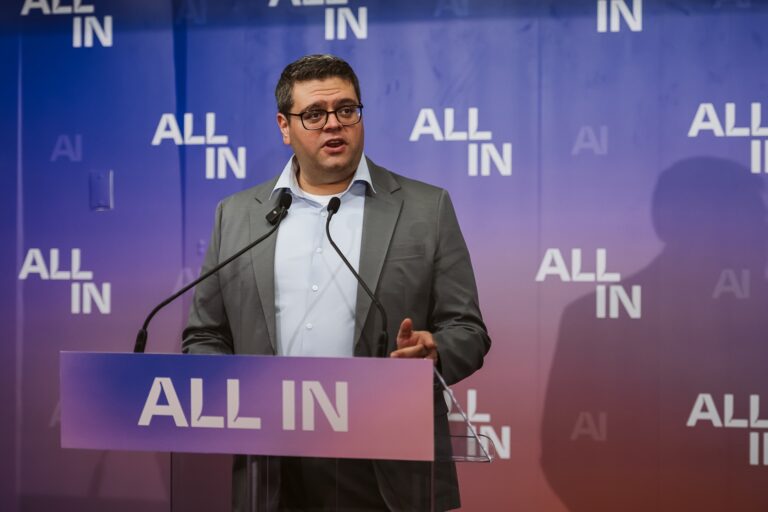
AI Minister Evan Solomon said the new centre “highlights the strength and global competitiveness of Canada’s AI ecosystem.” In December, he announced a new digital alliance with Germany, under which the two countries will develop and share AI infrastructure and collaborate on research and commercialization of the technology. Ottawa’s recently released AI strategy aims to expand that bilateral agreement to other middle powers.
Bilateral AI co-operation between Ottawa and Berlin is positive, said von Mitschke-Collande. “It’s just another element in the ecosystem play we were searching for.” Still, policy alignment alone didn’t spur G+D’s move into Montreal—the firm has had Canadian operations for decades, he said.
The AI institutes’ early partners were often established domestic firms and tech multinationals with the digital sophistication and challenges to take advantage of leading research in the field. Pisano said Mila is now fielding interest from companies in more sectors and sizes.
Both Mila’s planned $100-million venture scientist fund and the new national AI strategy are designed to address Canadian tech’s long-standing commercialization challenge. Canadian researchers played significant roles in inventing modern machine learning, and helped launch some of the field’s leading firms like OpenAI and Anthropic in San Francisco. But the massive revenues the technology is now generating have mostly flown to the U.S.
Some Canadian technology executives and policy analysts say that’s partly because publicly funded professors and AI institutes work with foreign firms, which then take the resulting intellectual property and profits.
The benefits of partnerships like the one Mila is forming with G+D flow both ways, according to Pisano. “There’s a long-time culture of working across boundaries and exchanging ideas,” she added, particularly in AI.
G+D could help the Canadian AI ecosystem by training new talent, and helping to apply research to real-world industrial problems, according to Pisano. “Canada is not big enough of a market for this to be something we would want to realistically strive to do fully at a Canadian basis,” she said, adding that international collaboration “pushes us to expand and become bigger, greater versions of ourselves.”