VANCOUVER — Amazon has been accused of ramping up a campaign of intimidation against workers who recently formed a union at its warehouse in Delta, B.C., according to documents obtained by The Logic.
Skip to content


Exclusive
Amazon accused of freezing pay and intimidating staff as part of union crackdown
Amazon has launched a “calculated effort” to stop a union from forming at one of its warehouses in British Columbia, according to documents seen by The Logic
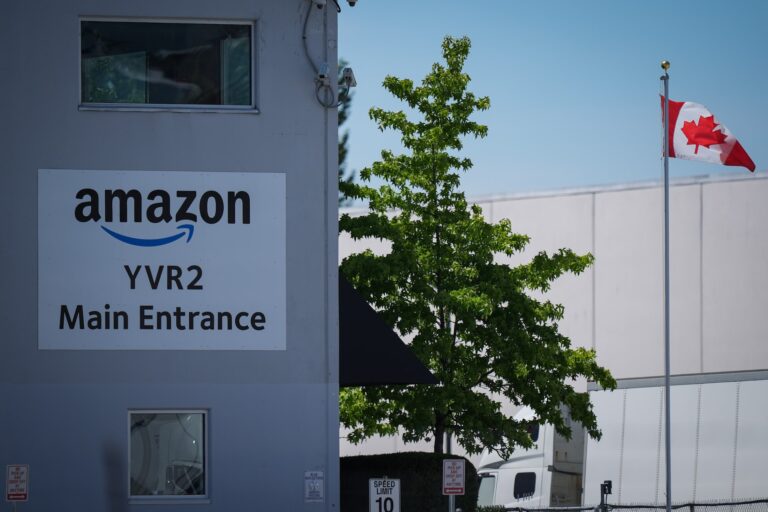
Amazon's fulfillment centre in Delta, B.C. The company has increased its discipline of staff known to support a unionization drive, according to unfair labour practice complaints. Photo: The Canadian Press/Darryl Dyck
VANCOUVER — Amazon has been accused of ramping up a campaign of intimidation against workers who recently formed a union at its warehouse in Delta, B.C., according to documents obtained by The Logic.
The retail giant has “engaged in a pattern of non-compliance,” according to two unfair labour practice complaints against the firm. The complaints, filed to the British Columbia Labour Relations Board (BCLRB) on Sept. 16 and 26, claim that Amazon has subverted the board’s orders, displayed anti-union messaging on internal systems and denied workers an annual wage increase.
Talking Points
- The union representing Amazon warehouse workers in Delta, B.C., has filed two unfair labour practice complaints against the retail giant, alleging it is “engaged in a pattern of non-compliance” with an order that it allow staff to unionize
- Amazon, which denies the allegations, has asked the British Columbia Labour Relations Board to dismiss the complaints without holding hearings, according to documents reviewed by The Logic
Amazon spokesperson Steve Kelly said the union’s claims were false and accused it of presenting “a false narrative.”
The alleged intimidation came after a BCLRB ruling in July that allowed workers at the firm’s Delta warehouse to unionize without a vote. Amazon appealed that ruling, a case which it lost in August, and has since asked the Supreme Court of B.C. to carry out a judicial review. Despite this, the union has forged ahead and will soon begin collective bargaining.
Those efforts, though, have been hampered by Amazon’s actions, the union alleges. The union claims that Amazon did not post the BCLRB’s decision informing the workers of the unionization effort, despite being ordered to do so by the BCLRB. Instead, the complaint states, the firm posted a message on an internal platform, which displays on screens in the warehouse, that claimed the BCLRB had “decided to take matters into their own hands, ignoring your right to be heard and make a decision.” Amazon sent a similar message criticizing the board’s decision when it lost its appeal, according to the complaint.
Related Articles
In its own filings to the BCLRB, sent in late September and early October and seen by The Logic, Amazon acknowledged it had displayed those messages, saying it had a right to freedom of speech to provide its position “whether or not the union likes or agrees with it.” The company also said it posted the original decision in two breakrooms at the warehouse.
The BCLRB ruling also ordered that Amazon allow the union to hold a number of meetings at the Delta warehouse and to pay staff for the time. In its complaint, the union alleges Amazon offered all employees a paid break during the scheduled meetings, regardless of attendance; allowed staff who opposed the union to attend multiple meetings, while restricting supporters to only one; and placed management and a lawyer near the entryway in an effort to disincentivize attendance.
In its filing, Amazon said it paid all staff during the meetings to avoid knowing who attended and to prevent understaffed departments. It claims management escorted union representatives to comply with Amazon’s visitor-to-staff ratio policy, while the lawyer remained on hand to help with logistics. It denies preventing any employees from attending more than one meeting. No managers were in the room and the company didn’t take attendance, added Kelly.
Amazon has also increased its discipline of staff, the union’s filing claims, especially those known to support the unionization drive. The firm has allegedly sent out written warnings as part of this, as well as suspended and terminated staff. In its filing, Amazon said those claims “lack even the basic particulars necessary to allow a response.” Kelly added that Amazon doesn’t “take punitive measures against employees.” Unifor’s western regional director Gavin McGarrigle said it will present more evidence to the BCLRB as the process unfolds.
The union claims one warehouse employee, who was a key witness during the BCLRB hearings, had experienced “continued intimidation.” The witness was asked to attend an HR meeting about an undisclosed matter—which was dropped after they said they would inform the union about it. Amazon called this “a routine step in a workplace investigation” for which the person might be a witness.
The union’s complaint also claims Amazon attempted to “manufacture discipline” when the witness was asked to attend a disciplinary meeting 24 hours after attending another meeting wearing a Unifor shirt. In its filing, Amazon denied the investigation was “improperly motivated” and said it was still ongoing.
The complaint also alleges Amazon had made a “calculated effort” to create a “sense of insecurity regarding the union and to foster resentment” towards it. As part of this effort, the complaint claims, it has withheld wage increases at the Delta warehouse, despite giving a pay bump to staff working at nearby facilities.
In September, Amazon told all of its warehouse employees in and around Vancouver, except those working at the facility in Delta, that they would be receiving an hourly pay increase.
Amazon’s Kelly said the company is “subject to a statutory freeze on terms of employment,” including wages, at its Delta warehouse. Amazon’s filings claim B.C.’s Labour Relations Code prevents it from making any pay changes in the 12 months after a union is certified. Unifor sent Amazon a letter informing it “that we weren’t permitted to change pay or other terms and conditions of employment” after certification, claimed Kelly. McGarrigle claimed that “Amazon is deliberately misinterpreting” the code when its purpose is to set a minimum standard rather than a maximum.
Unifor Local 114 lawyer Colin Gusikoski argued the code does allow for annual raises to be issued, so long as they are deemed normal practice. In its complaint, the union argues Amazon has previously issued such pay increases even when union drives were ongoing.
Unifor has asked that the BCLRB order Amazon to pay the Delta employees the same hourly wage as other workers; Amazon wants Unifor’s complaints dismissed without a hearing.
The BCLRB will either hold hearings to gather more information or make a decision based on the submissions, said Gusikoski, a process that he expects will take several months.
Update: This story has been updated with additional comment from Unifor’s Gavin McGarrigle.



Loading...
Thanks for sharing!
You have shared 5 articles this month and reached the maximum amount of shares available.
CloseThis account has reached its share limit.
If you would like to purchase a sharing license please contact The Logic support at [email protected].
CloseGift the full article!
You have gifted 0 article(s) this month and have 5 remaining.
Recipients will be able to read the full text of the article after submitting their email address. They will not have access to other articles or subscriber benefits.
Photo: The Canadian Press/Darryl Dyck
Most Popular This Week




In-depth, agenda-setting reporting
Great journalism delivered straight to your inbox.
News
Cohere plans to acquire cyber startup Aisle and set up a new security division
Briefing
Banks should have kill switches, IDs for AI agents, says global finance watchdog
B.C. First Nations decry rushed consultations as Major Projects Office CEO promises to do better
Feds pledge $100M to back Nova Scotia’s plans for offshore wind farms
Best business newsletter in Canada
Get up to speed in minutes with insights and analysis on the most important stories of the day, every weekday.
Exclusive events
See the bigger picture with reporters and industry experts in subscriber-exclusive events.
Membership in The Logic Council
Membership provides access to our popular Slack channel, participation in subscriber surveys and invitations to exclusive events with our journalists and special guests.