CALGARY — In 1982, Michael Houghton left his home in England to join a Silicon Valley biotech startup called Chiron, where he worked in a “dilapidated” concrete research facility with a leaky roof. It was there that Houghton, now a Nobel Prize-winning scientist, co-discovered the hepatitis C virus.
Skip to content

Exclusive
Alberta biotech group seeking $85M in federal funding to close ‘critical’ supply-chain gaps: Documents
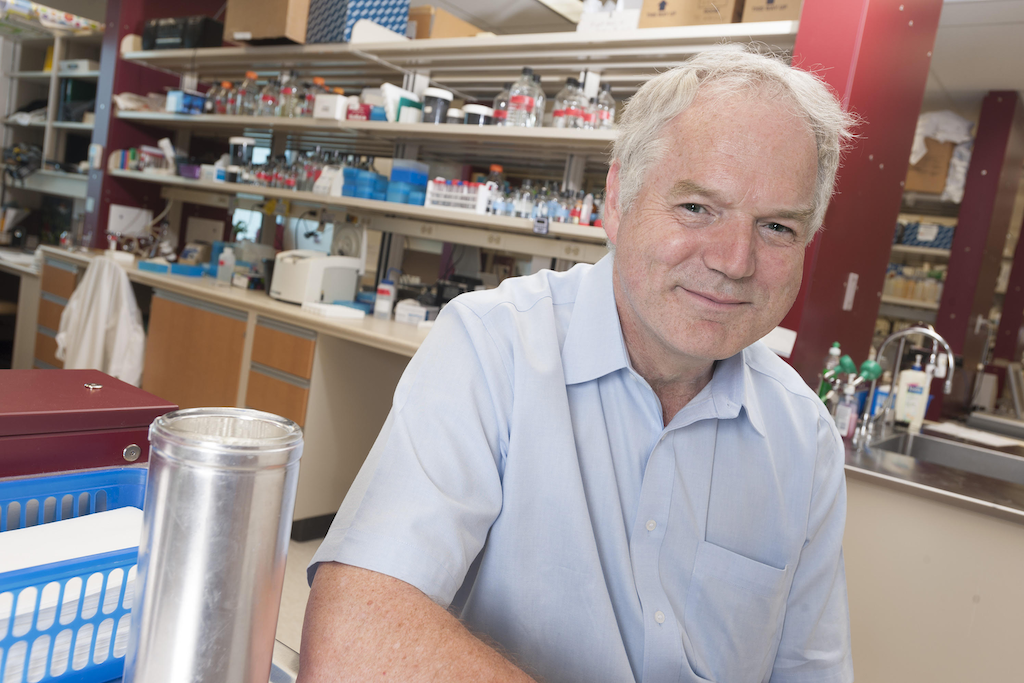
Michael Houghton in his lab at the University of Alberta’s Li Ka Shing Institute of Virology. Photo: University of Alberta | Handout
CALGARY — In 1982, Michael Houghton left his home in England to join a Silicon Valley biotech startup called Chiron, where he worked in a “dilapidated” concrete research facility with a leaky roof. It was there that Houghton, now a Nobel Prize-winning scientist, co-discovered the hepatitis C virus.
Chiron used the breakthrough to develop a blood-screening test and around five individual treatments for hepatitis C, reaching hundreds of thousands of patients. The company’s workforce ballooned from just over 23 people to around 6,000. In 2005, the Swiss pharma giant Novartis acquired Chiron for US$5.1 billion.
Talking Point
The biopharmaceuticals sector is witnessing a surge in interest from both investors and national governments amid the global pandemic. The University of Alberta’s Li Ka Shing Applied Virology Institute and Edmonton-based Applied Pharmaceutical Innovation are seeking federal funding to research and manufacture a suite of vaccines and antivirals to close a “critical” supply-chain gap.
Five years later, Hougton moved to Edmonton to become co-director of the University of Alberta’s Li Ka Shing Applied Virology Institute (LKSAVI), a body that he hopes will form the bedrock of a burgeoning new biotech sector in the province capable of generating its own billion-dollar unicorns.
“I want to do the same thing for Alberta, I want to do the same thing for Canada,” Houghton said in an interview with The Logic. “I want it to realize its intellectual prospects, its intellectual talent, and I want it to discover new health-care products and commercialize them for the benefit of everybody.”
To that end, Houghton, along with co-director Lorne Tyrrell and Edmonton-based Applied Pharmaceutical Innovation, is seeking $84.7 million in federal funds to develop a new biotech cluster in Alberta that would fill “a key gap” in Canada’s domestic drug-manufacturing capacity and establish “critical supply-chain support,” according to a pre-budget submission The Logic obtained from a source.
The partnership between the LKSAVI and API, called the Canadian Critical Drug Initiative (CCDI), aims to rapidly build out Alberta’s research and manufacturing capacity of small molecule drugs, a category that accounts for roughly 90 per cent of pharmaceuticals like insulin and aspirin.
The CCDI’s request for funding, the details of which have not previously been reported, would go toward developing LKSAVI’s portfolio of six vaccines and drugs, as well as the construction of a 40,000-square-foot facility in Edmonton capable of manufacturing 70 million vials per year. It would also be used to upgrade the existing 67,000-square-foot Biotechnology Business Development Centre, a shared “wet-lab” space in the city.
The request comes after Alberta Premier Jason Kenney said the province was willing to provide $81.2 million in funding to develop vaccines and drugs in the province so long as the federal government pitched in a similar sum. The province gave the LKSAVI $55 million last December to upgrade its laboratory and install a high-resolution microscope used to determine the structure of molecules.
The CCDI’s bid comes as Ottawa looks to establish meaningful biomanufacturing capacity in Canada, after the global pandemic exposed cavernous gaps in the country’s medical supply chains. Those efforts include funding for vaccine maker Moderna, French drugmaker Sanofi Pasteur, and a mandate for the National Research Council to develop vaccines and other biologics at a Montreal facility.
In its pre-budget consultation document, the CCDI says those expenditures are well placed, but argues more funding is needed in small molecule pharmaceuticals and chemical-based drugs to ensure a more resilient health-care system.
“While the federal government has made significant investments into development and manufacturing of vaccines, such as company investments and the new NRC biologics manufacturing centre in Montreal, a serious gap remains for therapeutics, particularly small molecule drugs (SMDs), a category of pharmaceutical that makes up the majority of medications, from antivirals to critical care hospital drugs,” the document says.
The Logic reported last week that the LKSAVI was seeking $20 million in federal funding to develop six vaccines and drugs, including a hepatitis C vaccine. Houghton, Tyrrell and the University of Alberta institute did not respond to questions for comment on the story. After publication, The Logic learned that the bid had since been expanded to include Applied Pharmaceutical Innovation, a non-profit consortium, that raised the stakes to $84.7 million to add manufacturing and supply-chain components.
Andrew MacIsaac, CEO of Applied Pharmaceutical Innovation, told The Logic he believes biotech is an ideal sector for Canada to make big bets, particularly in Alberta, amid an ongoing failure to shift the provincial economy away from its dependence on oil and gas.
“If you’re looking for a sector that can really drive economic diversification, life sciences is perfect. If you look at the largest companies in the U.S. it’s basically: energy, tech unicorns and life sciences. And if we’re really serious about diversifying Alberta in the same way, we really need to focus on all three.”
Houghton was part of a team that won a 2020 Nobel Prize in the category of physiology or medicine for the discovery of hepatitis C, and Lorne Tyrrell is an inductee into the Canadian Medical Hall of Fame whose research in the 1980s and ‘90s led to a breakthrough treatment for hepatitis B.
The LKSAVI is developing a number of drugs and vaccines including a Group A Streptococcus vaccine, treatments for non-alcoholic fatty liver disease, and therapeutics for Alzheimer’s disease, which affects some 44 million people worldwide, according to a memo obtained by The Logic.
Houghton said he believes Alberta has many of the key components needed to establish a self-sustaining biotech cluster, including deep research expertise.
He also said Edmonton’s high level of expertise in both artificial intelligence and biotechnology is likely to dramatically accelerate the pace of scientific breakthroughs in coming years, as researchers have already begun using computational lab testing to predict potential drug treatments. Edmonton-based AI company AltaML recently partnered with Amplitude Venture Capital to blend machine learning with life-sciences research.
But the region lacks domestic manufacturing capacity, a reality made plain by the supply-chain constraints the lab faced during COVID-19. Supplies of synthetic peptides, which the LKSAVI uses in its research of the hepatitis C vaccine, got held up in months-long backlogs from the U.S., for example.
“It’s slowed us down a lot,” Houghton said.
He also acknowledged concerns that Canada’s relatively risk-averse innovation sector could be a drag on efforts to rapidly develop and commercialize pharmaceutical products. When he arrived in Canada in 2010, Houghton said he was “a little shocked” to find how little emphasis its biotech researchers put into commercialization, similar to what he witnessed in the U.K.
“But I would say in the last 12 years, slowly but surely, that’s changing.”



Loading...
Thanks for sharing!
You have shared 5 articles this month and reached the maximum amount of shares available.
CloseThis account has reached its share limit.
If you would like to purchase a sharing license please contact The Logic support at [email protected].
CloseGift the full article!
You have gifted 0 article(s) this month and have 5 remaining.
Recipients will be able to read the full text of the article after submitting their email address. They will not have access to other articles or subscriber benefits.
Photo: University of Alberta | Handout
Most Popular This Week


In-depth, agenda-setting reporting
Great journalism delivered straight to your inbox.
News
AI could help invent new materials. First, firms must figure out how to make them
Briefing
Defence Investment Agency to be a Crown corporation so it can get deeper into Canada’s military industry
Mark Carney says he’ll work with Quebec separatist premier-to-be on housing, infrastructure, big projects
Mistral claims its new AI model closes the gap with leading Chinese developers
Best business newsletter in Canada
Get up to speed in minutes with insights and analysis on the most important stories of the day, every weekday.
Exclusive events
See the bigger picture with reporters and industry experts in subscriber-exclusive events.
Membership in The Logic Council
Membership provides access to our popular Slack channel, participation in subscriber surveys and invitations to exclusive events with our journalists and special guests.