Canada will need to spend nearly $201 billion to reach the Liberal government’s revised goal of reducing greenhouse-gas emissions by 40 to 45 per cent below 2005 levels by 2030, according to a new report.
Skip to content

News
Exclusive: Meeting 2030 emissions targets to cost Canada more than $200B, study finds
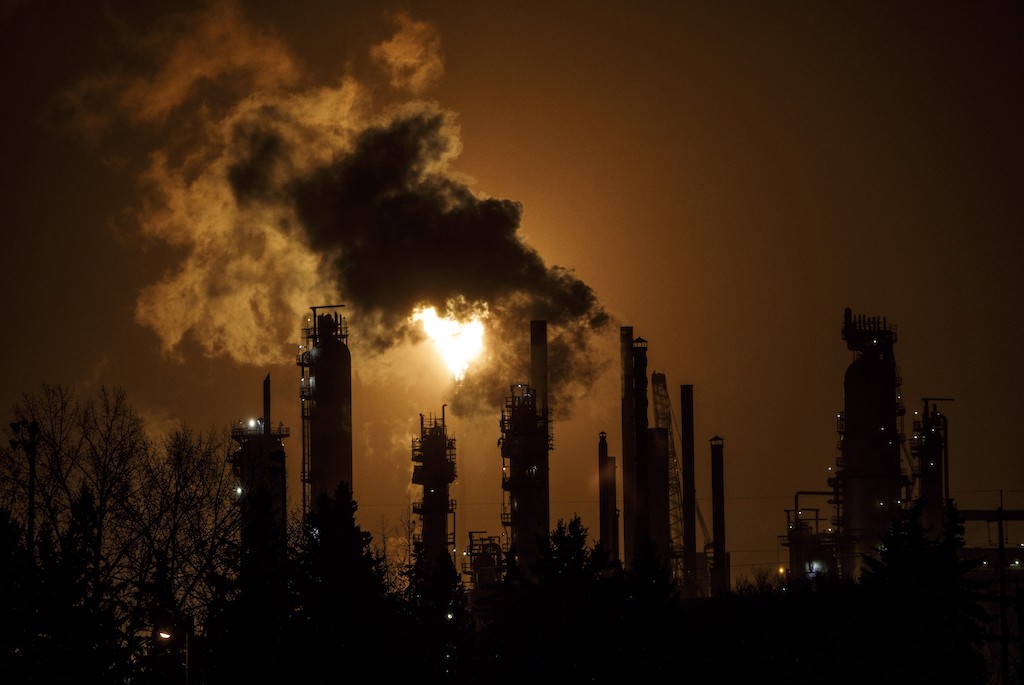
A flare stack lights the sky from the Imperial Oil refinery in Edmonton Alta, on Friday December 28, 2018. Photo: THE CANADIAN PRESS/Jason Franson
Canada will need to spend nearly $201 billion to reach the Liberal government’s revised goal of reducing greenhouse-gas emissions by 40 to 45 per cent below 2005 levels by 2030, according to a new report.
The analysis by the Institute for Sustainable Finance (ISF) at Queen’s University found that hitting the new mark will cost almost $73 billion more than its previous estimate for the government’s earlier plan to cut emissions by 30 per cent.
Talking Point
Canada will have to spend nearly $201 billion to meet its goal to cut carbon emissions by 40 to 45 per cent below 2005 levels by the end of the decade, according to a new report. The analysis by Queen’s University’s Institute for Sustainable Finance found a nearly $73-billion increase in projected costs compared to earlier federal emissions targets. Despite the growing price tag and slow progress towards meeting the goal, the report’s co-author said Canada should be able to manage the budget, which represents just over one per cent of GDP.
The findings are based on average historical abatement costs by sector, and calculations that Canada has to cut 1.2 billion metric tonnes of CO2 and equivalent emissions from the atmosphere by the end of the decade.
Canada is among the dozens of countries that have pledged to eliminate greenhouse-gas emissions by 2050. In April, the federal government set new interim targets for how to get there, first committing to cut carbon by 36 per cent by 2030, then three days later upping that goal to 40 to 45 per cent. It unveiled the more ambitious targets the same day U.S. President Joe Biden pledged to cut U.S. emissions by 50 to 52 per cent from 2005 levels within the decade.
The Liberal government has not disclosed details of how it plans to reach its emissions targets, or the total projected cost associated with achieving them. In December 2020, the government unveiled a $15-billion plan to incentivize reducing emissions through a string of new programs and strategies. But that amount is far less than the ISF’s projections.
Meanwhile, Canada has made little progress on cutting carbon: while government data projected a two per cent reduction for 2020, emissions actually increased 0.28 per cent, according to the ISF report. “This may seem trivial, but this highlights the difficulty in projecting GHG growth rates and how hard actually reducing emissions is, in Canada,” the report reads.
The ISF’s nearly $201-billion projection is the most pessimistic among several estimates outlined in the report. It assumes the price to cut carbon will stay the same from now until 2030. But depending on new technologies and potential changes in costs associated with using them, spending on reducing emissions could be much lower. More optimistic scenarios show it could cost between $91 billion and $155 billion to cut carbon by 42.5 per cent. “This suggests that efforts to invest in new abatement technologies, alongside systemic changes in behaviour, can dramatically reduce the amount of capital required to reduce our emissions,” the report states.
However, Ryan Riordan, the report’s co-author, believes the $201-billion estimate reflects the most likely scenario. “A lot of people put a lot of hope in technology,” he said. “I think technology is going to help us a lot, but I don’t think it’s going to cut down the cost dramatically in the next nine years.”
Despite the larger short-term price tag associated with cutting emissions, Riordan said Canada should be able to manage the budget, which is about 1.3 per cent of GDP. “That should be pretty easy for us to mobilize,” he said. “Compared to most of the world, Canada actually looks pretty good.”
Indeed, developing countries, on average, would have to spend about 4.2 per cent of their GDP to meet the same interim targets as Canada, Riordan and his co-author Simon Martin estimated. However, Canada still has to spend more than double that of other developed nations, relative to GDP, to meet its goal. While other developed countries are on track to cut emissions by 1.11 per cent each year, on average, between 2019 and 2030, Canada is reducing emissions at a rate of just 0.08 per cent. “Clearly Canada has some work to do by 2030,” the report reads.
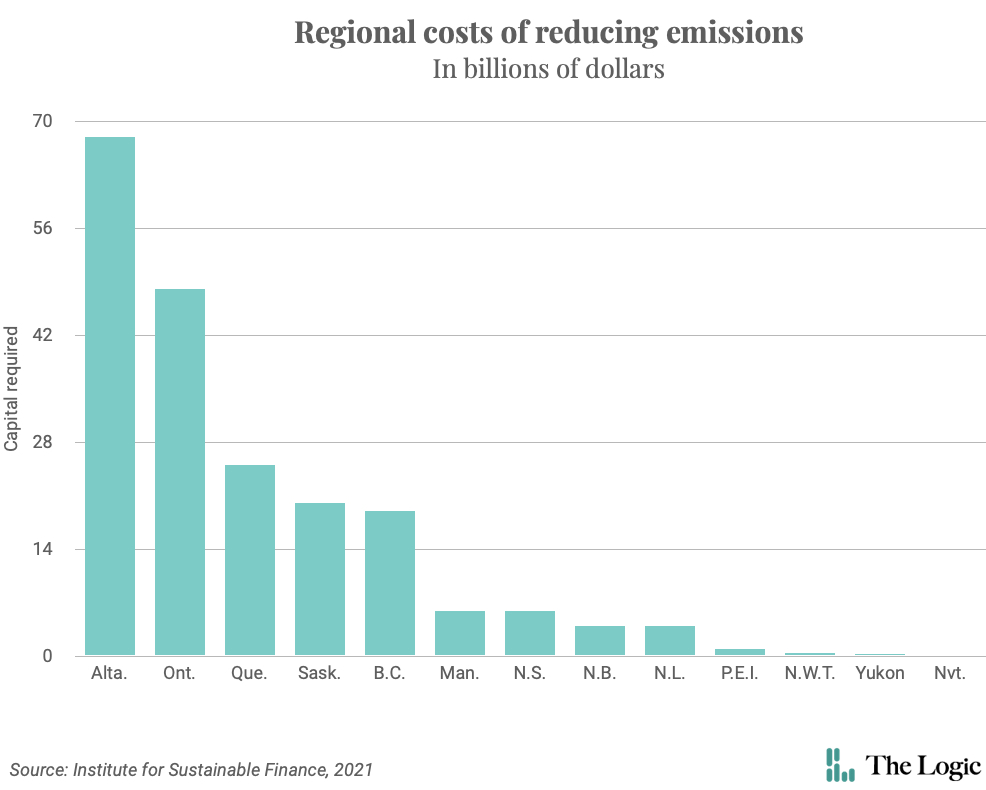
That burden is spread unevenly across the provinces. At the high end, Alberta would have to spend nearly $68 billion to meet reduction targets, about 2.1 per cent of its GDP; Nunavut, meanwhile, would need just $241 million. Saskatchewan would require the most spending as a share of GDP, at 2.55 per cent, while Ontario, Quebec and British Columbia would need the lowest, with abatement costs representing 0.59, 0.61 and 0.70 per cent of GDP, respectively.
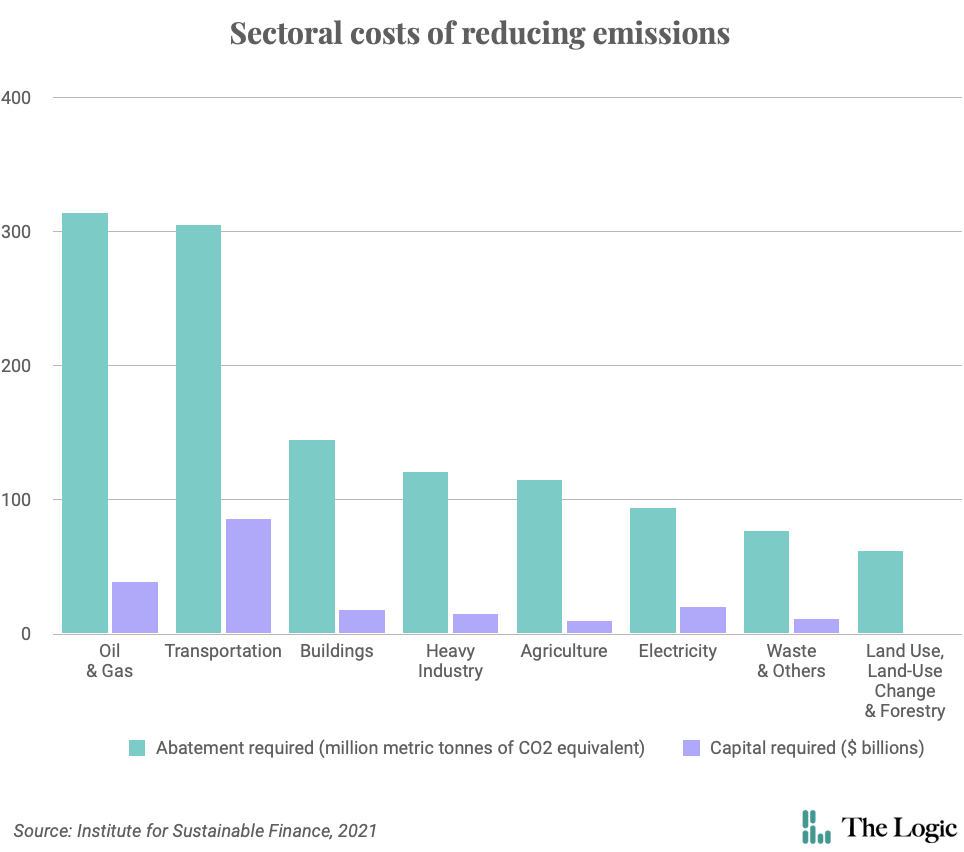
The report also highlights several sectors that need aggressive spending to reduce emissions. Transportation faces the highest cost. The sector is projected to need about $86 billion to cut 305 million tonnes of CO2 over the next nine years. That would account for 24.8 per cent of emission reductions, but 43 per cent of Canada’s required spending to meet its 2030 target. Oil and gas, meanwhile, would have the most carbon to cut (314 million tonnes), which is expected to cost about $39.5 billion.
Canada should focus on three priority areas if it’s to meet its goals, said Riordan. Transportation is one of them. “We need to really push electrification,” he said. “Transportation still makes up a huge portion of our emissions in Canada and they’re very expensive to evade, so investing in this quickly is super important.” Spending on energy-efficient buildings—both in new constructions and retrofitting old structures—is another “straightforward” way to cut emissions, he said, pointing to government incentives like offering credits for home retrofits.
Canada also needs to focus on removing existing carbon from the atmosphere, said Riordan, for example, by leaving forests intact and planting new ones, and developing technologies that can remove carbon from the air. “Even if we stopped all of our emissions today, we still have climate change right now that’s relatively dramatic and we still have five or 10 years of the effects of what we emit today,” he said. “So we’re going to have to start thinking about really smart ways of removing carbon from the atmosphere.”
Beyond its own borders, Canada is expected to join other developed countries in helping poorer nations cut carbon, many of which have had their budgets stretched thin by the COVID-19 crisis. Creating financial supports to help developing countries address global warming is a priority for COP26, the UN climate-change conference in Glasgow. “A lot of these countries just can’t afford [the investments],” said Riordan, “but we can’t, as a planet, afford not to do it.”



Loading...
Thanks for sharing!
You have shared 5 articles this month and reached the maximum amount of shares available.
CloseThis account has reached its share limit.
If you would like to purchase a sharing license please contact The Logic support at [email protected].
CloseGift the full article!
You have gifted 0 article(s) this month and have 5 remaining.
Recipients will be able to read the full text of the article after submitting their email address. They will not have access to other articles or subscriber benefits.
Photo: THE CANADIAN PRESS/Jason Franson
Most Popular This Week


In-depth, agenda-setting reporting
Great journalism delivered straight to your inbox.
Commentary
Carmichael: What Finland can teach Canada about sleeping next to an elephant
Briefing
Financing instability is slowing down Ottawa’s housing agency, CEO says
Cleveland-Cliffs CEO says federal lawsuit would be a bad business decision for Canada
BoC shows off its new forecasting model, Prima
Best business newsletter in Canada
Get up to speed in minutes with insights and analysis on the most important stories of the day, every weekday.
Exclusive events
See the bigger picture with reporters and industry experts in subscriber-exclusive events.
Membership in The Logic Council
Membership provides access to our popular Slack channel, participation in subscriber surveys and invitations to exclusive events with our journalists and special guests.