The firms that make up Canada’s private capital markets are slowly diversifying, according to a new report, with more women, people of colour, LGBTQ2+ and folks with disabilities than ever across all ranks of venture capital and private equity firms.
Skip to content


News
Diversity at Canadian VC firms is improving, but inclusion gap threatens progress, CVCA report finds
Photo: Unsplash
The firms that make up Canada’s private capital markets are slowly diversifying, according to a new report, with more women, people of colour, LGBTQ2+ and folks with disabilities than ever across all ranks of venture capital and private equity firms.
The Canadian Venture Capital & Private Equity Association’s State of Diversity and Inclusion report—sponsored by BDC Capital, CIBC and The51, and to be released Thursday afternoon—gathered data on metrics like gender, race and sexual orientation from 413 employees across 122 firms in the country to get a clear picture of the demographic makeup of an industry that’s traditionally been overwhelmingly white and male.
Talking Point
Canada’s private capital markets are slowly diversifying their workforces, according to the latest diversity and inclusion report from the Canadian Venture Capital & Private Equity Association. Greater representation of women, racial minorities and LGBTQ2+ employees in VC firms’ junior ranks shows potential for a demographic shift at the partner level. But concerns about inclusion could threaten that progress.
The results show an improvement over the CVCA’s last diversity report, released in 2019, but president and CEO Kim Furlong said diversifying the industry is still a work in progress. Here’s what you need to know:
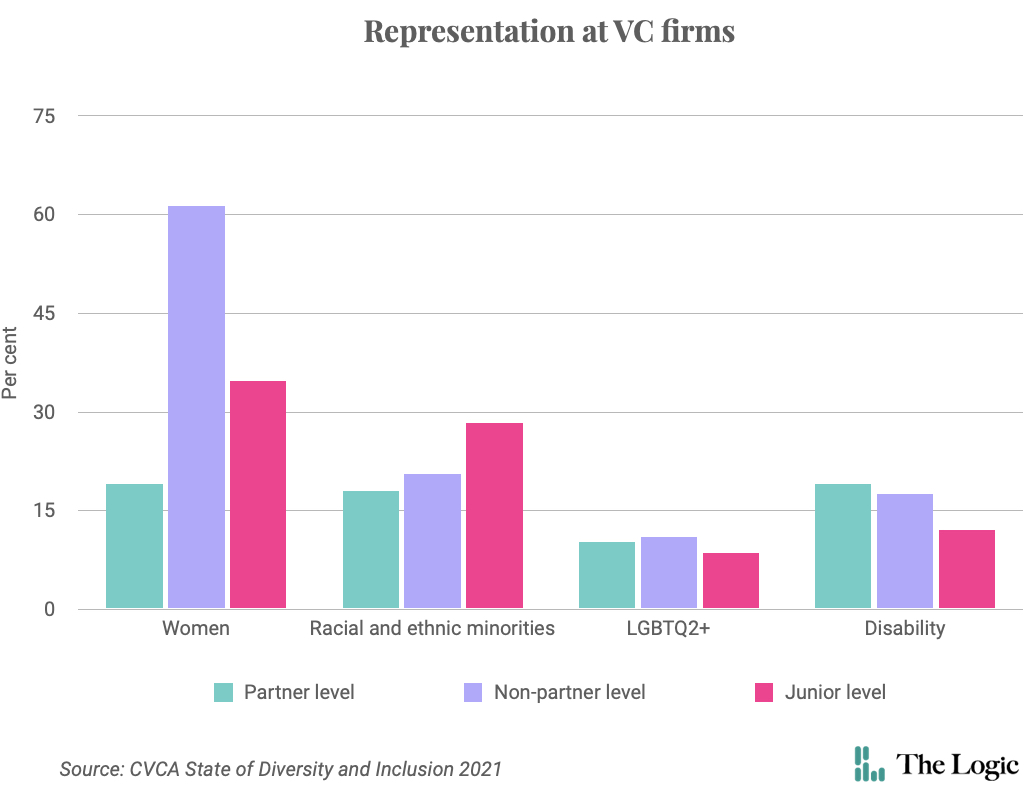
Women overtake men in non-management roles: Women accounted for 61.3 per cent of all non-partner employees at venture capital firms in 2021. (The report does not include data on non-binary employees.) That’s more than in the broader financial industry, which the CVCA used as a benchmark; industry-wide, 52 per cent of non-partner employees are women. In 2019, less than a quarter of VC firms that responded to the CVCA survey had women in over half of all junior-level positions, and about 14 per cent of firms had women in more than half of non-partner management roles.
Diversity overall decreases with seniority: At the partner level, the number of women dropped to just 19 per cent. For racial and ethnic minorities, representation fell from 20.6 per cent among non-partners to 18 per cent among partners, while LGBTQ2+ people accounted for 11 per cent of all non-management employees and 10.3 per cent of partners. People with disabilities—a category that includes physical, cognitive and learning disabilities, as well as mental health conditions—were the only group whose representation consistently increased with seniority, from 12 per cent of junior employees to 17.6 per cent of staff excluding partners and 19 per cent of partners.
Black and Indigenous underrepresentation: Most of the gains in racial and ethnic diversity at the VC partner level—up 5.2 per cent from 2019—came from people with East and South Asian backgrounds, while partners from Black, Indigenous, Middle Eastern and Latin backgrounds “remain few and far between,” the report notes. The CVCA identified the same pattern in the private equity sector. “Notably Black and Indigenous remain significantly underrepresented,” it reads.
Derrick Raphael, co-founder and CEO of Icon Talent Partners, a non-profit that helps organizations build and recruit diverse employees, said firms need to invest in talent at the earliest stages—for example, through internship programs—to build the talent pipeline for diverse venture capital and private equity partners. “It’s very popular right now to do things that are, quote, ‘diverse and inclusive.’” said Raphael. “But firms that are serious about this need to have their own programs starting from the ground up. Take people that are in early university and groom them—provide them an internship, and give them the building blocks to be competitive.”
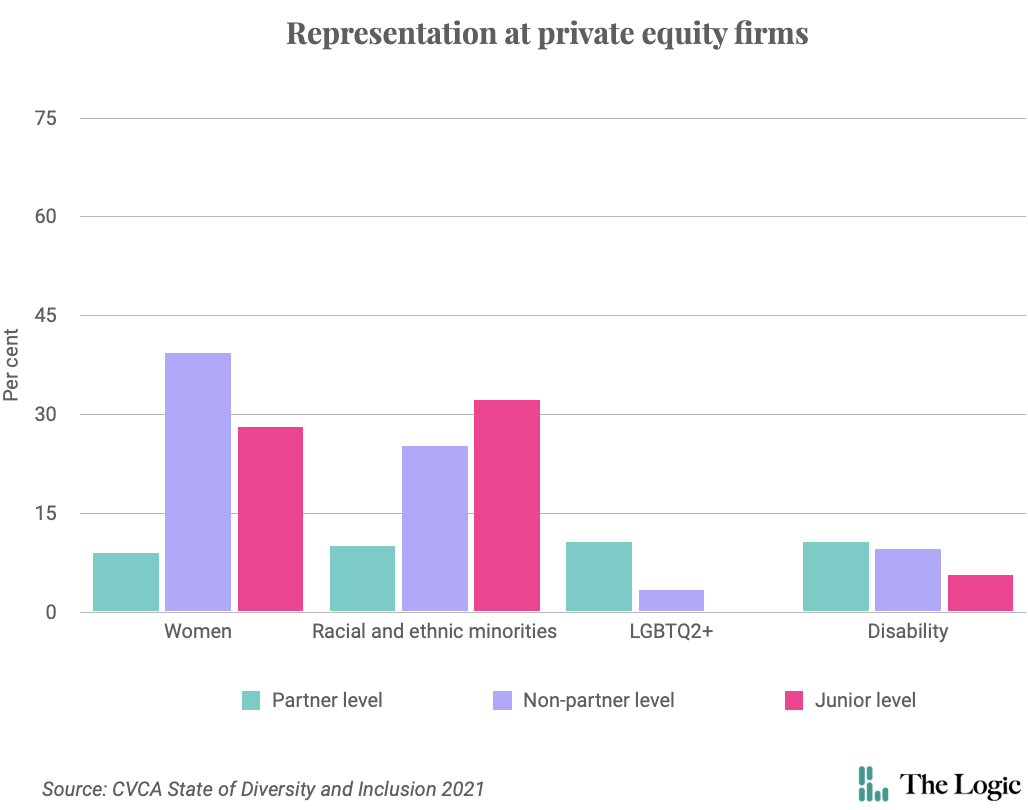
Private equity is still a straight white man’s game: Firms in the sector, which typically makes bigger deals in later-stage firms than venture capital, reported far less diversity overall than their VC peers. Women accounted for just nine per cent of PE partners, while people from racial and ethnic minority groups represented 10 per cent of partners. LGBTQ2+ and people with disabilities each made up 10.7 per cent of private equity firm partners. For non-partner employees, women and racial minorities were significantly better represented than in higher ranks, at 39.4 and 25.3 per cent, respectively. Representation of LGBTQ2+ employees and those with disabilities dropped in less senior roles.
Senior women face harassment, inclusion gap: Beyond measuring demographics, the CVCA surveyed respondents on five metrics to help determine how inclusive their firms were. These included questions about fairness and bias at work, opportunities for career development, workplace flexibility and safety. The findings show women VCs at the partner level are about six times more likely than men to report harassment or feel their opinions aren’t valued or heard, and 3.5 times more likely to feel no one is invested in their career growth. Feelings of inclusion among women partners are “even lower than women’s experience in the more junior levels on investment teams,” the report notes.
“Partners from racially and ethnically diverse backgrounds as well as those with a disability similarly report lower levels of inclusion, although the differences in experience are not as stark.” At the junior and non-partner levels, employees with disabilities and mental health challenges experienced the widest inclusion gap. They were 3.6 times more likely to feel unsafe at work compared to colleagues without disabilities and 4.7 times more likely to feel unsafe compared to more senior colleagues with disabilities.
Furlong said the inclusion gap mutes the diversity gains at firms. “You spend all this time and effort trying to attract diverse individuals to your team, but if you don’t do the work of really truly understanding how people feel about the culture that you’re creating, then you’re going to lose them,” she said. “All that effort is in vain.”
Private capital markets are less diverse than the overall financial industry: The report found that both venture capital and private equity were less diverse than the financial sector as a whole, the industry the CVCA used as a benchmark. The report noted a few exceptions: venture capital firms had slightly more women and people with disabilities at the non-partner level than the financial industry on average. At private equity firms, partners that identified as LGBTQ2+ outnumbered the financial-industry average. Diversity in private equity among all lower-ranking employees was lower than the overall industry average.
Furlong said, however, that she was encouraged by the pipeline showing more diversity among junior-ranking venture capital employees, suggesting it could catch up to the industry average. “Those numbers point to the succession,” she said. “They point to the next group of people that will be promoted.”
The majority of investors polled didn’t respond: The data is based on responses from 413 employees, but that represents just 30 per cent of the total number of employees at firms the CVCA contacted for the report. Diversio, a data company that works with firms seeking to measure and improve their diversity and inclusion, with which the CVCA partnered on the effort, said in the report the response rate was above the industry average. Furlong said the rate is also much higher than it was for the CVCA’s last diversity report, which saw responses from around 10 per cent of firms. “When you talk about people’s sexual orientation and mental illness, these aren’t questions that people are used to answering in work surveys,” said Furlong.
Still, she hopes participation will increase as firms get used to collecting diversity data. “I think this will become part of people’s lives and measuring these things will be the same as doing audits and year-end reports. Eventually people will get more and more comfortable with it.”
Editor’s Note: This story has been updated to clarify the nature of Diversio’s business.



Loading...
Thanks for sharing!
You have shared 5 articles this month and reached the maximum amount of shares available.
CloseThis account has reached its share limit.
If you would like to purchase a sharing license please contact The Logic support at [email protected].
CloseGift the full article!
You have gifted 0 article(s) this month and have 5 remaining.
Recipients will be able to read the full text of the article after submitting their email address. They will not have access to other articles or subscriber benefits.
Photo: Unsplash
Most Popular This Week




In-depth, agenda-setting reporting
Great journalism delivered straight to your inbox.
Commentary
Carmichael: Canadian ignorance about India is a strategic weakness
Briefing
Aritzia shares pop after earnings rise 204%
First Nation in Alberta goes to court over fast-tracked oil pipeline
Chinese EV maker Geely Auto Group to launch in Canadian market in 2027
Best business newsletter in Canada
Get up to speed in minutes with insights and analysis on the most important stories of the day, every weekday.
Exclusive events
See the bigger picture with reporters and industry experts in subscriber-exclusive events.
Membership in The Logic Council
Membership provides access to our popular Slack channel, participation in subscriber surveys and invitations to exclusive events with our journalists and special guests.