VANCOUVER — There’s a scene during Moana that makes Harley Knife emotional, but it’s one that happens offscreen, in his living room. When he sees his daughter dancing along to the songs of the movie’s Polynesian-inspired culture, he’s moved by the power of diversity and representation in media. But it also makes him jealous—he wishes it were his culture, and by extension hers, she was celebrating.
Skip to content

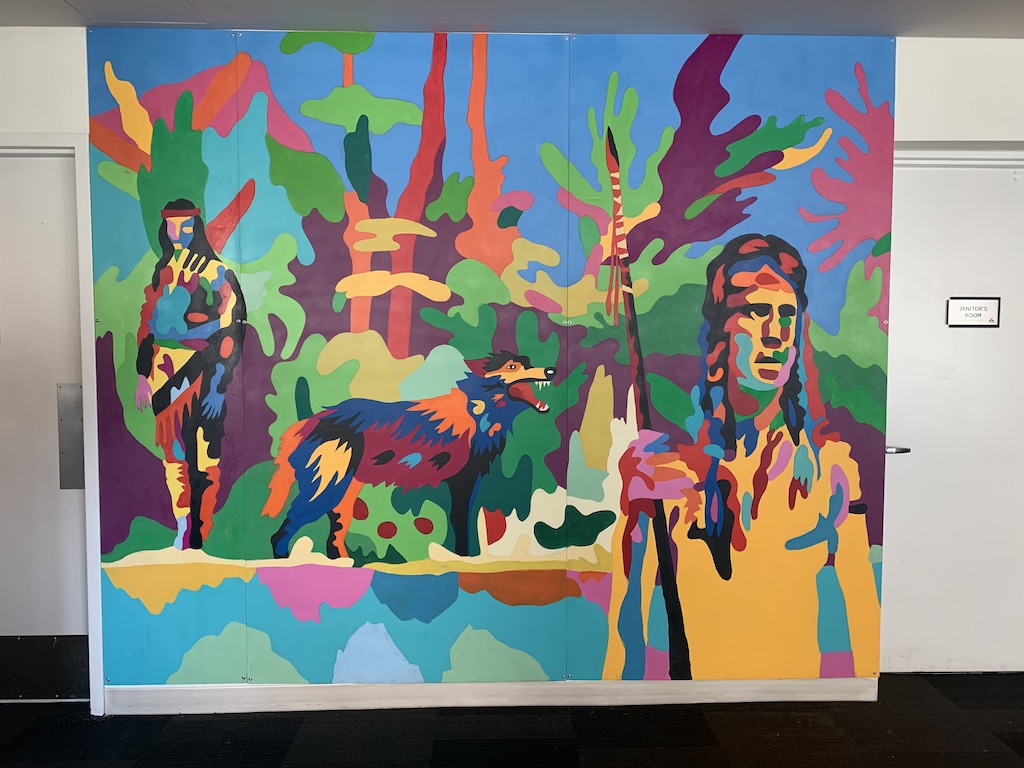 The mural in East Side Games’s office lobby, called “The Welcoming Committee” by Jean Paul Langlois. Photo: East Side Games | Handout
News
‘Diverse workspaces are more powerful’: How Indigenous people in B.C.’s gaming and animation industry are driving change
East Side Games staff commemorate Orange Shirt Day on Sept. 30, 2018. Photo: Eastsidegamestudio | Instagram
VANCOUVER — There’s a scene during Moana that makes Harley Knife emotional, but it’s one that happens offscreen, in his living room. When he sees his daughter dancing along to the songs of the movie’s Polynesian-inspired culture, he’s moved by the power of diversity and representation in media. But it also makes him jealous—he wishes it were his culture, and by extension hers, she was celebrating.
“I want my daughter to see our culture like that, up on the big screen or on TV,” said Knife, a senior animator at animation-production company Titmouse (which has an office in Vancouver), who is from the Ahtahkakoop Cree Nation. “It’s not there and it needs to be there, especially if Canada cares about reconciliation.”
Talking Point
While about six per cent of B.C.’s population identifies as Aboriginal, less than one per cent of those working in the province’s tech industry does, according to 2016 figures from Statistics Canada and the BC Tech Association, respectively. Some Indigenous people in the gaming and animation industry are working to change that.
That on-screen representation is less likely without more Indigenous people working in the gaming and animation industries. Though about six per cent of British Columbia’s population identify as Aboriginal, according to Statistics Canada, less than one per cent of the province’s technology workforce does, according to 2016 numbers from the BC Tech Association. Knife is among those working to increase Indigenous representation in their industry by creating more welcoming, inclusive workplaces and providing opportunities for Indigenous youth and students to try their hand at game design.
“I think diverse workspaces are more powerful,” said Josh Nilson, co-founder and general manager at Vancouver-based East Side Games, who is Métis. The facts back him up: Gender, ethnic and cultural diversity at the corporate-leadership level boosts performance, with the most diverse companies more likely to outearn their less diverse competitors, according to a multi-year analysis by consulting firm McKinsey & Company.
Nilson co-founded East Side Games in 2011. It’s since grown to over 150 people and has made games based on popular TV shows, including “Trailer Park Boys.” Throughout his career, he’s noticed a dearth of Indigenous workers. He believes one of the first steps in addressing that is having ongoing conversations in an effort to educate people about Indigenous history in Canada and build inclusive workspaces. “Our games that we make, we want everyone to feel that they can play, and there’s no barriers, and [they are] welcoming. Our workspaces should be like that, as well,” he said.
East Side Games attempts to spark that conversation in several different ways. Since early 2020, an eight-by-10-foot mural in the company’s office lobby has greeted employees and visitors alike. Titled “The Welcoming Committee,” it’s by Métis painter Jean Paul Langlois—one of Nilson’s favourite artists—and depicts a landscape that evokes the Group of Seven, two Indigenous figures and a wolf with bared teeth. “I think art’s meant to be controversial,” said Nilson, who chose to put the piece in the lobby to spark conversation. “It’s bold and it’s in your face, and it tells a statement of your company right away.”
Another attempt comes in the form of the company’s resource library. East Side Games keeps a stock of books on anti-racism, feminism and Indigenous history. With their office closed because of the pandemic, the books are kept at a small general store in Vancouver. Employees can walk in and borrow Bob Joseph’s 21 Things You May Not Know About the Indian Act, for example. Making these books available to staff removes any barriers to access, said Nilson, who said providing such libraries is a simple thing every employer should do.
The company has also set aside time for staff to have these discussions. Every Monday morning, it hosts kafii, a word meaning “coffee,” and Thursday afternoon tansi, meaning “hello,” sessions at which people can talk about all sorts of topics, born of the Métis storytelling tradition. Nilson begins the meetings with a traditional greeting and the focus tends to be driven by attendees. Sometimes they discuss Indigenous issues. Other times, COVID-19 reopening plans.
Actions, of course, matter too. Nilson speaks on industry panels to share his story and increase Indigenous visibility in the industry. East Side Games supports Indigenous-owned businesses—for example, by ordering most of its company swag from Section 35, a Vancouver-based clothing retailer co-founded by designer Justin Louis, from the Samson Cree Nation—and supports a number of charities and initiatives working to accomplish similar goals, including imagineNative, which helps boost Indigenous-made art. And Nilson believes companies celebrating Canada Day should consider also doing something for National Indigenous Peoples Day and Orange Shirt Day, the latter of which commemorates the experiences of residential school students, and the schools’ violent legacy.
Nilson wants more companies to make similar moves. “I’d like it not just to be the same couple companies there,” he said. Next Orange Shirt Day, for example, Nilson would like to see “every single tech CEO” buy orange shirts for their team and wear one themselves. That kind of education and representation matters in making progress, he said.
The industry is starting to take note. DigiBC, the interactive- and digital-media association in the province, is working on quantifying the problem. “We’re working on developing how our companies and therefore how the sector can collect this data,” said executive director Loc Dao, “so we can actually benchmark and set goals against what is actually happening, as opposed to having no idea what the representation is.”
Like other organizations, it’s working to get more underrepresented youth involved and connect students with co-ops and internships. DigiBC is running a camp for girls this summer where they’ll create a game using Python. The organization wants to run a similar one for Indigenous youth, or at least include them in all its future camps, Dao said. It’s also working with post-secondary institutions to create work placements at its 100-plus member firms for Indigenous students and students from other minority groups. The BC Tech Association is focusing on internships, among other initiatives, in what Nilson said are “all positive steps forward.”
Knife knows just how big a deal it can be to see another Indigenous person in the industry. He mentors Indigenous youth trying to break into the industry, and recalls one session about a decade ago, in which he told a group about lessons he learned in college, while teaching them how to make a dream board—a collage visualizing their hopes for their future. While he was working at another animation studio a couple of years ago, he met a junior employee who turned out to be one of the kids from that youth group.
“That made me feel good,” said Knife. “He told me that … I was like an inspiration to him.”
Loading...
Thanks for sharing!
You have shared 5 articles this month and reached the maximum amount of shares available.
CloseThis account has reached its share limit.
If you would like to purchase a sharing license please contact The Logic support at [email protected].
CloseGift the full article!
You have gifted 0 article(s) this month and have 5 remaining.
Recipients will be able to read the full text of the article after submitting their email address. They will not have access to other articles or subscriber benefits.
Photo: Eastsidegamestudio | Instagram
The mural in East Side Games’s office lobby, called “The Welcoming Committee” by Jean Paul Langlois.
Most Popular This Week



In-depth, agenda-setting reporting
Great journalism delivered straight to your inbox.
News
The $100B bet Canada is putting on European submarines
Briefing
Brookfield-backed Csquare seeks to raise up to US$1.35B in its IPO
Alberta government uses Claude to check its code
Rogers to take full control of MLSE, buying Kilmer Sports’ stake for $4.35B
Best business newsletter in Canada
Get up to speed in minutes with insights and analysis on the most important stories of the day, every weekday.
Exclusive events
See the bigger picture with reporters and industry experts in subscriber-exclusive events.
Membership in The Logic Council
Membership provides access to our popular Slack channel, participation in subscriber surveys and invitations to exclusive events with our journalists and special guests.