Skip to content

News
CRTC says it’s trying to slash the red tape strangling public-interest groups
Non-profits say the commission takes nine months to approve payment for participation in hearings, causing “existential” financial risk
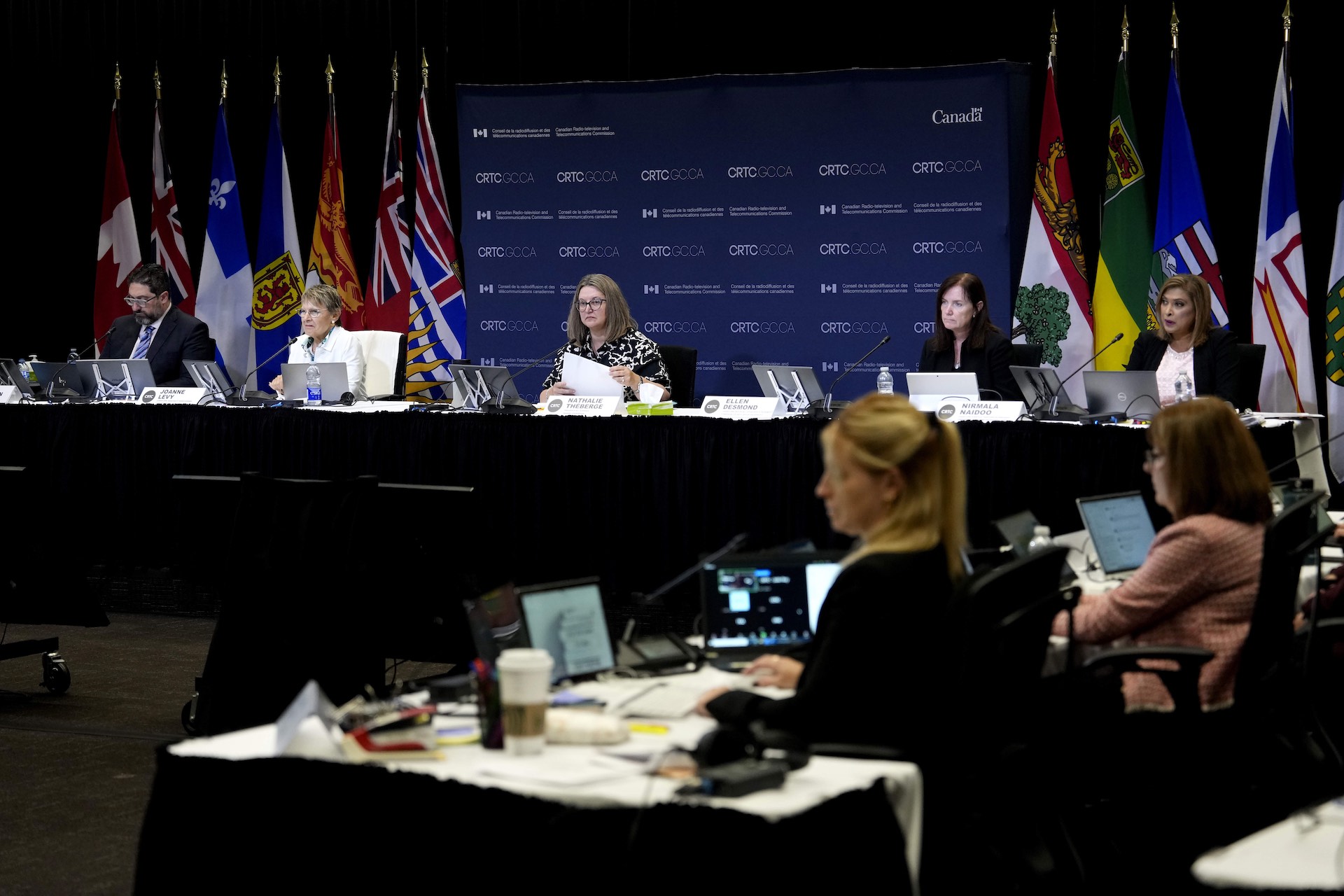
Public-advocacy groups say the CRTC takes as long as nine months to approve payment for their participation in hearings. Photo: The Canadian Press/Justin Tang
OTTAWA — Canada’s communication-sector regulator says it’s trying to fix a long-standing problem that has mired public advocacy groups in red tape and put them under what they describe as “existential” financial pressure.
“The CRTC will continue to find ways to move more quickly across the organization and to improve its processes,” CRTC spokesperson Leigh Cameron said in a statement to The Logic.
Talking Points
- The Canadian Radio-television and Telecommunications Commission reimburses consumer advocates who contribute to its regulatory decisions, but the process can take months or even years. The communications regulator said it hopes to change that.
- The Public Interest Advocacy Centre and Consumers Council of Canada say the delays are unfair, and leave them on the hook for the cost of representing the public interest against major corporate interests in the broadcasting and telecommunications sector
Consumer advocates and public-interest groups often go up against government and corporate giants like streaming services or telecommunications companies at independent tribunals like the Canadian Radio-television and Telecommunications Commission (CRTC). Their contributions come at a cost, especially if they have to hire expert researchers or lawyers.
Public-interest groups can apply to the CRTC for reimbursement for their contributions to those tribunals and hearings, where they speak for consumers and other members of the public on issues ranging from privacy rights to communications needs in remote regions. But it can take months or even years for the regulator to decide whether they qualify for the funds.
Related Articles

In the meantime, many public-interest organizations are in a precarious situation, said Jonathan Schachter, chair of the Public Interest Advocacy Centre (PIAC), a regular contributor to the CRTC’s hearings. Last week, The Logic reported the former executive director of the organization, Geoff White, resigned over the group’s dire financial straits after going without pay for months.
Schachter said it takes an average of nine months for the commission to decide whether it will reimburse participants, leaving organizations like his to carry the costs. The majority of PIAC’s funding comes from representing consumers at CRTC proceedings, he said in a letter to government ministers earlier this year. As of this fall, the centre estimated that it has over $30,000 in outstanding applications waiting for decisions.
The CRTC said that, this year, it has responded to PIAC’s applications within an average of five months. Regardless, Schacter said in a statement, “unpaid cost awards from the CRTC are an interest-free loan from PIAC (a not-for-profit) to the CRTC, with no certain date of repayment. This forces public-interest advocates to work for free until the CRTC gets its stuff together.”
The delays leave advocacy groups holding the bag, agreed Ken Whitehurst, executive director of the Consumers Council of Canada, another organization that has contributed to some CRTC hearings. “Current CRTC procedures concerning intervenor cost reimbursement so delay payment that our organization considers it nearly an existential risk to incur costs to intervene at the CRTC,” he said in a statement to The Logic.
The council once had a small payment held up by two years because of internal wrangling at CRTC, he said. Trying to secure lawyers that will agree to represent the organization, knowing their payment could be held up for months, has been “challenging, to say the least,” he added.
Letting such organizations wither means ceding major regulatory decisions to corporate players, according to Monica Auer, executive director of the Forum for Research and Policy in Communications.
“Ever-more concentrated ownership in broadcasting means that very few Canadians can match large companies that hire lawyers, accountants, researchers and other experts to make their submissions,” she wrote in a post on the group’s website in September. “Providing financial support to participants that use the same approach but in the public interest helps to level the regulatory playing field just a bit.”
The CRTC hasn’t updated the rates it offers for participating public-interest groups since 2007, Auer said in a submission to the regulator in September, and the time it takes to process those reimbursement requests has trended up over the years, from just over five months in 2000 to roughly nine in 2025.
The CRTC also established the Broadcasting Participation Fund in 2011, to help support public-interest and consumer groups that offer input on hearings and consultations related to the Broadcasting Act, but Auer said it has been teetering on the brink of collapse for years and effectively closed earlier this year. In September, CRTC announced the fund would stop accepting claims at the end of October and advised applicants to plan accordingly.
In May, the CRTC put out a call for input on how to improve public-interest participation in its proceedings, and acknowledged the long and unpredictable waits groups face for reimbursement. It will be the first time the rules have been updated in over 10 years. The commission has also promised to speed up the processing times as part of government-wide efforts to cut unnecessary red tape.
The Public Interest Advocacy Centre responded to the CRTC’s request for input, but Schachter told ministers in his letter that, given the current turnaround, he doesn’t expect the group to get paid for that work until August 2026.
With files from Claire Brownell in Toronto



Loading...
Thanks for sharing!
You have shared 5 articles this month and reached the maximum amount of shares available.
CloseThis account has reached its share limit.
If you would like to purchase a sharing license please contact The Logic support at [email protected].
CloseGift the full article!
You have gifted 0 article(s) this month and have 5 remaining.
Recipients will be able to read the full text of the article after submitting their email address. They will not have access to other articles or subscriber benefits.
Photo: The Canadian Press/Justin Tang
Most Popular This Week




In-depth, agenda-setting reporting
Great journalism delivered straight to your inbox.
News
Canada’s banking regulator weighs new rules for AI risks
Briefing
Mecka raises US$60M to gather data for robot training
Businesses should expect AI to get better, but not necessarily cheaper
Weston family and Fairfax agree to buy drugstore Boots for US$8.9B
Best business newsletter in Canada
Get up to speed in minutes with insights and analysis on the most important stories of the day, every weekday.
Exclusive events
See the bigger picture with reporters and industry experts in subscriber-exclusive events.
Membership in The Logic Council
Membership provides access to our popular Slack channel, participation in subscriber surveys and invitations to exclusive events with our journalists and special guests.