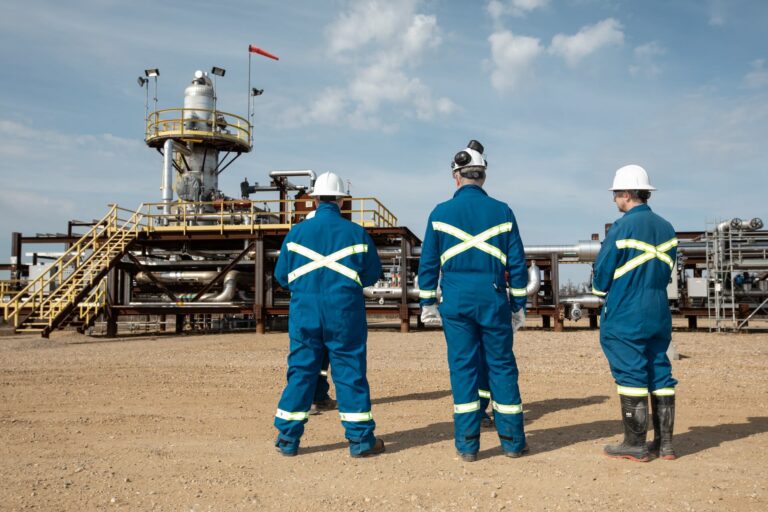
In a sea of art installations, food vendors and company exhibits at COP28, the province of Saskatchewan has become the business centre for Canadian entrepreneurs, business executives and lobbyists who want to strike deals at the UN climate conference in Dubai.
Skip to content


News
COP28: What Canadian businesses want from the climate conference in Dubai
Outside negotiating rooms, executives are in the UAE to make deals
From left: Grant Fagerheim of Whitecap Resources, Rhona DelFrari of Cenovus Energy, Rob Morgan of Strathcona Resources and Saskatchewan Premier Scott Moe. Photo: Government of Saskatchewan/Handout
In a sea of art installations, food vendors and company exhibits at COP28, the province of Saskatchewan has become the business centre for Canadian entrepreneurs, business executives and lobbyists who want to strike deals at the UN climate conference in Dubai.
The province’s pavilion is the home base for its delegation at COP28, where more than 50 organizations are slated to participate in events over the two-week summit, many of them looking to pitch their business ideas, make investments and find new customers.
Talking Point
- Dozens of representatives from Canada’s energy and adjacent sectors are in Dubai to pitch their business ideas, make investments and find new customers at the COP28 climate conference
Officially, the climate conference is the venue where world leaders meet every year to reach a collective agreement on how best to address the climate crisis. But outside negotiating rooms, large groups of attendees are there to make deals.
Business dealings have long been a feature of the annual summit. But with oil-rich United Arab Emirates as host, representatives from Canadian energy and adjacent sectors have descended on this year’s conference in massive numbers.
“The UAE has very deep pockets for direct foreign investments in Canada,” said Les Jacobs, vice-president of research and innovation at Ontario Tech University.
The Logic spoke with leaders from major Canadian industries on the ground in Dubai about what they’re hoping to achieve at COP28:
Oil and gas: Canada’s oil and gas sector is well represented, with delegates from major companies including Suncor, Enbridge, Cenovus, Imperial Oil, and MEG Energy on-site, as well as lobby group Pathways Alliance, whose members account for 95 per cent of Canada’s oil sands production. An analysis by Environmental Defence identified 35 fossil fuel representatives in Canada’s official delegation, up from eight last year.
Related Articles

The sector has been under fire since before attendees arrived in Dubai, following reports that COP28 president and oil executive Sultan Ahmed Al Jaber was coordinating business deals to strike with fossil fuel companies attending the summit.
While Al Jaber has since denied the reports, the controversy fuelled criticism that oil giants and their lobbyists are at COP28 on business, not to solve the climate crisis.
Rhona DelFrari, chief sustainability officer at Calgary-based Cenovus Energy, said the two motivations aren’t mutually exclusive. She’s in Dubai to meet potential partners from around the world that can help the company reach its net-zero goals, she said.
DelFrari said she’s getting a lot of interest at COP from companies seeking investments from large oil companies like Cenovus for their decarbonization technologies. “After I do a speaking engagement, people always come up to me and offer solutions,” she said. Earlier in the week, for example, a company working on small modular reactors pitched DelFrari on using the technology at Cenovus. “I took their card, and [I’ll] let our technology and our operations teams assess whether it’s a good opportunity.”
Nuclear power: There are at least six Canadian companies in the nuclear and uranium sector at COP28, including the Canadian Nuclear Association and uranium producers Cameco and NexGen Energy. The large contingent of nuclear power firms speaks to the business opportunities with the UAE, the first middle eastern country to operate a nuclear power plant, said Ontario Tech University’s Jacobs.
The energy source has long split environmentalists, some of whom tout it as a low-emissions fossil-fuel alternative and others who say the safety concerns outweigh benefits. Jacobs, who’s also the director of the International Atomic Energy Agency Collaborating Centre for Canada, said that while there are still skeptics, it’s mostly being embraced at COP28. “It certainly is significant that the European Union recognized nuclear as a clean energy source this past year,” he said. Earlier this week, 20 countries, including Canada, the U.S., the UAE, France and Ukraine, agreed to triple nuclear energy capacity by 2050. That support for the industry, Jacbos said, was likely helped by the host country’s support for the energy source.
Agriculture: Food systems—which are responsible for about a third of global greenhouse gas emissions—are a core theme of this year’s climate conference, with an entire day dedicated to food, agriculture and water.
Keith Currie, president of the Canadian Federation of Agriculture, said he travelled to Dubai to make sure someone from Canada’s agriculture sector is at the proverbial table. “There’s been lots of goals set at COP conferences,” said Currie, “but they never get made because they aren’t talking to the people on the ground that actually have to implement programs.”
He’s advocating for more financing, of which he said the sector needs a lot to reach its net-zero targets. “We can’t expect our government or any government to fund all the climate initiatives that everybody’s asking for,” he said. “It’s just not realistic.”
Currie isn’t the only Canadian agriculture representative at COP. Ken Seitz, CEO of Saskatoon-based fertilizer company Nutrien, is there. So is Bob Lowe, former president and board director of the Canadian Cattle Association.
Like other heavy-emitting industries, protestors have targeted Big Agriculture, specifically meat and dairy, for its involvement in COP, arguing the sector is there to swing policy in its favour, which doesn’t necessarily align with solving climate change. While Currie thinks the sector is “demonized very unfairly” for its environmental impact, he said it’s working to lower emissions. He doesn’t expect decisions reached in Dubai to trigger quick or easy fixes.
“Anytime you’re dealing with governments from around the world that are trying to come together and move in one direction, that’s not easy,” he said. “But you can’t get there if you don’t start, and that’s why we’re here.”



Loading...
Thanks for sharing!
You have shared 5 articles this month and reached the maximum amount of shares available.
CloseThis account has reached its share limit.
If you would like to purchase a sharing license please contact The Logic support at [email protected].
CloseGift the full article!
You have gifted 0 article(s) this month and have 5 remaining.
Recipients will be able to read the full text of the article after submitting their email address. They will not have access to other articles or subscriber benefits.
Photo: Government of Saskatchewan/Handout
Most Popular This Week



In-depth, agenda-setting reporting
Great journalism delivered straight to your inbox.
Commentary
Carmichael: Canadian ignorance about India is a strategic weakness
Briefing
Aritzia shares pop after earnings rise 204%
First Nation in Alberta goes to court over fast-tracked oil pipeline
Chinese EV maker Geely Auto Group to launch in Canadian market in 2027
Best business newsletter in Canada
Get up to speed in minutes with insights and analysis on the most important stories of the day, every weekday.
Exclusive events
See the bigger picture with reporters and industry experts in subscriber-exclusive events.
Membership in The Logic Council
Membership provides access to our popular Slack channel, participation in subscriber surveys and invitations to exclusive events with our journalists and special guests.