Listen Now
0:00
Nearly two-thirds of Canadians want to plot a national course that assumes the relationship between Canada and the United States will not go back to the way it was before Donald Trump returned to the U.S. presidency, according to new polling for The Logic by Abacus Data.
And frankly, said Abacus CEO David Coletto, Canadians feel pretty good about how that will turn out.
Talking Points
- The panic that set in as Donald Trump launched his trade war has subsided and Canadians are optimistic about building new economic relationships, Abacus Data CEO David Coletto says
- That means business leaders should be seen rooting for Canada and seizing new opportunities in the national interest
“There’s this uniquely Canadian optimism. I don’t think it exists in any other part of the world,” Coletto said. “You have half the country thinking the country’s headed in the right direction, even as they think the world and the United States isn’t.”
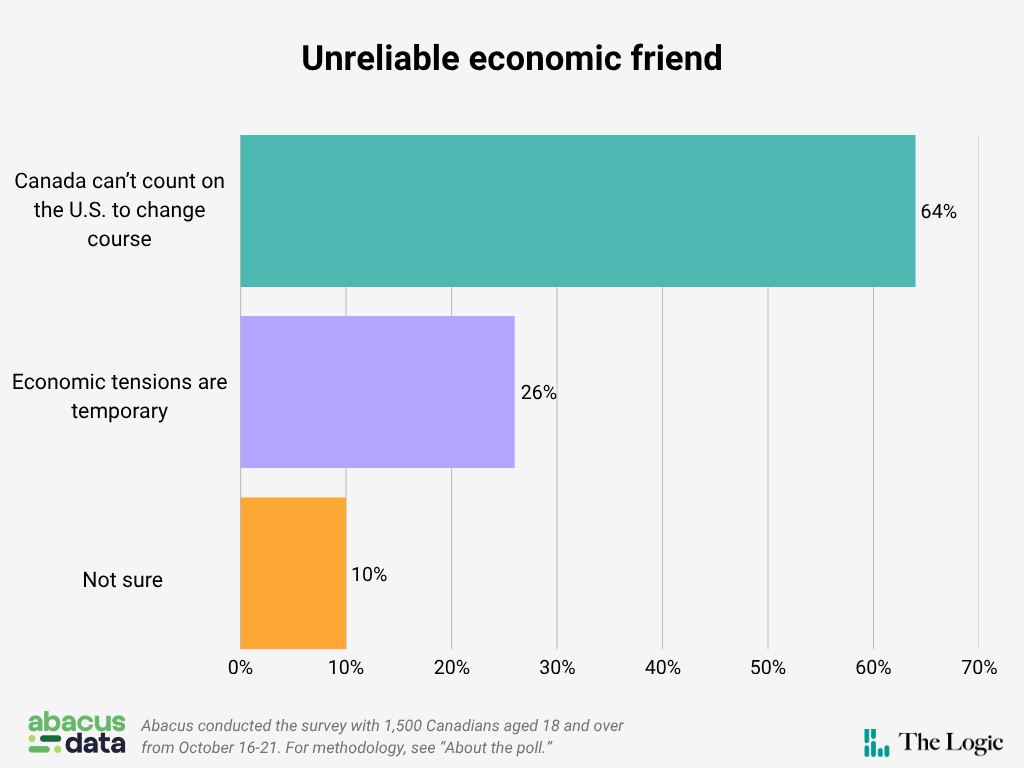
An Abacus survey of 1,500 Canadians found 64 per cent of respondents saying that Canada cannot count on the United States to revert to its pre-Trump attitudes. Just 26 per cent said Canada’s best move is to be patient and wait for U.S. politics to change. (Ten per cent weren’t sure.)
Abacus found no subcategory of respondents who thought very differently—no region of the country, income grouping, party affiliation or age cohort. Younger respondents were a bit more likely than older ones to prefer patience with the U.S., but that was still far from a majority view.
Coletto thinks younger people might be more likely to see Trump and his policies as just one of many threats to their futures, among a set of worries that includes climate change and what artificial intelligence might do to the economy. They may still see opportunity south of the border, he said.
Older respondents have longer memories of Canada-U.S. friendship and feel more deeply betrayed, he said, and are more invested in the order that Trump has turned upside down.
But overall, he said, this is markedly different from the early days of Trump’s second stint in the White House, when he started tariffing Canadian goods after musing about forcing Canada into annexation.
“There was a sense of urgency,” Coletto said. “Canadians thought, ‘We need to solve this now. This is something we cannot get through and survive.’”
With some pain, though, Canada has survived. Now, as they have held on to negative feelings toward the U.S. that remain “pretty broad and deep,” Coletto said, they’re keen to look for new economic partnerships rather than trying to repair the old one.
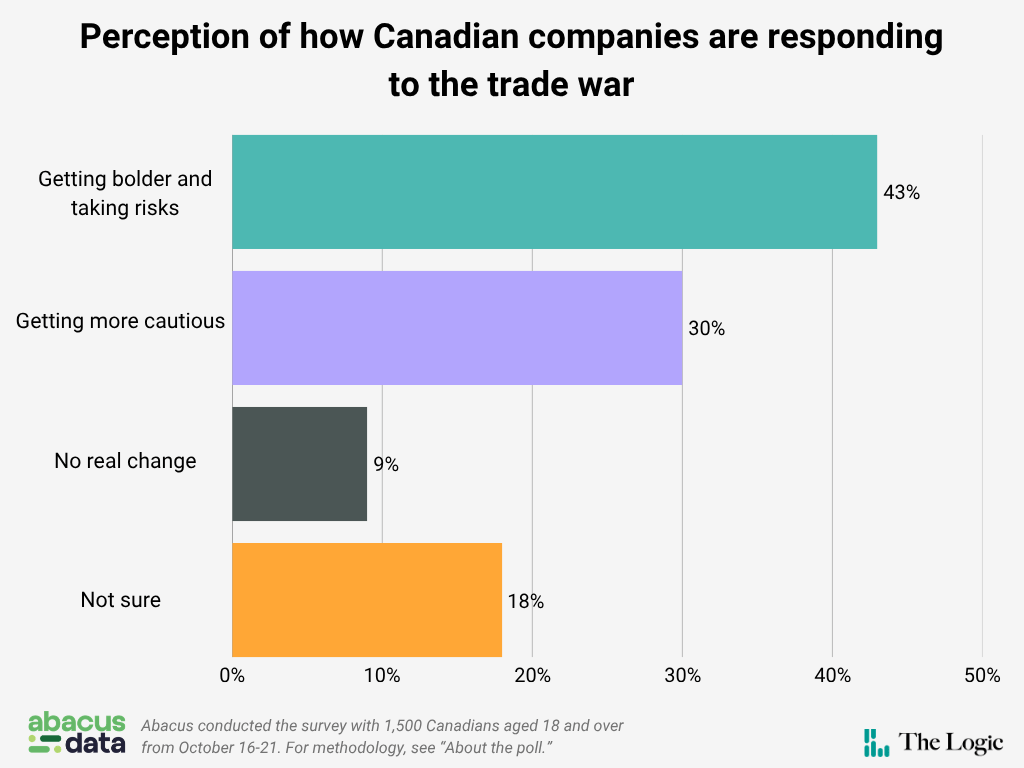
In answering another Abacus question, 43 per cent of respondents said they think the trade war has generally made companies more willing to take risks, against 30 per cent who think they’ve hunkered down and become more cautious. And Canadians welcome it, said Coletto.
“People are more inclined to think businesses should take bold action,” he said. Canadians have been hearing from their leaders for almost two years that Canada has everything the world wants, he said. “So let’s go.”
This has implications for how business leaders should conduct themselves, Coletto said.
“I think the public expects business leaders to be cheering for Canada. I think they want to see the same kind of optimism, and they want to see people who are investing in Canada’s future.”
That’s easier for a Canadian-owned company than for the Canadian branch of a multinational, especially one rooted in the United States. For them, he said, “it’s a more challenging environment.” But Canadians will be pleased to see them demonstrate commitments to Canada.
Ambition and action are the keys, he said: “A little less full-out complaining and more doing, I would say, is probably the orientation of most Canadians.”
About the poll: Abacus surveyed 1,500 Canadians aged 18 and over from Oct. 16 to 21 through online panels and weighted the results using census data to match the Canadian population according to age, gender and region. The margin of error for a comparable probability-based random sample of the same size would be 2.5 percentage points, 19 times out of 20.