After nearly six years as an angel investor in Canadian technology companies, Alex Tong started a venture capital firm late last year. Though Tong is based in Toronto, where he has built an extensive professional network, he opted to incorporate Seguin Ventures in Delaware.
Skip to content


News
‘I need to follow the money’: Canadian VCs eye U.S. moves amid tough fundraising conditions at home
Investors wrestle with sluggish exit market, more funds vying for fewer dollars
Some investors are considering domiciling in Delaware or other U.S. states due to a challenging fundraising market in Canada. Photo: Getty Images/Joe Sohm/Visions of America/Universal Images Group
After nearly six years as an angel investor in Canadian technology companies, Alex Tong started a venture capital firm late last year. Though Tong is based in Toronto, where he has built an extensive professional network, he opted to incorporate Seguin Ventures in Delaware.
Tong is among a cohort of Canadian venture capitalists launching their next funds in the U.S. in a bid to overcome what they say are tough fundraising conditions at home for entrepreneurs and the investors that back them.
Talking Points
- Canadian venture capital firms are struggling to raise money from limited partners who have reaped little in the way of returns on their investments in recent years
- Emerging managers—VCs raising their first or second funds—are especially disadvantaged in the challenging market, leading some of them to explore moving to the U.S. in search of a friendlier investment environment
“Our decision to domicile in the U.S. was a fairly short discussion,” said Tong, one of three Canadian investors who recently told The Logic they have now domiciled in Delaware or are considering the move. Tong has a U.S.-based investment partner, whom he declined to name, but beyond that, he said, there’s simply more money there for emerging managers—investors establishing their first or second fund.
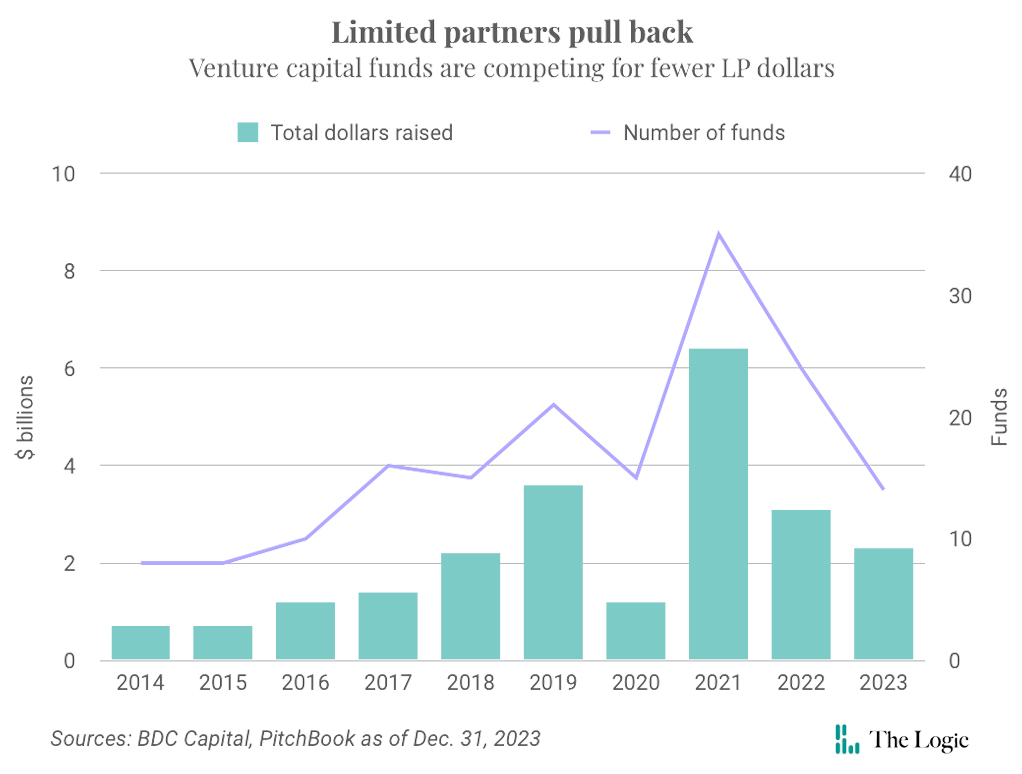
The movement south is a reaction to a challenging fundraising market in Canada. VC firms in the country raised just $2.3 billion across 14 funds in 2023, down from a peak of $6.4 billion across 35 funds in 2021, according to a report from BDC Capital, Canada’s largest venture capital investor, which backs both VC funds and companies directly. “The current macroeconomic backdrop is challenging for GPs [general partners] actively fundraising,” the report reads, “with many not achieving their ideal first close and final close targets, or not being able to raise altogether.”
The slowdown stems from a lethargic exit market over the last two years, with relatively few companies going public or being acquired. While M&A has started picking up, there hasn’t been a single initial public offering from a VC-backed Canadian company this year, and only one since 2022, according to a Canadian Venture Capital and Private Equity Association report published last week. That has left limited partners—the investors that back VC funds—with little in the way of returns to reinvest into venture capital.
Emerging managers feel it the most when LPs tighten their belts since LPs tend to reinvest in funds that have generated returns for them, Senia Rapisarda, managing director at HarbourVest, which invests in Canadian VC funds, told The Logic in a December interview.
The surge in new investors during the pandemic-era VC boom has also meant more funds are competing for fewer dollars. Rapisarda said investors that don’t yet have a strong track record should consider teaming up with established funds rather than starting something new in 2024.
Related Articles


It’s not advice most emerging managers want to hear. Tong said he knew before starting his fund that it wasn’t going to be easy. “It’s going to be tough for anybody to raise capital as a new manager, regardless of market—bear or bull,” he said.
Ian Whytock is another Canadian investor who said he’s considering domiciling his next fund in Delaware, or another U.S. jurisdiction. “I need to follow the money,” said Whytock, co-founder and managing partner at Halifax-based Tidal Venture Partners, which closed its first fund in 2022. While Canadian funds can and often do raise money from U.S. investors, they may need to set up a separate U.S. vehicle for those investors. That’s an extra layer of friction Whytock said he’d like to avoid. “If we’re domiciled in the U.S., we just look like every other U.S. investment, except that our funds are focused on Canada.”
Tong said raising in Canada feels particularly prohibitive in 2024. On top of there being fewer LP dollars to go around, the federal government’s hike on the taxable amount of capital gains—the earnings from selling assets like shares, real estate and companies—has caused some investors and founders to sour on the Canadian market. Tong said he had decided to domicile Seguin Ventures in the U.S. before the proposed capital gains changes in April. However, the changes validated his decision further. “I suspect that took a lot of steam out of people’s risk appetite,” he said, “which was already pretty low for stuff like this in Canada.”
Delaware, by contrast, has some of the most lenient business tax policies in the world. Companies that are incorporated there but don’t do business in the state do not pay corporate or income taxes. There’s also no investment income tax, and the state’s same-day business filings makes it easy to incorporate. This is why the world’s largest companies—including Amazon, Google and Walmart—are based in the state, and why the number of businesses (more than two million) eclipses the population (about one million).
Alex Tong said he had decided to domicile Seguin Ventures in the U.S. even before the proposed capital gains changes in April.
Council of Canadian Innovators president Benjamin Bergen said funds moving to the U.S. could siphon value away from the broader Canadian economy. If the VCs are based in the U.S., they often encourage the startups in which they invest to move south as well, “because they can network better, they often have stronger connections, and there’s just more talent and more money,” he said.
Those funds’ portfolio companies may be more likely to exit in the U.S., too, said Bergen, leaving Canada to miss out on economic value created by companies going public, for example. “We’ve got to think about venture capital as strategic infrastructure,” he said. “Where we’re investing as a country matters.”
While Tong said he is positioning Seguin, which is still in stealth mode, as a U.S. fund that invests in both Canadian and U.S. startups, Whytock is committed to funding only Canadian firms. “In order to do that, we need LP dollars,” he said. While Whytock hopes being based in the U.S. will broaden the investor pool, he is still interested in raising from Canadian LPs.
Some more established investors who spoke to The Logic pushed back against the benefits of domiciling in Delaware. Boris Wertz, founder and general partner of Vancouver-based Version One Ventures, said he hasn’t had issues fundraising from U.S. or other foreign investors.
Of course, Version One has rewarded its investors over its 12 years with large exits, including Clio, Coinbase and Wattpad, making it more likely than emerging managers to clinch limited LP dollars. More established VCs may also have an easier time landing capital from larger U.S. firms that can easily manage the extra paperwork involved with investing in a foreign fund.
Fundraising in the U.S. isn’t guaranteed to be easy, either. Emerging managers have been capturing a smaller and smaller share of U.S. private capital over the last decade, according to a PitchBook analysis published in April. In 2023, the number fell to 12.7 per cent, the lowest level since before 2000. “There’s tons and tons of emerging managers out there that are trying to raise,” said Wertz. “It’s not a Canadian phenomenon or U.S. phenomenon. It’s just a tough time.”



Loading...
Thanks for sharing!
You have shared 5 articles this month and reached the maximum amount of shares available.
CloseThis account has reached its share limit.
If you would like to purchase a sharing license please contact The Logic support at [email protected].
CloseGift the full article!
You have gifted 0 article(s) this month and have 5 remaining.
Recipients will be able to read the full text of the article after submitting their email address. They will not have access to other articles or subscriber benefits.
Photo: Getty Images/Joe Sohm/Visions of America/Universal Images Group
Most Popular This Week




In-depth, agenda-setting reporting
Great journalism delivered straight to your inbox.
News
Anthropic revealed as client for EverWind’s $10B Nova Scotia data centre
Briefing
EverWind plans $10B data centre and wind development in Nova Scotia
Canada ready to force Stelco to sell its Canadian operations, Joly says
Feds plan a 60 MW defence-oriented data centre for Ottawa
Best business newsletter in Canada
Get up to speed in minutes with insights and analysis on the most important stories of the day, every weekday.
Exclusive events
See the bigger picture with reporters and industry experts in subscriber-exclusive events.
Membership in The Logic Council
Membership provides access to our popular Slack channel, participation in subscriber surveys and invitations to exclusive events with our journalists and special guests.