Canada’s labour market has been “sleepwalking” through much of 2025, according to Brendon Bernard, an analyst with the recruitment company Indeed. To understand what he means, just look at Statistics Canada’s latest jobs numbers, released Friday.
Skip to content


News
Canada is sleepwalking into higher unemployment
The jobless rate has crept steadily higher over the past two years and U.S. tariffs are only starting to bite
The latest labour force survey from Statistics Canada showed another in a series of increases to the unemployment rate. Photo: The Canadian Press/Nathan Denette
Canada’s labour market has been “sleepwalking” through much of 2025, according to Brendon Bernard, an analyst with the recruitment company Indeed. To understand what he means, just look at Statistics Canada’s latest jobs numbers, released Friday.
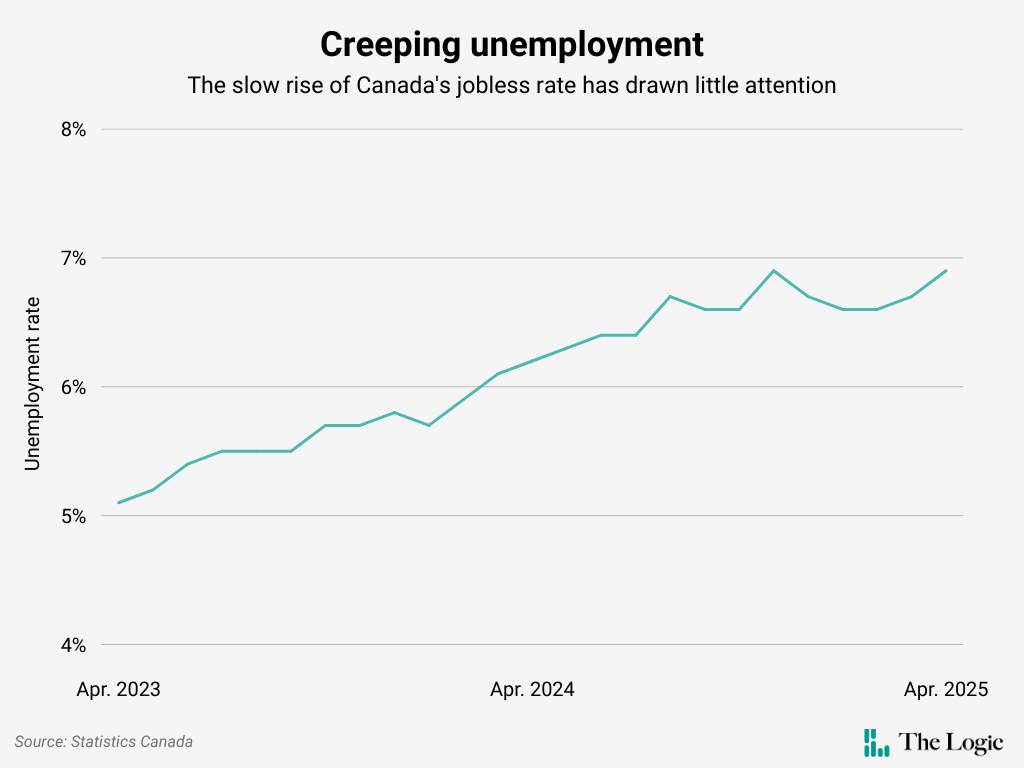
Despite trade uncertainty, plunging business sentiment and geopolitical upheaval, the economy created marginally more jobs than it lost in April. Yet unemployment ticked higher, as it has again and again over the past two years—incremental rises that have yet to trigger widespread alarm.
Related Articles


Hence Bernard’s sleepwalking analogy. Unemployment isn’t excessively high, but is steadily climbing. Meanwhile, more and more Canadians say they’re having difficulty finding new work, and hiring activity has slowed. Wages are growing more slowly in 2025 than in 2024 as hiring and inflation fade.
Canada’s labour market is carrying on, but it’s doing so with dragging feet and eyes half-shut.
Nothing to see here: According to Friday’s jobs numbers, the unemployment rate in April increased 0.2 percentage points, to 6.9 per cent. The country added a meagre 7,400 jobs over the month, up from a decline of 33,000 in March.
While the jobless rate is within the typical range of the last 10 years, 6.9 per cent marks a return to its November 2024 level, the highest since January 2017, excluding the pandemic. Unemployment has been gradually increasing for the last two years, as job availability has failed to keep up with rapid population growth.
Thus far, the incremental nature of rising unemployment has led to a more subdued policy response, but that could change, as April’s figures have some analysts expecting the Bank of Canada to begin cutting rates in June. RBC is projecting unemployment to surpass seven per cent this year.
No longer hiring: Unemployment isn’t the only worrying metric. Hiring is also in decline, according to Indeed’s analysis of the labour market in the first quarter of 2025. Between February and April, job postings fell 10 per cent in production and manufacturing; nine per cent in construction; and seven per cent in industrial engineering, Indeed’s examination found.
Meanwhile, retail saw a one per cent increase in hiring, while software development and banking saw the greatest increase in hiring efforts, each rising four per cent over the same period.
Your tariffs took our jobs: While Canada has so far avoided abrupt declines in its labour market, April gave an early hint how trade uncertainty could threaten jobs if tariff threats persist.
The manufacturing sector across the country lost 33,000 jobs in April, according to Statistics Canada, 32,700 of them in Ontario alone. Public administration saw the biggest gain in April with 27,000 jobs gained—a rise the agency attributed to a temporary boost from the federal election.
“We’ve got this looming trade cloud that is, at the end of the day, going to set the course for the Canadian economy in the coming months,” Bernard said.



Loading...
Thanks for sharing!
You have shared 5 articles this month and reached the maximum amount of shares available.
CloseThis account has reached its share limit.
If you would like to purchase a sharing license please contact The Logic support at [email protected].
CloseGift the full article!
You have gifted 0 article(s) this month and have 5 remaining.
Recipients will be able to read the full text of the article after submitting their email address. They will not have access to other articles or subscriber benefits.
Photo: The Canadian Press/Nathan Denette
Most Popular This Week




In-depth, agenda-setting reporting
Great journalism delivered straight to your inbox.
Commentary
Carmichael: Being boxed in will help Canada focus on what matters
Briefing
Rio Tinto gets nearly $165M in additional federal funds for Quebec aluminum
U.S. to lift tariffs on some Canadian products crucial to Maine: Collins
Carney warns of tech dependence after Starlink disruptions in Ukraine
Best business newsletter in Canada
Get up to speed in minutes with insights and analysis on the most important stories of the day, every weekday.
Exclusive events
See the bigger picture with reporters and industry experts in subscriber-exclusive events.
Membership in The Logic Council
Membership provides access to our popular Slack channel, participation in subscriber surveys and invitations to exclusive events with our journalists and special guests.






