TORONTO — AI Minister Evan Solomon has named prominent Canadian researchers, venture capitalists and founders to a new 26-person task force that will help shape an updated national AI strategy.
Skip to content

News
Debow, Pichette and Pineau are among the tech leaders who will help Ottawa update its AI strategy
A 26-person task force unveiled Friday will have 30 days to provide recommendations on research, adoption, safety and other key issues
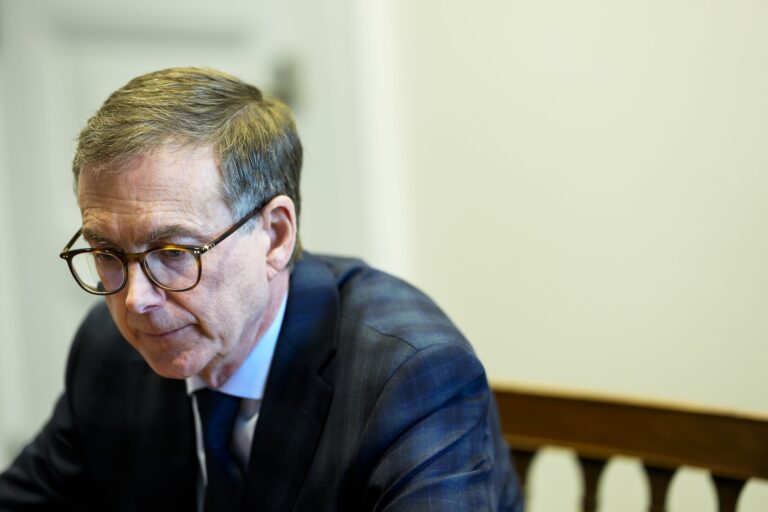
Evan Solomon, the federal minister of artificial intelligence and digital innovation, speaking in Ottawa in June 2025. Photo: The Canadian Press/Spencer Colby
TORONTO — AI Minister Evan Solomon has named prominent Canadian researchers, venture capitalists and founders to a new 26-person task force that will help shape an updated national AI strategy.
The group will have 30 days to make proposals focused on AI research, adoption and commercialization. They’ll also make recommendations on how to encourage investment, ensure safety and trust in the technology, skills development, digital infrastructure and the security of systems.
Solomon promised that the new Liberal government will release the “refreshed” AI strategy by the end of the year. The government is also launching public consultations on the AI strategy at the start of October.
Related Articles

Task force members include major industry executives like Cohere’s new chief AI officer Joelle Pineau; Sam Ramadori, co-president of LawZero; League CEO Michael Serbinis; Coveo executive chair Louis Têtu and Samdesk CEO James Neufeld.
Patrick Pichette, a partner at venture firm Inovia Capital, is also on the panel, as is Michael Bowling, a University of Alberta researcher who has done pioneering work applying AI to games. So are Daniel Debow, a former Shopify executive and chair of Build Canada, and Marc-Etienne Ouimette, previously a lobbyist and policy executive for Amazon Web Services and Element AI.
Tech industry organizations are also represented on the task force. They include Council of Canadian Innovators president Benjamin Bergen and First Nations Technology Council CEO Natiea Vinson.
The task force will include university administrators Gail Murphy, UBC’s vice-president of research and innovation, and University of Waterloo engineering dean Mary Wells. David Naylor and Arvind Gupta, the former presidents of the University of Toronto and University of British Columbia (UBC), respectively, are also members.
Each panel member is tasked with engaging their professional networks to solicit recommendations and ideas.
Past iterations of the Pan-Canadian AI Strategy have focused on some of the issues the new task force will study.
The program was originally focused on science, allocating $125 million for the Canadian Institute for Advanced Research (CIFAR) and three AI institutes—Montreal’s Mila, Toronto’s Vector Institute and Edmonton’s Amii—to recruit and retain top AI researchers. In April 2021, the Liberals renewed the strategy with $443.8 million in fresh funding, $185 million of which was for programs to help commercialize the technology, including via the federally backed innovation clusters.
Last April’s federal budget promised $2 billion to increase computing capacity in Canada, as well as $50 million to set up a new Canadian AI Safety Institute; $200 million to pay for regional development agencies to subsidize firms to adopt the technology; and $50 million to retrain workers displaced by AI.
“We have to own the rules and the tools,” Solomon said in a speech at the Empire Club of Canada in Toronto, calling the government’s push to build sovereign AI infrastructure and boost homegrown firms “a digital insurance policy.”
He repeated promises to create new incentives for investors to back AI companies, to buy their tools for the public sector and military and to support the development of Canadian-controlled data centres.
The Liberal government recast its AI advisory council as recently as March, and added a new group focused on AI safety and security. There’s little overlap between those two panels and the new task force.
Solomon also promised that Ottawa would launch a “major new program” for the quantum sector next month. As The Logic first reported, the federal Quantum Advisory Council has recommended that the government commit almost $2 billion to measures to help advance the disruptive technology and grow an industry around it.
The group’s proposals include establishing a $1-billion program to match the U.S. Defense Advanced Research Projects Agency’s (DARPA) blockbuster Quantum Benchmarking Initiative. The U.S. agency has selected three Canadian startups—Sherbrooke, Que.-based Nord Quantique, Vancouver-based Photonic and Toronto-based Xanadu—among 18 firms for the first phase of its program. That has sparked fears that Washington might try to poach Canadian quantum companies.
The full 26-person AI Strategy Task Force:
- Ajay Agrawal, University of Toronto professor, founder of the Creative Destructive Lab and co-founder of Intrepid Growth Partners
- Benjamin Bergen, president of the Council of Canadian Innovators
- Olivier Blais, co-founder and CTO at Moov AI, and co-chair of the federal Advisory Council on AI
- Michael Bowling, University of Alberta computing science professor and former research scientist at DeepMind
- Shelly Bruce, former chief of the Communications Security Establishment
- Cari Covent, former vice-president and head of AI and emerging technology at Canadian Tire
- Daniel Debow, chair of Build Canada and former vice-president at Shopify
- Diane Gutiw, vice-president and global AI research lead at CGI
- Garth Gibson, former CEO of the Vector Institute
- Arvind Gupta, University of Toronto computer science professor and former president of the University of British Columbia
- Adam Keating, CEO of CoLab Software
- Alex LaPlante, vice-president of cash management technology at RBC
- Gail Murphy, computer science professor and vice-president of research and innovation at University of British Columbia
- David Naylor, former University of Toronto president and chair of Canada’s Fundamental Science Review in 2017
- James Neufeld, CEO, Samdesk
- Marc-Etienne Ouimette, founder of Cardinal Policy, previously global lead for AI policy at Amazon Web Services and head of public policy and government relations at Element AI
- Taylor Owen, founding director of McGill University’s Centre for Media, Technology and Democracy
- Joelle Pineau, chief AI officer at Cohere and former vice-president of AI research at Meta
- Patrick Pichette, partner at Inovia Capital and former Google CFO
- Sam Ramadori, co-president and executive director at LawZero and former CEO of Brainbox AI
- Ian Rae, founder and CEO of CloudOps
- Michael Serbinis, founder and CEO of League
- Sonia Sennik, CEO of the Creative Destruction Lab
- Louis Têtu, executive chair of Coveo
- Natiea Vinson, CEO of the First Nations Technology Council
- Mary Wells, dean of engineering at University of Waterloo
Editor’s note: This story has been updated with more details on the appointees to the task force, and to clarify a task force member’s title.
Loading...
Thanks for sharing!
You have shared 5 articles this month and reached the maximum amount of shares available.
CloseThis account has reached its share limit.
If you would like to purchase a sharing license please contact The Logic support at [email protected].
CloseGift the full article!
You have gifted 0 article(s) this month and have 5 remaining.
Recipients will be able to read the full text of the article after submitting their email address. They will not have access to other articles or subscriber benefits.
Photo: The Canadian Press/Spencer Colby
Most Popular This Week



In-depth, agenda-setting reporting
Great journalism delivered straight to your inbox.
Commentary
Carmichael: Was Chicken Little stirring panic, or just taking precautions?
Briefing
Carney plans to discuss US$135B defence bank with new U.K. prime minister
B.C. nearing federal MOU of its own as talks continue on Alberta’s West Coast pipeline
Quebecor urges CRTC to block Corus restructuring as part of takeover push
Best business newsletter in Canada
Get up to speed in minutes with insights and analysis on the most important stories of the day, every weekday.
Exclusive events
See the bigger picture with reporters and industry experts in subscriber-exclusive events.
Membership in The Logic Council
Membership provides access to our popular Slack channel, participation in subscriber surveys and invitations to exclusive events with our journalists and special guests.