Brookfield’s controlling interest in Westinghouse Electric Co., a global nuclear energy giant and a key symbol of its push into renewables, has landed the asset manager on blacklists at several ESG-minded investment funds because of Westinghouse’s role in sustaining the American nuclear weapons arsenal.
Skip to content

News
Brookfield’s involvement in U.S. nuclear weapons makes it taboo for some European investors
Toronto finance giant controls Westinghouse, which is key to supply of tritium for atomic bombs and missiles
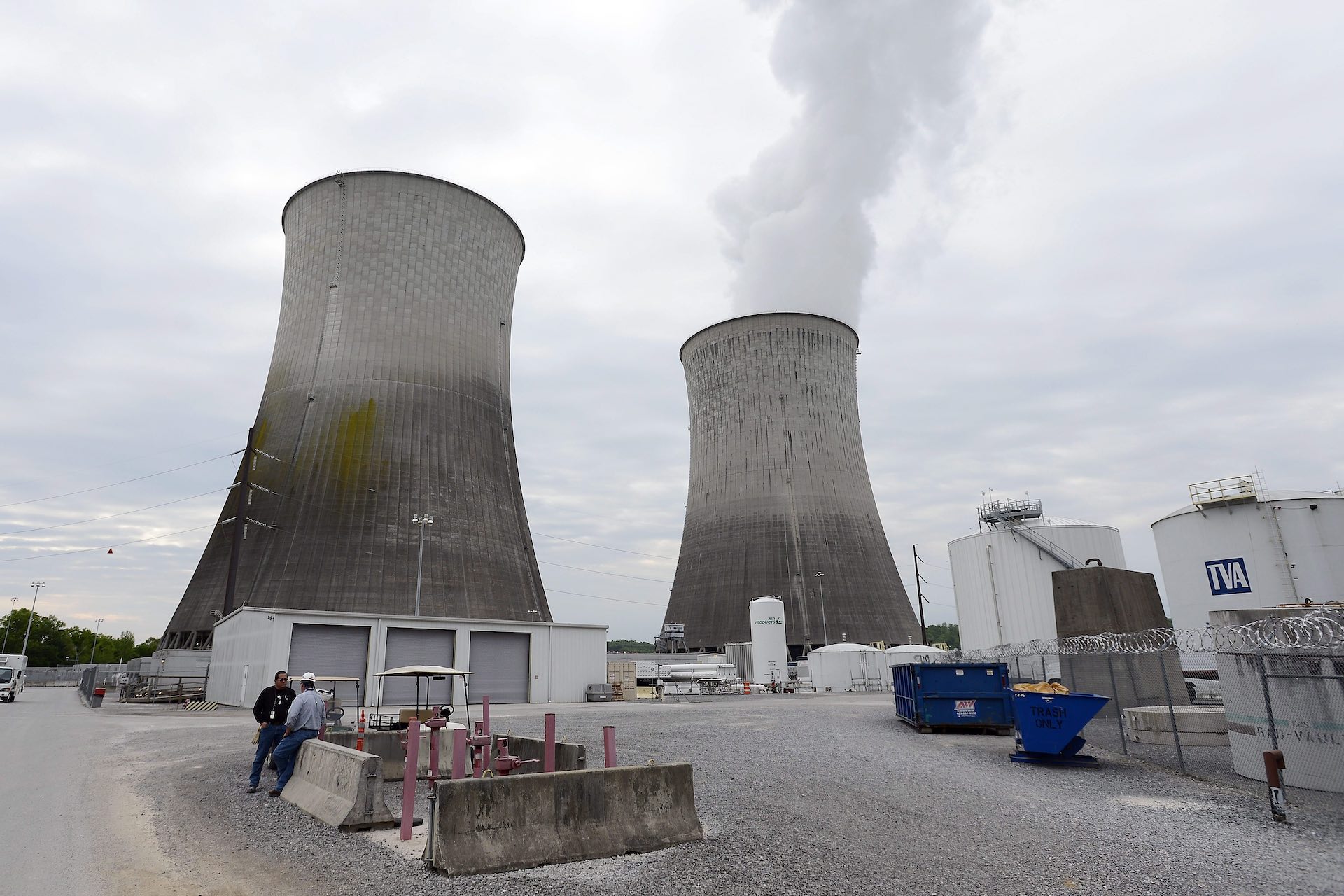
The Tennessee Valley Authority's nuclear power station in Watts Bar, Tenn., in April 2015. The plant produces tritium particles using special rods made by Westinghouse Electric Co. Photo: The Associated Press/Mark Zaleski
Brookfield’s controlling interest in Westinghouse Electric Co., a global nuclear energy giant and a key symbol of its push into renewables, has landed the asset manager on blacklists at several ESG-minded investment funds because of Westinghouse’s role in sustaining the American nuclear weapons arsenal.
Brookfield has promoted nuclear power as a clean alternative to fossil fuels as it aims for net-zero greenhouse gas emissions in its portfolio by 2050, and cut emissions by 50 per cent by 2030. It routinely touts Westinghouse Electric, which it acquired in 2018, as the crown jewel in its renewable energy portfolio. It singled out the asset in a recent financial report for helping boost funds from operations in its Brookfield Renewable Partners business year over year from US$10 million to US$42 million.
Talking Points
- When Brookfield bought U.S. nuclear company Westinghouse in 2018, it acquired a major global player in civilian energy—and a critical supplier for the United States’s atomic arsenal
- Some European investment funds have put Brookfield, or some of its affiliates, on their “exclusion lists” of companies with which they won’t do business, as a result
Westinghouse was once part of a vast U.S. manufacturing conglomerate built around electrical products, including pioneering nuclear designs. Its atomic technology is in hundreds of nuclear power plants around the world. Less known is the company’s status as a contributor to the United States’ production of tritium, a critical element in U.S. missiles and bombs.
The company manufactures special rods that, when irradiated in nuclear energy reactors operated by the Tennessee Valley Authority (TVA), emit tritium gas used in the American arsenal. The supply chain, dating to the early 2000s, had Westinghouse’s production built in from the start. The system was the result of a major U.S. government process for deciding how to get more tritium after it stopped making its own in 1988.
That work means Westinghouse’s Canadian parent, which says it manages US$1 trillion in assets, sits on some investors’ environmental, social and governance (ESG) “exclusion lists” alongside pornographers, tobacco vendors, coal and oilsands companies and makers of cluster munitions and landmines.
Luxembourg’s public pension fund, the Caisse nationale d’assurance pension (CNAP), has Brookfield Renewable Partners on its exclusion list for involvement with “controversial weapons.”
Related Articles

The problem they have with Brookfield is “its ownership in company Westinghouse Electric Co., considered to support the nuclear weapons program of the United States,” CNAP spokesperson Sarah Encarnacao wrote in an email.
Luxembourg is small and so is its pension fund; CNAP had about €26 billion in its reserves at the end of last year. But Brookfield or its affiliates are also on exclusion lists with Finland’s Nordea (a financial services group with assets under management of €400 billion, which puts it in the same league as the Canada Pension Plan), Norway’s Storebrand (a financial services group with assets of C$165 billion), Denmark’s Laerenes Pension and Sweden’s Skandia, all regarding Brookfield’s involvement with weapons.
“Brookfield has no investments related to nuclear weapons manufacturing or involved in the nuclear weapons supply chain,” its managing director communications for renewable power and transition, Simon Maine, wrote in an initial email to The Logic. “We have sought to correct external groups who have erroneously made this claim.”
After being presented with public material from Westinghouse itself and U.S. authorities, outlining the source of the nuclear arsenal’s tritium, Maine agreed that “Westinghouse produces components for a commercial nuclear plant owned by the TVA,” but said it “has no contractual involvement with nuclear weapons.”
Westinghouse itself “does not produce tritium or use it in any commercial product,” he added.
Maine said Brookfield hasn’t felt a noticeable hit from the European firms’ exclusions, while Nourhane ElGarhy, director at Montreal-based sustainable finance consulting firm Millani, noted it can take a throng of large investors for blacklists to have a meaningful impact.
Still, being barred from even a handful of European pension funds could have a negative effect on Brookfield’s business, ElGarhy said. “Companies do feel the hit eventually.”
Brookfield is making an aggressive push to expand its nuclear-energy business. Last week, the firm signed an international declaration supporting the tripling of nuclear power by 2050.
Opportunities in nuclear energy also featured prominently in Brookfield’s pitch to Canadian pension plans for a $50-billion domestic investment fund. Documents obtained by The Logic mention a partnership with Westinghouse, specifically, as a potential use of the pensions’ money.
Banning companies or funds involved in the nuclear weapons supply chain isn’t uncommon, said ElGarhy, who helps large institutional investors craft ESG policies and comply with laws and standards. She said the calculus for excluding companies for social and environmental reasons varies.
The Logic did not find records of Canadian investors excluding Brookfield over its Westinghouse ownership, or for any other reason. European funds may have “more advanced exclusion strategies,” Elgarhy said. One reason is the prevalence of treaties that asset owners and managers in some of the region’s countries are obliged to respect. The Convention on Cluster Munitions is a big one; it prevents signatories from supporting the production, use and transfer of those weapons.
European firms may also be more likely to publicize the companies and funds they exclude, said ElGarhy, due to more stringent disclosure requirements.
Westinghouse’s involvement in U.S. nuclear weapons is longstanding, a bit complex, and a matter of public record. Tritium is a rare radioactive form of hydrogen that makes the boom from a nuclear weapon bigger. Though the U.S. doesn’t disclose everything about its nuclear weapons, it’s believed all of its nuclear missiles and bombs use tritium this way.
Because the stuff is radioactive, tritium gradually decays and needs to be topped off from time to time. In other words: just to keep its existing weapons, the U.S. needs tritium to keep flowing.
Brookfield’s private-equity arm bought the Westinghouse nuclear operation from Toshiba in 2018, when the nuclear company was in bankruptcy protection. In 2023, two other parts of the Brookfield empire—Brookfield Asset Management and Brookfield Renewable Partners—acquired a 51 per cent stake in Westinghouse, while Saskatchewan uranium company Cameco bought the rest.
Under Canadian control, Westinghouse is angling for a lucrative place in this country’s nuclear power plans and expanding its presence here.
Institutional investors in Canada don’t typically blacklist companies or divest assets, ElGarhy said. Instead, they try to influence portfolio firms through engagement—pressuring them to change objectionable business practices through shareholder resolutions and proxy voting, for example.
Exclusion does happen in some cases, however. The Caisse de dépôt et placement du Québec’s (CDPQ) divestment of the oil and gas sector is one high-profile example.
CDPQ was the only Canadian pension fund to respond to The Logic’s questions about their investment policies regarding nuclear weapons. Spokesperson Jean-Benoît Houde said the firm “takes human rights and ethical issues into account in its investment decisions,” as well as international laws and standards in jurisdictions where it operates.
CDPQ has no exposure to makers of cluster bombs or anti-personnel mines, in line with international conventions, Houde said, and excludes companies that manufacture certain firearms. It doesn’t have an explicit exclusion policy for nuclear weapons. Houde said it would consider investing in such companies if they have “exemplary practices and operate in well-regulated jurisdictions.”



Loading...
Thanks for sharing!
You have shared 5 articles this month and reached the maximum amount of shares available.
CloseThis account has reached its share limit.
If you would like to purchase a sharing license please contact The Logic support at [email protected].
CloseGift the full article!
You have gifted 0 article(s) this month and have 5 remaining.
Recipients will be able to read the full text of the article after submitting their email address. They will not have access to other articles or subscriber benefits.
Photo: The Associated Press/Mark Zaleski
Most Popular This Week




In-depth, agenda-setting reporting
Great journalism delivered straight to your inbox.
Commentary
Carmichael: Canadian ignorance about India is a strategic weakness
Briefing
Aritzia shares pop after earnings rise 204%
First Nation in Alberta goes to court over fast-tracked oil pipeline
Chinese EV maker Geely Auto Group to launch in Canadian market in 2027
Best business newsletter in Canada
Get up to speed in minutes with insights and analysis on the most important stories of the day, every weekday.
Exclusive events
See the bigger picture with reporters and industry experts in subscriber-exclusive events.
Membership in The Logic Council
Membership provides access to our popular Slack channel, participation in subscriber surveys and invitations to exclusive events with our journalists and special guests.





