Listen Now
0:00
Big Tech’s race to finance new data centres is driving a record boom in Canadian corporate bonds, siphoning billions of dollars from the capital pool and testing investor appetite for tech debt.
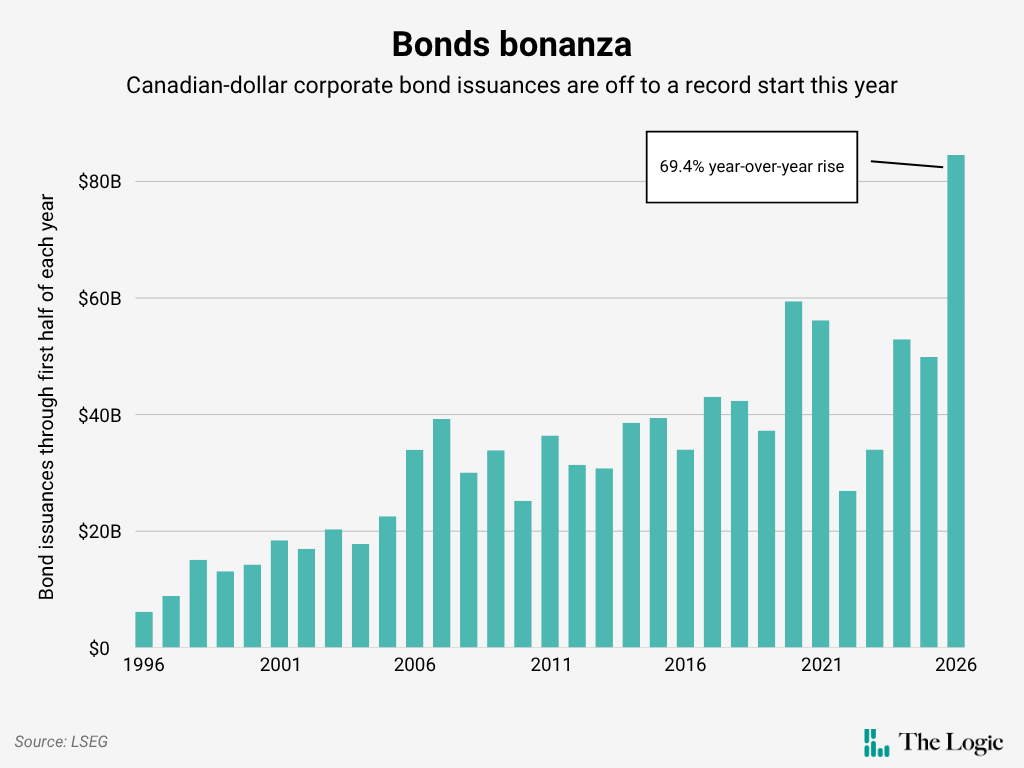
Companies issued about $84.5 billion in Canadian-dollar bonds in the first half of this year, according to LSEG data, up nearly 70 per cent from the $49.9 billion issued in the first half of 2025. Bonds let firms raise cash without taking on traditional loans or diluting their stock ownership, and many of this year’s issuers are tech companies raising Canadian dollars to fund hyperscale AI projects.
Talking Points
- Technology companies are borrowing billions of Canadian dollars to fund data-centre and AI projects, boosting the value of bonds issued this year by nearly 70 per cent
- Many on Bay Street see the more active debt market as a good way to boost the country’s profile and diversify investment options. But exhausting investor interest is a long-term concern.
Alphabet and Amazon set records with their nearly $8.5-billion and $14-billion bond issuances in May and June, respectively, accounting for 26.5 per cent of the total. Data-centre firm Equinix and telecom firms AT&T, Rogers and Bell also made blockbuster issuances.
“The scale of digital infrastructure investment right now is really, really off the charts,” said Victor Leung, sector lead of asset finance at Morningstar DBRS. Some companies may be looking north to diversify their fundraising as U.S. financial institutions “reach their limit” on exposure to one company or sector, he said.
Bonds are the latest cash cow in a data-centre spending spree that could reach US$3 trillion globally over five years, according to Moody’s, after lenders extended an estimated US$122 billion in credit on data-centre properties last year, according to S&P Global Market Intelligence.
Related Articles


TD estimates that even a small data centre requires about US$200 million. Meta will pour $13 billion into its Alberta computing hub, while financial giants like Blackstone are turning away some AI infrastructure investments due to high insurance prices.
Yet investors welcomed Amazon and Alphabet’s loonie-denominated offerings, in part because the country’s bond pool previously lacked tech exposure and was dominated by local financial and infrastructure firms, said Giampiero D’Agnillo, portfolio manager for corporate bonds at iA Financial.
RBC data shows the surge is part of a broader hot streak across the primary debt market, with a record $121.3 billion entering the domestic market in the first half of the year, up 57 per cent from the same period last year. About 30 per cent of the new activity tracked by RBC was from so-called maple bonds: loonie issuances by foreign borrowers.
Goldman Sachs, Enbridge and Ford Credit Canada were among the 18 organizations issuing at least $1 billion in new notes over the first half of the year, according to LSEG.
Big Tech’s debt binge comes at an unusual moment for Bay Street, after a 2025 policy shift opened the door to more foreign investment when the Financial Times Stock Exchange (FTSE) began including maple bonds in more indices. Both passive investors that track the index and active investors that benchmark their performance against it have followed corporate issuances more closely over the past two years.
That’s brought more liquidity to the local market, said D’Agnillo. “It really forces some investors to do their homework [on] these new names.”
Meanwhile, banks have been putting loonie bonds on clients’ radars, highlighting the deepening investor base against a backdrop of attractive interest rates and competitive spreads (what bankers call the gap between corporate and government yields).
“We will go to an Amazon, for example, and we’ll say, ‘This is what we think is the art of the possible,” said Rob Brown, co-head of Canadian debt capital markets at RBC, describing how banks help companies compare size and pricing opportunities across U.S., European and Canadian markets. RBC was one of the lenders that worked on the Amazon and Alphabet deals.
“As recently as three to five years ago, there was perhaps a perception that the Canadian market was small… that’s really changed.”
Companies have also started raising money more globally. Great-West Lifeco closed a €500-million Eurobond offering earlier this month, while Hydro One issued an inaugural US$1-billion offering in May.
Still, some domestic firms are watching the market frenzy as they prepare their own issuances, amid concerns that the megadeals will cramp pricing or demand if investors have less room in their portfolios after loading up on Amazon and Alphabet debt.
Lawyer David Seville, co-head of Torys’ capital markets practice, who works with domestic issuers, said the Canadian market has proven resilient so far, weathering tariff threats and the war in Iran.
“Lots of deal activity is a very positive thing,” he said. “The Canadian market being elevated on investors’ radars, that’s a good thing.”