OTTAWA — Despite the federal government’s major pandemic-driven investments in rebuilding Canada’s pharmaceutical industry, drug companies spent less on research in Canada in 2022 than they did the year before.
Skip to content

News
Big Pharma’s research spending in Canada declined in 2022, despite federal push
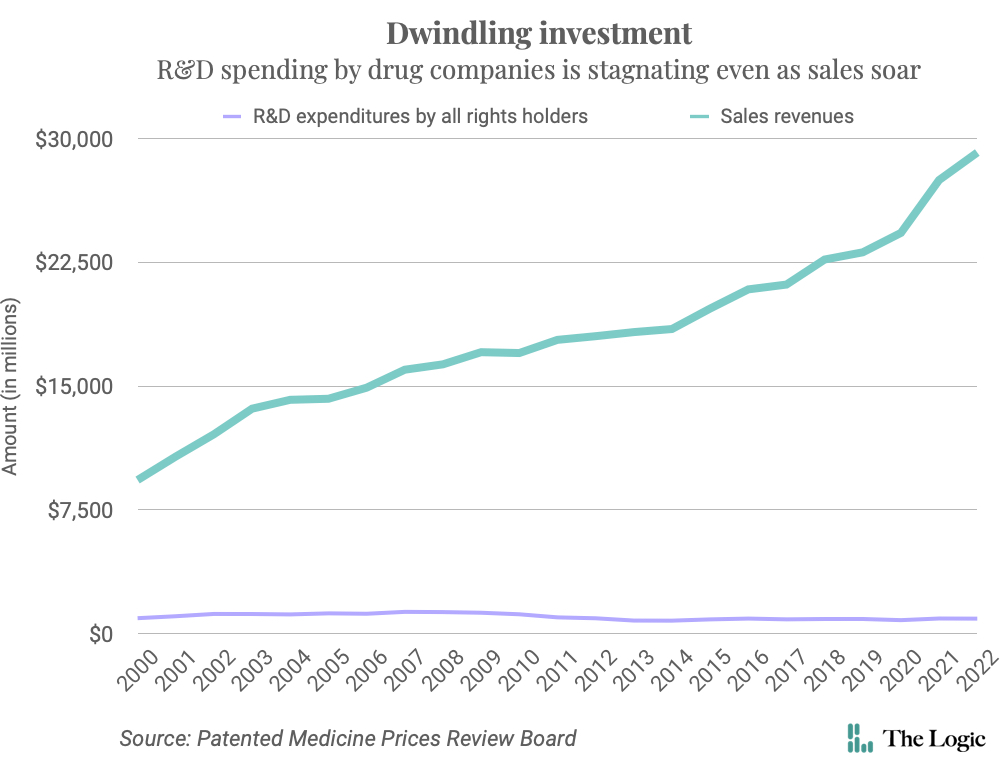
As a share of (soaring) sales, R&D investments reached a record low
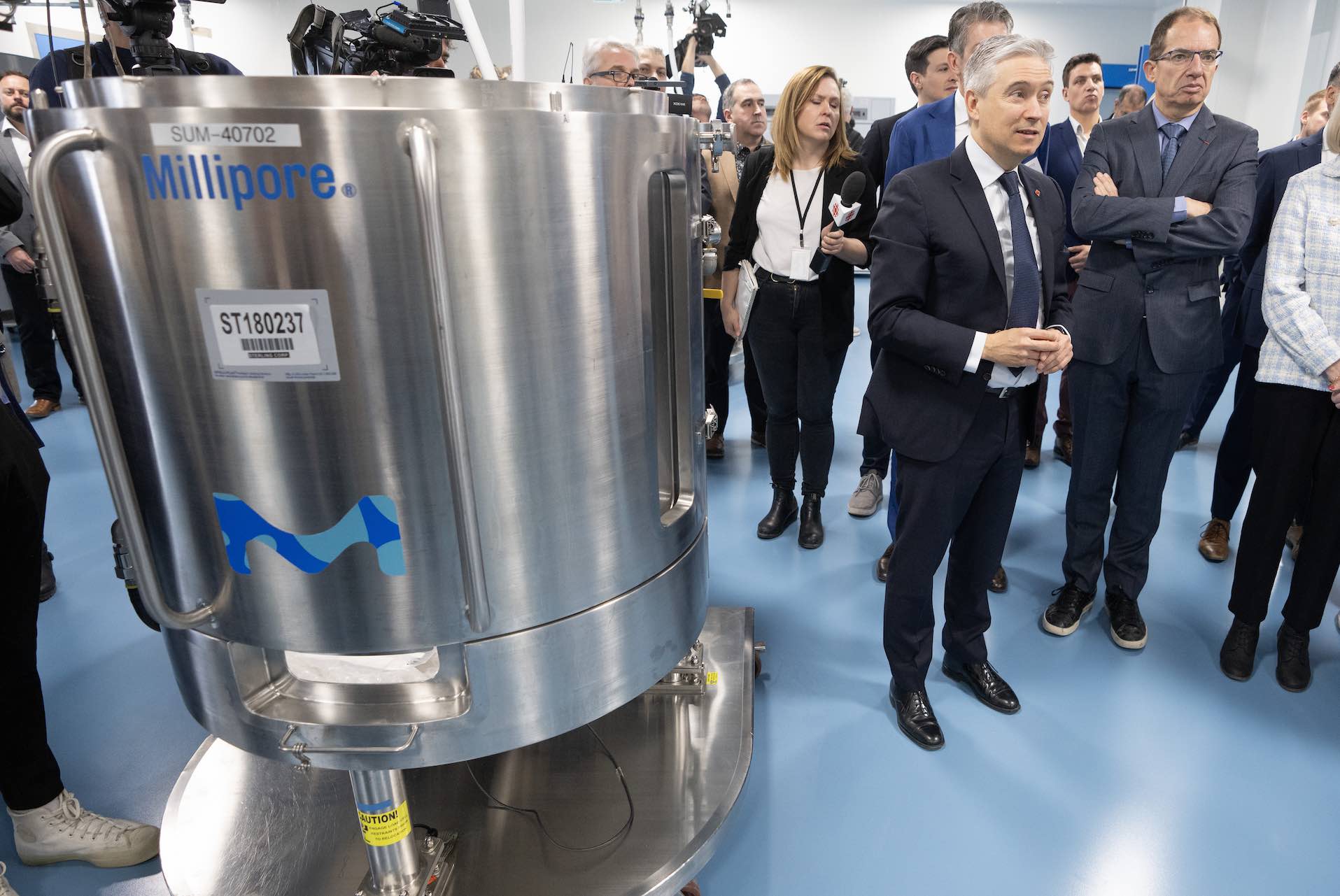
Moderna chief executive Stephane Bancel, right, and Federal Innovation Minister François-Philippe Champagne, left, tour the company's soon-to-open vaccine production facility in Laval, Que., on Feb. 23, 2024. Photo: The Canadian Press/Ryan Remiorz
OTTAWA — Despite the federal government’s major pandemic-driven investments in rebuilding Canada’s pharmaceutical industry, drug companies spent less on research in Canada in 2022 than they did the year before.
The reckoning is in the latest annual report from the Patented Medicine Prices Review Board (PMPRB), a federal agency whose job is to keep companies that hold patents on medications from using their exclusive rights to gouge patients or the health system.
Talking Points
- The federal Liberals say the billions they’ve spent to build up Canada’s pharmaceutical industry since COVID-19 hit are having an effect, even if they aren’t showing up in the numbers compiled by federal regulators yet
- The industry says Canada needs more coordinated policy and “reasonable, predictable and stable” price regulations to make pharma companies really want to work here
In raw dollars, patented-drug companies’ spending on Canadian R&D peaked at $1.325 billion in 2007 and bottomed out at $792.2 million in 2014. It reached $922.9 million in 2021 but fell again to $914 million in 2022, despite inflation.
That was just 3.1 per cent of what we spent to buy the companies’ products, down from 3.4 per cent in 2021. The ratio peaked at 11.7 per cent in 1995 and has fallen nearly every year since as drug spending has soared—surpassing $29.1 billion in 2022.
Rebuilding Canada’s capacity to develop and manufacture new drugs has been a federal preoccupation since COVID-19 struck in 2020 and the government found itself fighting to get vaccines and treatments made elsewhere. In 2021, Innovation Minister François-Philippe Champagne and then-health minister Patty Hajdu produced a strategy for boosting the life sciences and biomanufacturing industries, backed by $2.2 billion in that year’s budget.
The strategy focused on vaccines, given the time when it was written, but it was also meant to look beyond the crisis, with support for every part of drug creation from basic research through manufacturing.
The government made a deal with Moderna to build its first factory outside the United States; major construction on the building in suburban Montreal finished last week. It sank hundreds of millions of dollars into a new Sanofi flu-vaccine plant and tens of millions into BioVectra facilities in Atlantic Canada. It built a $126-million vaccine plant in Montreal for the National Research Council.
Those are just highlights; the Strategic Innovation Fund—a marquee program but far from the government’s only one—lists 28 federal investments in life sciences and biomanufacturing projects. Much of that funding has been for manufacturing, though the idea has been that researching new drugs in Canada will be more appealing if it’s possible to make them here, too.
Related Articles
(The government also gave $173 million in SIF money to Quebec City’s Medicago, which had a COVID-19 vaccine candidate in the works in 2020; that investment proved to be a lowlight.)
The federal spending has slowed—drawing some criticism—but not stopped. If results are not visible in the research spending figures, said Andréa Daigle, a spokesperson for the Innovation Department, they’re just not showing up yet: “As investments in new facilities and capacity come online, they will enable R&D activities in the years to come,” she wrote in an email.
Research by early-stage pharma companies that don’t have patented products yet isn’t included in the board’s reckoning, nor is work by those that only manufacture patented drugs for others, she added. Plus, a year ago, AstraZeneca announced it would add 500 researchers to its labs in Mississauga, Ont.
The life-sciences strategy is starting to work, wrote a spokesperson for Health Minister Mark Holland, in a separate statement.
“The federal government’s overall pharmaceutical policy includes supporting the pharmaceutical sector in Canada through investments in the federal Biomanufacturing and Life Sciences Strategy of $2.2 billion, including $250 million for the Clinical Trials Fund led by the Canada Institutes of Health Research that is intended to reinforce Canada’s clinical trials infrastructure, training, and research,” Christopher Aoun wrote.
Canada needs to approve new medicines faster and regulate maximum prices in a “reasonable, predictable and stable” way.
“Thanks to these efforts, Canada has attracted major investments from leading global companies, such as Moderna, Sanofi, and AstraZeneca, including its $500-million investment in February 2023.”
Innovative Medicines Canada, the industry group that represents most of the drug companies that hold patents here, has also long disputed the price review board’s definition of research and development spending, arguing it should take into account pharma companies’ work with hospitals and universities and investments in startups.
Although the federal government’s spending “sends an encouraging signal to industry that the federal government recognizes the importance of the life sciences sector,” it’s not enough, the group’s interim president David Renwick told The Logic.
To be a more attractive place to develop drugs, Renwick wrote, Canada needs to approve new medicines faster and regulate maximum prices in a “reasonable, predictable and stable” way.
The PMPRB said soaring drug costs are driven by sales of more expensive medications: In 2013 the median cost of a year’s supply of the 20 top-selling medicines was $803; in 2022, it was $21,345.
Figures from pharma consulting and analytics firm IQVIA showed double-digit increases in sales of drugs for cancer and diabetes, and immunologic agents (a category that includes vaccines, treatments for autoimmune disorders and medications to keep transplant recipients’ bodies from rejecting new organs). In its list of the top 10 drug categories by sales, only purchases of arthritis drugs decreased in 2022—by 0.6 per cent.
The board is in a years-long drama over how to rein in drug costs. A roundtable consultation in December led to inconclusive arguments over questions as basic as whether the PMPRB should compare Canadian prices to the highest or median prices in other countries. Innovative Medicines Canada wants the highest international price to be the benchmark, and for existing drugs to not be re-reviewed under any new rules.
The federal government has an advisory council on its biosciences strategy—a panel of academic and industry scientists, plus a couple of former pharma executives and venture capitalists from Lumira and TwinRiver. Renwick argued the council ought to include top officials from federal departments and provincial governments and current CEOs, to make sure the strategy isn’t “undermined by decisions made elsewhere in the regulatory or policy environment.”



Loading...
Thanks for sharing!
You have shared 5 articles this month and reached the maximum amount of shares available.
CloseThis account has reached its share limit.
If you would like to purchase a sharing license please contact The Logic support at [email protected].
CloseGift the full article!
You have gifted 0 article(s) this month and have 5 remaining.
Recipients will be able to read the full text of the article after submitting their email address. They will not have access to other articles or subscriber benefits.
Photo: The Canadian Press/Ryan Remiorz
Most Popular This Week




In-depth, agenda-setting reporting
Great journalism delivered straight to your inbox.
The Big Read
Alberta’s referendum is just the start of the turmoil
Briefing
EverWind plans $10B data centre and wind development in Nova Scotia
Canada ready to force Stelco to sell its Canadian operations, Joly says
Feds plan a 60 MW defence-oriented data centre for Ottawa
Best business newsletter in Canada
Get up to speed in minutes with insights and analysis on the most important stories of the day, every weekday.
Exclusive events
See the bigger picture with reporters and industry experts in subscriber-exclusive events.
Membership in The Logic Council
Membership provides access to our popular Slack channel, participation in subscriber surveys and invitations to exclusive events with our journalists and special guests.






