Listen Now
0:00
The Canadian economy is lurching and sputtering but it’ll be OK if it’s left alone, the Bank of Canada said in explaining its governing council’s decision to keep holding its market-setting interest rate steady at 2.25 per cent.
“After a year of weakness, Canada’s economy is showing signs of improvement,” the bank said in its new monetary policy report, its periodic assessment of the economy and forecast of what’s to come. “Growth is expected to pick up, and inflation eases gradually from its recent peak.”
That expectation about inflation—that is, increases in prices that reflect no growth in national wealth—assumes that the U.S.’s war on Iran doesn’t lead to sustained high oil prices and that President Donald Trump doesn’t throw up new trade barriers. But so far, in the bank’s view, so good.
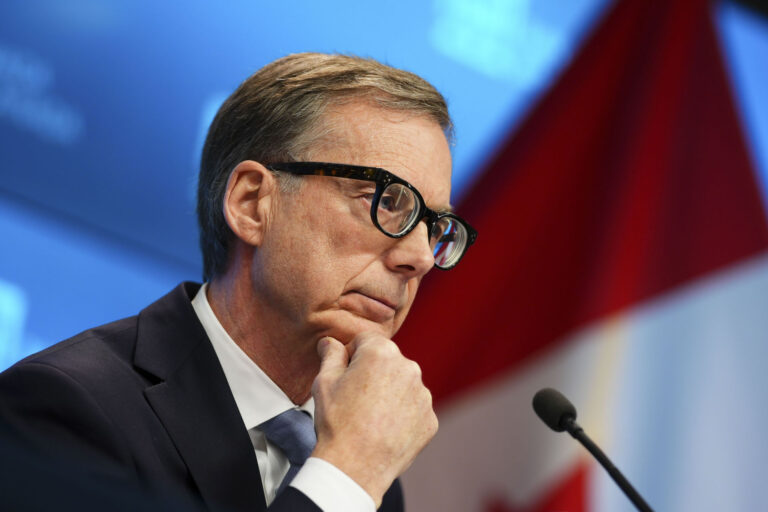
“The data we have received since April have increased our confidence that the economy is indeed working its way through this period of global upheaval,” Bank of Canada governor Tiff Macklem said in a prepared explanation of the decision.
In a news conference, Macklem noted a mismatch between what corporate leaders say about the economy and what they’re planning to do in their own businesses.
“When you look at the data we have, when you look at our business surveys… the overall index isn’t very optimistic,” he said. “But if you look at the subcomponents, you look at what companies are telling you about their plans, you can see more optimism going forward.”
Related Articles

Worried about the war but not acting yet
In June, when the bank also left its key interest rate unchanged, it warned that it was watching the effects of the war carefully.
Higher fuel prices were to be expected, in the circumstances, but if those started pushing other prices up, “we will not let their effects become broad-based persistent inflation,” the bank warned. In other words, it would raise interest rates.
New readings of the inflation rate in May did come in higher than the bank would like—the consumer price index increased 3.2 per cent from the previous May, well above the bank’s target of two per cent—but much of that was directly attributable to higher prices for gasoline and jet fuel.
“This suggests that, so far, spillovers to the prices of other goods and services remain contained,” the bank’s latest analysis says.
Back in April, the last time the bank publicly took stock of the economy as a whole, the benchmark price of Brent crude oil was over US$100 a barrel and the bank projected it would average US$90 in the second quarter.
Despite the on-again-off-again closures of the Strait of Hormuz, Brent crude has been down around US$80 a barrel lately, though the price was climbing again Wednesday after renewed hostilities between the U.S. and Iran all but blocked shipping traffic.
Even putting energy aside, physical goods have become more expensive, but lower-than-average price increases for services have moderated the overall effect, the analysis says.
An economy with room to grow
If anything, excess supply is a bigger problem for the Canadian economy than excess demand, in the bank’s view. Excess demand, when more buyers are chasing the same goods and services, drives inflation.
The unemployment rate—hovering between 6.5 and 7 per cent—isn’t great but suggests there’s no shortage of workers, which would drive up wages without gains in production. In surveys, businesses generally report that they could meet increased demand for their products and services without too much trouble.
Capricious U.S. trade policies and the international responses to them are hurting (“investment
remains on a lower path than it was before U.S. tariffs were imposed,” the bank says) but firms are adapting.
Uncertainty remains high
The monetary policy report uses words like “choppy” and “uneven” to describe many parts of the economy, and observes that conditions vary from region to region and industry to industry. Global conditions are weird and unpredictable.
“If cost increases and their pass-through are larger than expected or the economy recovers faster than expected, inflationary pressures will increase,” Macklem said in his statement. “On the other hand, there’s a risk that the second-quarter pickup in growth is not sustained. The recovery in exports could stall, which would likely weigh on business investment and hiring. A weaker economy would put more downward pressure on inflation.”
Anything could happen, in other words. In the face of all that, the bank’s power to influence the cost of borrowing is both mighty and imprecise. Its governing council has decided not to apply it, for now.