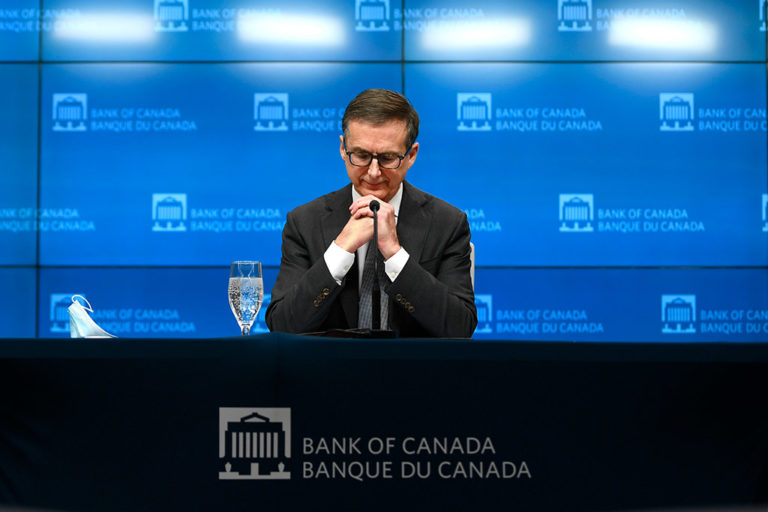
The Bank of Canada opted to leave its benchmark interest rate at five per cent and released updated forecasts that predict Canada will avoid a recession, despite one the most aggressive series of interest-rate increases in history.
However, the headline Wednesday was that governor Tiff Macklem all but confirmed that borrowing costs have peaked and the next move by the central bank will be a cut. Here’s what you need to know:
A soft landing is still a landing: The goal of central banks was to throttle demand and they have succeeded at doing that. The Bank of Canada cut its estimate of economic growth in the fourth quarter of 2023 to an annualized rate of zero, from its previous estimate of 0.8 per cent, and predicted the economy will grow at a rate of only 0.5 per cent this quarter. “Economic growth stalled in the middle of 2023,” Macklem said in a statement. “For many Canadians, the combination of higher prices and higher interest rates has been difficult.” For all of 2024, the central bank projects gross domestic product will increase 0.8 per cent, down from one per cent in 2023 and 3.8 per cent in 2022. So, no recession, but it might feel like one.
Why cuts are coming: Inflation was sparked by supply constraints related to the pandemic. Prices really took off when the economy recovered from COVID-19 lockdowns before supply bottlenecks cleared, leading to what the Bank of Canada calls “excess demand.” As growth slowed, demand and supply returned to balance. The balance has shifted again, but in the other direction. The central bank said in its policy statement that the economy probably now is operating in “modest excess supply.” That’s putting downward pressure on inflation and opens the door to rate cuts.
Timing is everything: Macklem said it’s still too soon to drop interest rates. The measures of inflation that the central bank watches to predict whether it’s on track to hit its target remain hotter than policymakers would like. But the governor sounded confident that things are moving in the right direction. “With overall demand in the economy no longer running ahead of supply, Governing Council’s discussion of monetary policy is shifting from whether our policy rate is restrictive enough to restore price stability, to how long it needs to stay at the current level.” In other words, policymakers are thinking about thinking about cutting rates.
Home economics: The most difficult call Macklem and his deputies will have to make is whether high-for-longer rates will have a material effect on shelter costs, which have become the main driver of inflation. Housing prices have moderated, but rent and mortgage costs have continued to climb higher. Rent inflation is the result of an extreme mismatch between a chronic lack of supply and immigration-fuelled demand, representing a structural issue that monetary policy can’t fix. Lower interest rates would ease mortgage costs, but policymakers would have to be confident that they’ve doused all the hot spots on their cost-of-living heat map.
Bottom line: Macklem insisted that he hasn’t ruled out more interest-rate increases, but that’s a hedge against inflation risks such as higher shipping costs because of conflict in the Middle East. When policymakers next gather in March, they will spend much of the time debating when they should cut interest rates. They won’t have enough evidence that they’ve beaten inflation by then to pivot at that meeting, but they might by April or June. “We don’t want to cool the economy more than necessary,” Macklem said. Monetary policy changes need more than a year to show up in the economy. If the central bank waits too long to start cutting rates, the soft landing could become a hard one.