The line of people waiting for admission to an Elevate Festival talk about how to sell Canadian AI technology snaked down a corridor in the basement of Toronto’s Meridian Hall Wednesday.
The glass-walled room hosting the panel, featuring representatives from three Canadian tech companies and MaRS Discovery District chief delivery officer Krista Jones, eventually reached capacity. Festival representatives started turning people away, causing one man to mutter that the experience was like trying to get into a Rolling Stones concert.
Chalk it up to AI mania. This year’s hottest technology is featured on our televisions, in our dinner table conversations and in the fired-up imaginations of the country’s tech workers.
“AI is the topic this year, the topic du jour,” said Jeff Ward, founder and chief executive of Victoria-based Indigenous technology company Animikii, in an interview with The Logic. “It’s overhyped and underhyped at the same time.”
While the overall mood at Elevate was more sombre than usual this week, amid an uncertain economy, an affordability crisis and tough times for raising capital, the AI boom that kicked off last November with the launch of ChatGPT offered a glimmer of hope—and accompanying anxiety. At sessions throughout the conference, speakers discussed what have now become familiar themes—the technology’s potential to radically improve human life and corporate bottom lines, as well as concerns that ranged from AI’s environmental impact to its dystopian potential.
Gillian Hadfield, director of the Schwartz Reisman Institute at the University of Toronto, said she’s started incorporating a slide into her talks that displays the date Nov. 30, 2022—the launch date of ChatGPT, an artificial intelligence chatbot from San Francisco startup OpenAI that can write code, pen poetry, pass legal exams and facilitate medical diagnoses.
“There’s before and after,” she said. “The whole conversation that I’ve seen in the policy domain has shifted.”
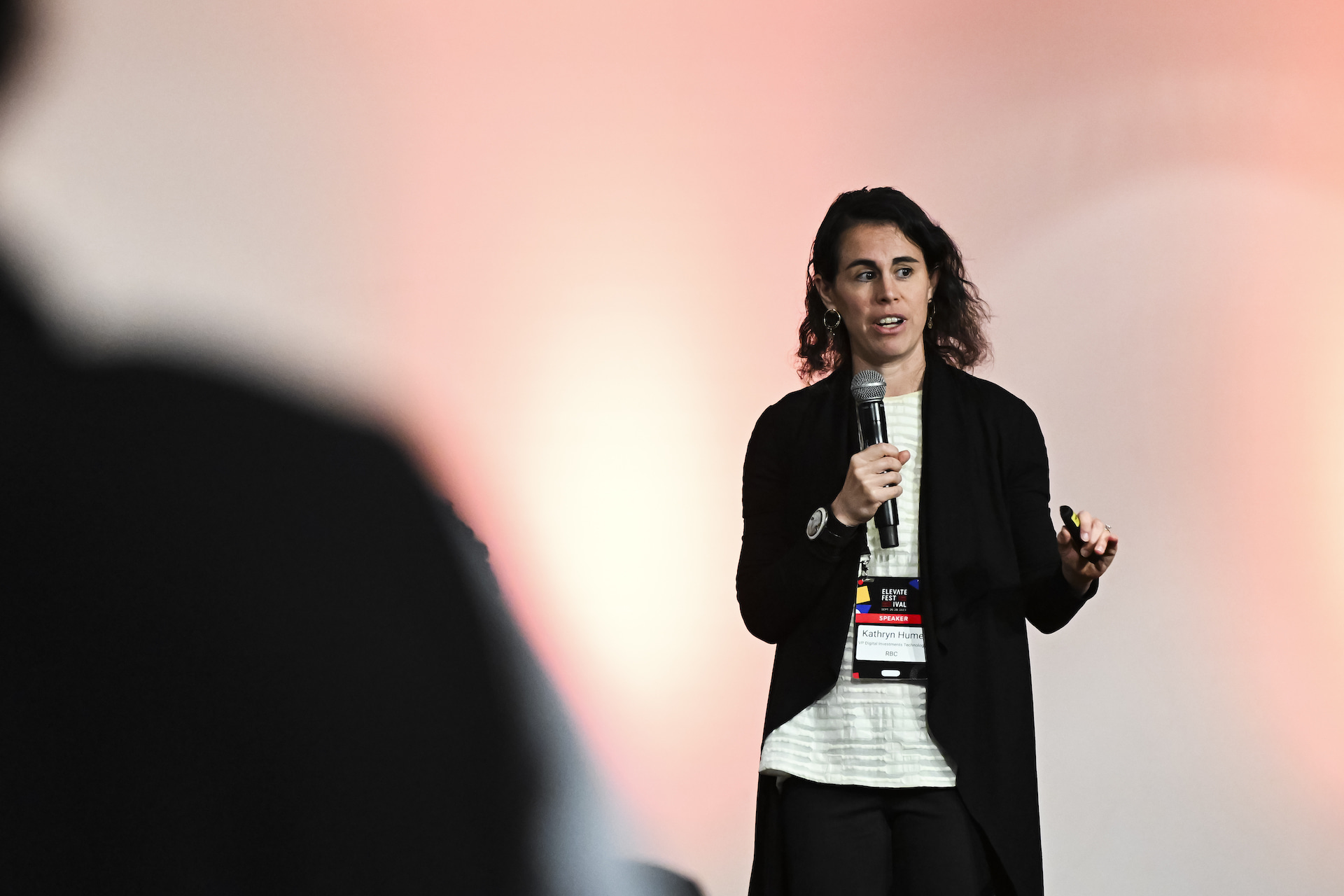
ChatGPT sparked an AI race among tech giants, as well as Canadian businesses big and small. Kathryn Hume, vice-president of digital investments technology at RBC, listed generative AI alongside other high-level concerns including technological disruption and climate change in a Thursday talk. “You’re always talking about how to change,” she said.
Canada is grappling with how to balance encouraging AI innovation and protecting the public from potential harms. At All In, a separate conference devoted to AI taking place in Montreal at the same time as Elevate, the federal government unveiled a voluntary code of conduct, which major Canadian AI firms Cohere, Coveo and Ada signed.
The world may be further from welcoming our robot overlords than some would have us believe, however. David Usher, the lead singer of the Canadian rock band Moist best known for its ’90s hits, struggled to get an AI-based video art installation called This Alien Heart to respond to his questions onstage in a timely manner.
“You’re broken. Are you still there?” Usher said. “I’m here. I was just daydreaming,” the alien heart responded by way of explanation.
Usher’s demonstration ended and the parade of speakers marched on. We don’t know what the AIs are daydreaming about, but Canada’s tech sector is certainly dreaming big about them.