Skip to content

Canada's Business and Tech Newsroom

  • Professional Subscription
  • Partnerships & Advertising
  • Licensing & Syndication
Log In Subscribe
Welcome,
  • My Account
  • Log Out
  • Business
  • Tech
  • National
  • The Big Read
  • Briefings
  • Commentary
Search
Log In Subscribe
Welcome,
  • My Account
  • Log Out
Analysis

Canada dodged a K-shaped economy. A growing wealth gap could change that

Listen Now
0:00
Analysis

Canada dodged a K-shaped economy. A growing wealth gap could change that

A split is emerging as younger Canadians build wealth in equity markets while older generations remain exposed to housing risks

By Chaimae Chouiekh
A woman stands with her back facing the camera pushing a grocery cart in an aisle of pasta sauce and canned goods. She wears a black coat and brown boots.
Canada’s income gap widened to 47.5 percentage points in the third quarter last year from the same period a year earlier, according to Statistics Canada data. Photo: The Canadian Press/Cole Burston
Feb 12, 2026
A A
A Small A Medium A Large
Share

Gift

Share

Listen Now
0:00

Canada’s income and wealth gaps reached new highs in the third quarter of last year, Statistics Canada data shows. While economists say the country has yet to slip into a K-shaped economy, they warn a widening class divide could have longer-term economic and political consequences.

The income gap widened to 47.5 percentage points—its highest level since 2010—driven largely by weak wage growth for low-income households. Meanwhile, recent interest rate cuts reduced that group’s savings by 21 per cent, while their average disposable income fell 0.5 per cent from a year earlier, according to Statistics Canada figures.

Talking Points

  • Canada’s income gap widened to 47.5 percentage points in the third quarter last year from the same period a year earlier—its biggest divide since 2010, according to Statistics Canada data
  • Between 2024 and 2025, Canada’s 40 richest billionaires grew their wealth by more than 20 per cent to almost $95 billion, a recent report by Oxfam Canada shows

In contrast, the richest Canadians saw their incomes grow 4.3 per cent from a year earlier, thanks to higher wages, including from self-employment. They were also the only group to post investment gains, the agency’s data shows.

That growing class divergence mirrors the “K-shaped” economy, a term popularized during the pandemic to describe widening income disparities in the U.S. The upper arm of the “K” represents higher-income households whose wealth has grown, while the lower arm reflects lower-income groups’ struggle with stagnant wages and steep prices.

Related Articles

A shot from behind of a shopper in winter clothing looking at the meat shelves in a supermarket.

Carmichael: The cost of living crisis is about feelings, not facts

By Kevin Carmichael
A man and woman, both apparently seniors, doing tai chi under the beams of a shelter, against a backdrop of autumnal leaves.

Carmichael: Canadians are living longer, and there are ways to make that pay

By Kevin Carmichael

Economists broadly agree that Canada has so far avoided such a split. One key reason has been the steady increase in consumer spending across all income groups over the past few years, CIBC senior economist Andrew Grantham said in a note to clients last month.

However, different forces are sustaining that spending resilience. The poorest households have been dipping into their savings to cover daily expenses, while the richest Canadians—who hold less wealth and income than their U.S. counterparts—have remained cautious, Grantham said in the report.

Recent interest rate cuts, personal income tax reductions and a surge in the Buy Canadian sentiment have helped keep “some spending in the country,” Douglas Porter, chief economist at BMO, wrote in a report.
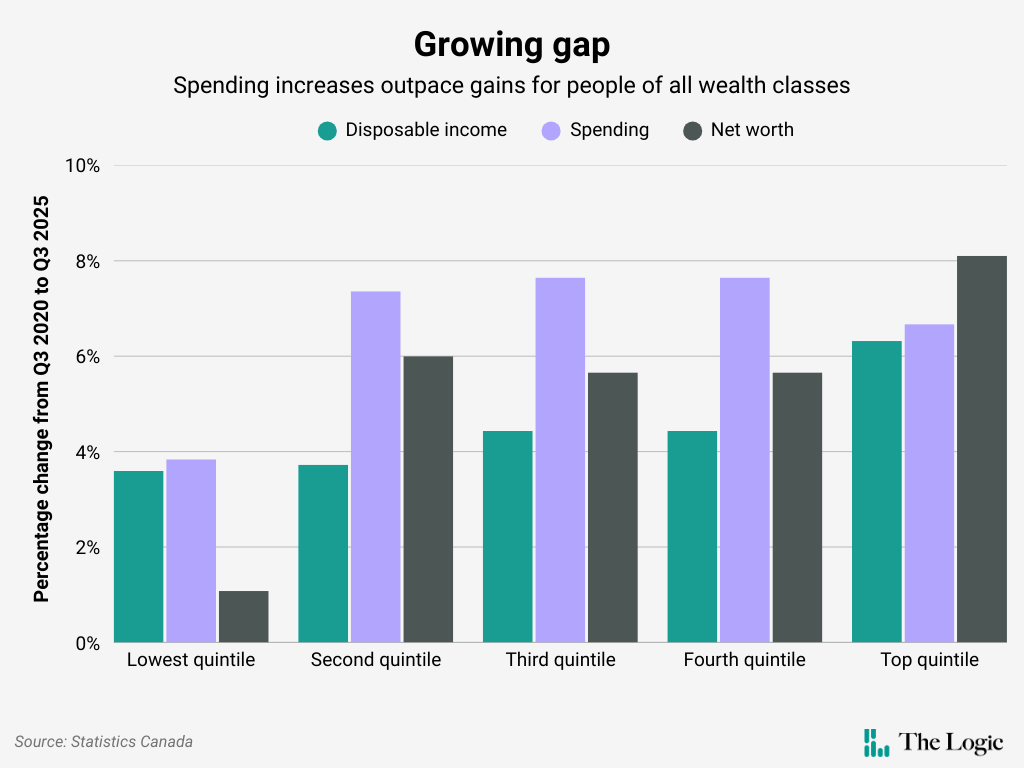
Chart with the headline "Growing gap" and the subheading "Spending increases outpace gains for people of all wealth classes." It shows the percentage change in disposable income, spending, and net worth for each quintile of wealth from Q3 2020 to Q3 2025. The lowest quintile saw nearly 4% growth in disposable income and spending, but about 1% growth in net worth. The top quintile saw a little over 6% growth in disposable income and spending, but over 8% growth in net worth. In the top and bottom bands, spending grew slightly faster than disposable income. In the three middle bands, disposable income grew in the neighbourhood of 4%, while spending grew closer to 7%.

Canada’s social safety net and progressive system of wealth redistribution have also helped blunt a sharper divide, said Rebekah Young, vice-president of inclusion and resilience economics at Scotiabank. 

“That gap has just widened further as the U.S. has rolled back [progressive] measures,” Young said. “The inequality arguments are far less pronounced in Canada than the U.S.”

But Dan Ciuriak, a fellow at the C.D. Howe Institute and former deputy chief economist at Global Affairs Canada, warned that the foundations of a K-shaped economy may already be forming beneath the surface. 

Canada could feel a “sympathetic echo” of the U.S. economy, he warned, where tech-driven sectors lift wealth at the top while more workers face unstable economic conditions.

That risk is evident in the country’s widening wealth divide, measured as net worth, or the total value of financial and non-financial assets like pensions, insurance and real estate, minus debts.

In the third quarter of last year, that gap widened to 62.4 percentage points, with households in the top 20 per cent holding 65.5 per cent of Canada’s total net worth—or an average of $3.5 million per household. The bottom 40 per cent, meanwhile, controlled just 3.1 per cent, or about $82,100 per household, according to Statistics Canada data.

The figures also point to a generational split. Households aged 35 and under saw the fastest gains of any age group, buoyed by strong equity market returns.

But that momentum may not last forever. “Financial markets are cyclical,” Young warned, noting that recent gains have been largely driven by rallies tied to the AI boom.

Meanwhile, older and lower-wealth Canadians remain heavily dependent on the housing market. Ciuriak said real estate has historically been their main source of wealth, leaving them with limited flexibility to invest in financial markets.

“As a country, I think that’s something we have to think about,” Young said. “How do we keep Canadians adequately sheltered without seeing housing primarily as a capital accumulation vehicle?”
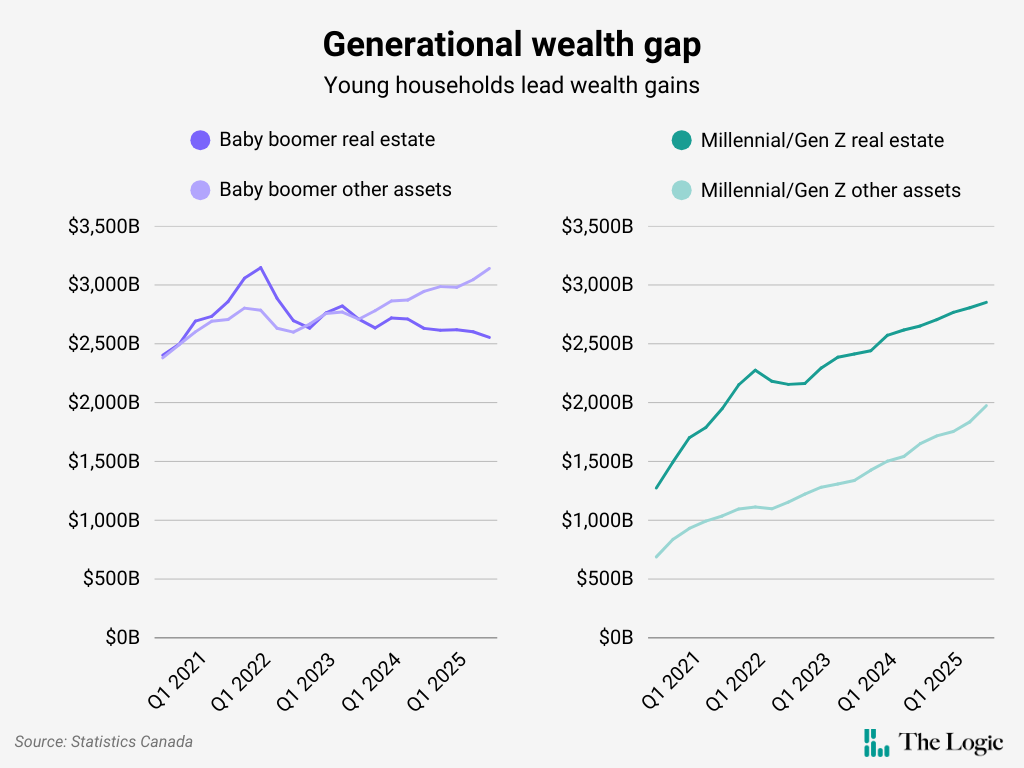
Two line graphs side-by-side under the headline "Generational wealth gap" with the subheading "Young households lead wealth gains." The first chart shows real estate holdings and other financial assets of baby boomers, with both starting a little under $2,500 billion in late 2020. By late 2025, real estate holdings were $2,554 billion while other financial assets were a little over $3,140 billion. The second chart shows Millennial and Gen Z real estate holdings going from $1,275 billion to nearly $2,851 billion over the five-year period, while other financial assets rose from $688 billion to $1,900 billion.

Between 2024 and 2025, Canada’s richest 40 billionaires grew their wealth by almost $95 billion, or more than 20 per cent, according to a recent Oxfam Canada report. 

The growing gulf between the ultra-rich and the rest of the country could have significant consequences, economists told The Logic. 

Although several affordability measures have been rolled out since Prime Minister Mark Carney’s election, Ciuriak described them as a “band-aid” fix, arguing they do little to address the structural drivers of economic inequality.

Instead, he said, the problem lies within the country’s tax system. With wages making up a shrinking share of national income, relying on labour taxes to fund public services is no longer sustainable, Ciuriak argued, saying Ottawa should ultimately shift more of the burden onto capital taxes.

Without deeper reforms, Ciuriak warned, mounting economic strain could spill into political instability. 

Gift the full article

“You [will] see an erosion of the tax base based on wage income, which undermines the provision of social services, which undermines the legitimacy of democratic governments, which drives populists,” he said.

Young said the federal government’s recent focus on boosting productivity and expanding employment opportunities across sectors could help narrow disparities, but that such a strategy may take years to produce tangible results.


#Business #economy #income #wealth #Wealth gap

Loading...

Thanks for sharing!

You have shared 5 articles this month and reached the maximum amount of shares available.

Close
This account has reached its share limit.

If you would like to purchase a sharing license please contact The Logic support at [email protected].

Close
Want to share this article?

Upgrade to all-access now

Close
Gift the full article!

You have gifted 0 article(s) this month and have 5 remaining.

Copy link and gift
Copy Link
Email to a friend
Send Email
Gift on Social Media

Recipients will be able to read the full text of the article after submitting their email address. They will not have access to other articles or subscriber benefits.

A woman stands with her back facing the camera pushing a grocery cart in an aisle of pasta sauce and canned goods. She wears a black coat and brown boots.

Photo: The Canadian Press/Cole Burston

Chart with the headline "Growing gap" and the subheading "Spending increases outpace gains for people of all wealth classes." It shows the percentage change in disposable income, spending, and net worth for each quintile of wealth from Q3 2020 to Q3 2025. The lowest quintile saw nearly 4% growth in disposable income and spending, but about 1% growth in net worth. The top quintile saw a little over 6% growth in disposable income and spending, but over 8% growth in net worth. In the top and bottom bands, spending grew slightly faster than disposable income. In the three middle bands, disposable income grew in the neighbourhood of 4%, while spending grew closer to 7%.

Two line graphs side-by-side under the headline "Generational wealth gap" with the subheading "Young households lead wealth gains." The first chart shows real estate holdings and other financial assets of baby boomers, with both starting a little under $2,500 billion in late 2020. By late 2025, real estate holdings were $2,554 billion while other financial assets were a little over $3,140 billion. The second chart shows Millennial and Gen Z real estate holdings going from $1,275 billion to nearly $2,851 billion over the five-year period, while other financial assets rose from $688 billion to $1,900 billion.

Most Popular This Week

An image of Mark Carney standing in front of a red podium with the words "AI for All / L'IA pour tous." He is wearing a suit and tie. In the background, people wearing scrubs and white coats are visible.
Special Report

Canada’s new AI strategy sets lofty goals for adoption and growth

By Murad Hemmadi and Laura Osman
Exclusive

Canada’s new AI strategy includes $500M fund to back key firms

By Murad Hemmadi and Catherine McIntyre
The Big Read

Canada’s AI boom is about to collide with a major labour shortage

By Catherine McIntyre
A low-angle shot of a truck carrying vehicles across the bridge at the Canada-U.S. border in Sarnia, Ont. The U.S. and Canadian flags are flying in the foreground.
Analysis

Why Canada’s wait-and-see approach to U.S. trade talks just might work

By Joanna Smith

In-depth, agenda-setting reporting

Great journalism delivered straight to your inbox.

The image shows the inside of Toronto Stadium on a sunny day. The rows of seats are empty; an empty green field is visible.
News

Toronto and Vancouver aren’t getting a World Cup bookings boom

By Chaimae Chouiekh

Briefing

Beleaguered Goeasy removed from Canada’s main stock index

By Chaimae Chouiekh   |   Jun 8, 2026 | 4:04 PM ET

Manitoba judge dismisses lawsuit against Winnipeg businessman Sandy Riley

By Catherine McIntyre   |   Jun 8, 2026 | 3:57 PM ET

Ottawa piloting use of AI tool to profile prisoners

By Murad Hemmadi   |   Jun 8, 2026 | 3:52 PM ET

Best business newsletter in Canada

Get up to speed in minutes with insights and analysis on the most important stories of the day, every weekday.

Exclusive events

See the bigger picture with reporters and industry experts in subscriber-exclusive events.

Membership in The Logic Council

Membership provides access to our popular Slack channel, participation in subscriber surveys and invitations to exclusive events with our journalists and special guests.

Recent Popular Stories

News

Canada’s surprise plan to buy Saab command jets leaves competitors seeking answers

By David Reevely   |   May 29, 2026
A closeup of a scale model of a jet covered in pixellated camouflage, with sensor equipment attached to the top of its fuselage. There are civilians and uniformed military personnel milling in the background.
News

Lion Electric is back—and smaller than ever

By Martin Patriquin   |   Jun 1, 2026
Exclusive

Canada’s new AI strategy includes $500M fund to back key firms

By Murad Hemmadi and Catherine McIntyre   |   Jun 3, 2026
Analysis

Why Canada’s wait-and-see approach to U.S. trade talks just might work

By Joanna Smith   |   Jun 2, 2026
A low-angle shot of a truck carrying vehicles across the bridge at the Canada-U.S. border in Sarnia, Ont. The U.S. and Canadian flags are flying in the foreground.
The Big Read

ApplyBoard faces a reckoning as Canada’s immigration boom turns into a bust

By Claire Brownell and David Reevely   |   May 27, 2026
The Big Read

We found every data centre in Canada

By Murad Hemmadi, David Reevely, Aleksandra Sagan, Chaimae Chouiekh, Martin Patriquin and Catherine McIntyre   |   Apr 8, 2026
Four vertical slices of aerial view photos. From left, a building in downtown Toronto housing several data centres, a picture of the Albertan wilderness where the proposed Wonder Valley data centre would go, a lit-up QScale data centre in Quebec, and a data centre at a Hydro-Quebec dam.

Canada's most influential executives and policymakers are reading The Logic

  • CPP Investments
  • Sun Life Financial
  • C100
  • Amazon
  • Telus
  • Mastercard
  • bdc
  • Shopify
  • Rogers
  • RBC
  • General Motors
  • MaRS
  • Government of Canada
  • Uber
  • Loblaw Companies Limited
logic-logo

Canada's Business and Tech Newsroom

100% human-crafted journalism

Newsroom

  • News Tips
  • AI Policy
  • Editorial Disclosures
  • Story Pitches

Company

  • About Us
  • Terms of Service
  • Privacy Statement
  • Corporate Information

Contact

  • Contact Us
  • Advertise
  • FAQs
  • Work at The Logic

© 2026 The Logic Inc. All Rights Reserved.

Trusted by leaders

Error

Account creation failed.

Please email us at [email protected].

Create Account

[wppb-register form_name=”cozmo-registration-form-for-modal”]

I do have an account
Login
or

[wppb-login]

I don’t have an account