In a future of AI-assisted weather forecasting, Canada’s national meteorological service should be a key public-safety agency that pulls together masses of information to predict catastrophes, says the head of a blue-ribbon panel on the service’s future.
Skip to content
News
An AI-assisted weather service could guard Canada against disasters—and the U.S.
Owning and controlling weather data and forecasts is a crucial sovereignty issue for Canada, according to the former president of the Canadian Meteorological and Oceanographic Society. And AI could help.
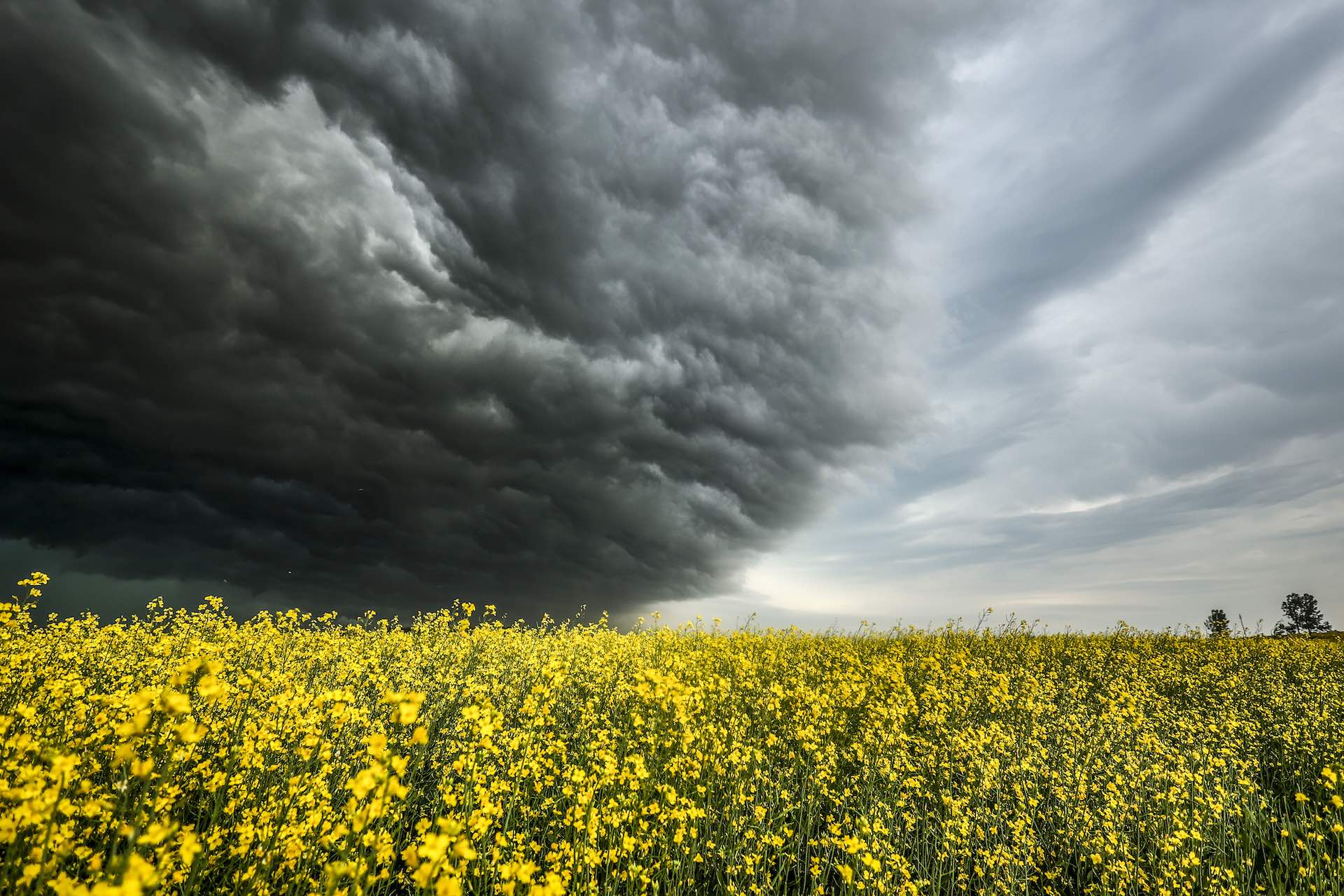
Storm clouds build over a canola field near Cremona, Alta., Friday, July 29, 2022. A new report says Canada’s national weather agency could harness AI to improve forecasts and better anticipate extreme weather and its impacts. Photo: The Canadian Press/Jeff McIntosh
In a future of AI-assisted weather forecasting, Canada’s national meteorological service should be a key public-safety agency that pulls together masses of information to predict catastrophes, says the head of a blue-ribbon panel on the service’s future.
First-rate forecasting isn’t ever going out of style, Jim Abraham said in an interview with The Logic, but it will do more to save lives, spare property and help industry if it’s linked through AI to other data.
“As populations increase, as urbanization continues to increase, as we become more vulnerable to drought or flood or what have you, this kind of information is going to become even more valuable,” Abraham said.
Talking Points
- Canada’s national weather agency can use artificial intelligence to assist its forecasting and free up resources to predict extreme conditions—and their consequences—says a new report on the future of the Meteorological Service of Canada
- Jim Abraham, past president and fellow at Canadian Meteorological and Oceanographic Society, told The Logic that doing this well will require data far beyond atmospheric conditions, including everything from hydrology to urban sewer capacity to traffic patterns
It’s one thing to predict that heavy rain is coming, but you have to combine that with how the land absorbs water and where it’ll flow if you’re going to tell people where a flood might hit. “What you need, ultimately, is to combine the meteorology with the hydrology and look at where water flows and where it collects, and ultimately see where the risks are highest. And that is ultimately the direction AI might help in,” Abraham said.
While the private sector has been quick to jump on AI weather forecasting, Environment Canada is still deciding how best to use AI in its work. It released a road map in late 2024, but still has a long way to go, in both technology and staffing, to move beyond its early days of experimenting with open-source weather models.
Now the head of climate-adaptation consulting firm ClimAction in Halifax, Abraham is a former senior executive at Environment Canada and was the president of the Canadian Meteorological and Oceanographic Society. He led a group assembled by the Council of Canadian Academies that was tasked with examining the national weather service’s future. Its report is being released today.
Related Articles

The Meteorological Service of Canada, as the government calls the weather forecasting unit (or the “Met service,” as Abraham does), is a $200-million-a-year operation with about 1,450 full-time equivalent staff. It’s contending with rapid technological advancement, a less reliable partner in the United States and hunger for detailed predictions of scary storms, floods and fires, the report finds.
The report Abraham spearheaded is cautiously optimistic about the technology’s potential. Purely AI-based tools that predict weather based on past patterns might be useful a lot of the time but they might not see calamities coming when extremes of heat or wetness are unprecedented. They can supplement more traditional physics-based weather models but not fully replace them, the report says.
Done right, though, AI-assisted predictions could cover a greater share of forecasting ordinary weather, freeing up experts and time to focus on dangerous extremes, Abraham said in the interview.
“On average, the human resources would be assigned to where the risk is highest,” he said.
Or take more workaday examples. If Abraham’s planning to drive to Sydney, N.S., from his Halifax home before Christmas, the specific conditions on the Canso Causeway (the one road link from the Nova Scotia mainland to Cape Breton) matter a lot. Elsewhere, the first centimetre of snow on Toronto does a lot more to traffic than a middling snowfall in Ottawa in January.
“What’s important in the wintertime in Canada is transportation forecasts, and nobody’s really doing them.”
Merging weather forecasts with past traffic data would give drivers better guidance than either on its own.
“What’s important in the wintertime in Canada is transportation forecasts, and nobody’s really doing them,” Abraham said.
Identifying the types of data that can usefully be combined and marshalling the diverse people and organizations that hold it all (the feds do weather forecasting but the provinces are responsible for flood preparations, for instance) requires technical knowledge and moral authority, he said. “The Met service is well positioned to do that.”
The service is adept at integrating new technology, Abraham said, but this technology—and knowing how to use it best—doesn’t come free.
“AI integration, hybrid modelling, and forecast calibration are particularly resource-intensive gaps,” the report warns.
Meanwhile, the United States is cutting its own National Oceanographic and Atmospheric Administration (NOAA), which shares data and expertise with Canada. Abraham himself learned how NOAA studies hurricanes at its National Hurricane Center in Miami as he started the Canadian version in the 1990s.
“I flew in their plane, and then I started a research program on flying into hurricanes,” he said.
He’s more worried about erosion in NOAA’s capabilities than immediate destruction, but the work it does is “the future of research. The research is the future of the business,” he said. Europe has know-how and data sources, and Canada ought to invest in co-operation across the Atlantic to make up for some of what it’s likely to lose from the south, he said.
Having its own weather data and forecasting ability is a stealth sovereignty issue for Canada, too, he said.
The weather affects waterways that Canada and the U.S. manage jointly, from Puget Sound to the St. Lawrence Seaway to rivers that empty into the Bay of Fundy, with implications for the people and industries around them. Weather also affects the ice, wildlife, infrastructure and people in the North—people who could also play bigger parts in the weather service’s work, Abraham said.
Ultimately, that’s what the review of the meteorological service is about, he said: “Coming up with collaborative approaches to work together for the benefit of the prosperity, the safety and security and the sovereignty of the country.”



Loading...
Thanks for sharing!
You have shared 5 articles this month and reached the maximum amount of shares available.
CloseThis account has reached its share limit.
If you would like to purchase a sharing license please contact The Logic support at [email protected].
CloseGift the full article!
You have gifted 0 article(s) this month and have 5 remaining.
Recipients will be able to read the full text of the article after submitting their email address. They will not have access to other articles or subscriber benefits.
Photo: The Canadian Press/Jeff McIntosh
Most Popular This Week




In-depth, agenda-setting reporting
Great journalism delivered straight to your inbox.
News
Canada faces a satellite-launch crunch as SpaceX retires its workhorse rocket
Briefing
Rio Tinto gets nearly $165M in additional federal funds for Quebec aluminum
U.S. to lift tariffs on some Canadian products crucial to Maine: Collins
Carney warns of tech dependence after Starlink disruptions in Ukraine
Best business newsletter in Canada
Get up to speed in minutes with insights and analysis on the most important stories of the day, every weekday.
Exclusive events
See the bigger picture with reporters and industry experts in subscriber-exclusive events.
Membership in The Logic Council
Membership provides access to our popular Slack channel, participation in subscriber surveys and invitations to exclusive events with our journalists and special guests.






