OTTAWA — Companies in the business of forecasting the weather are using artificial intelligence to make predictions quicker and more accurately, a valuable service for clients whose fortunes depend on if it rains or shines.
Skip to content

News
AI is making weather forecasts more accurate than ever
Companies are using deep learning to generate longer-term predictions faster, a valuable service for businesses grappling with increasingly extreme weather
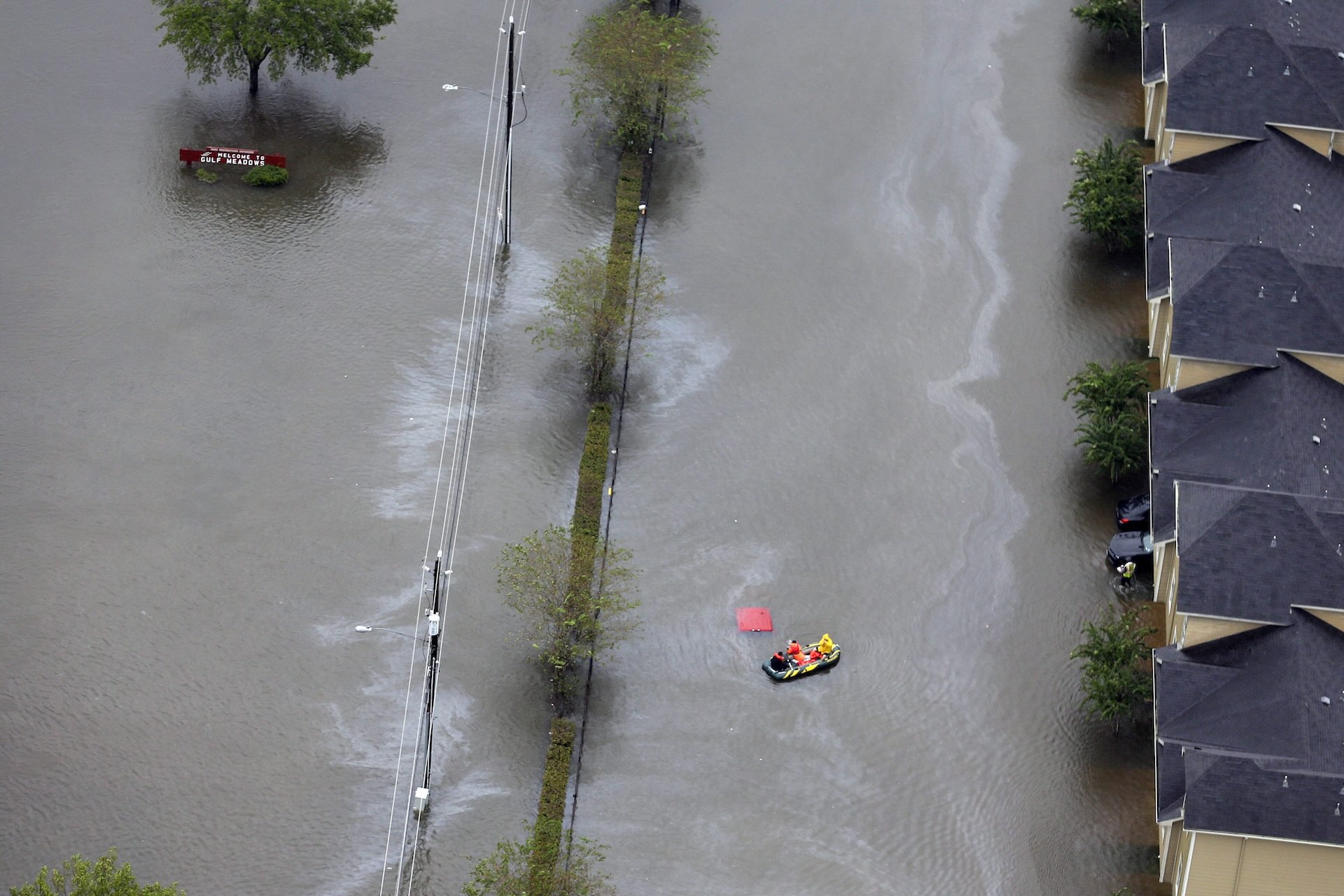
A boat navigates floodwaters in Houston in Aug. 2017, as the city monitors its dams and levees amid Tropical Storm Harvey. Photo: AP Photo/David J. Phillip
OTTAWA — Companies in the business of forecasting the weather are using artificial intelligence to make predictions quicker and more accurately, a valuable service for clients whose fortunes depend on if it rains or shines.
“Almost everything we touch has now gone the way of AI,” said Nana Banerjee, CEO of Pelmorex, the Oakville, Ont.-headquartered firm that runs the Weather Network.
Talking Points
- Weather companies are replacing traditional physics-based models for forecasting with deep-learning systems that use historical data about temperature, precipitation and other conditions
- Oakville, Ont.-headquartered Pelmorex has found the new AI tools quicker and more accurate than existing technology, while San Francisco’s ClimateAI uses them to track long-term extreme weather events
Tens of millions of people each month use the company’s apps, websites and television channels to check the forecast. Over the last two years, Pelmorex has adopted a type of AI called graph neural networks (GNNs), which map out the links in historical weather data to find patterns and make predictions. The firm’s new deep learning models produce forecasts in minutes, and are more accurate than the physics-based systems they replaced, Banerjee claimed. “That’s a huge leap for us in this sector.”
Meteorologists have traditionally used mathematical equations to predict how current conditions could change due to wind, pressure, temperature and other factors. Supercomputers running these physics-based models typically take several hours to produce a forecast, according to Banerjee.
Pelmorex’s clients are willing to pay for more up-to-date predictions. Wind, precipitation and other weather conditions “change around very rapidly,” said Banerjee. “So the value is immense.” Customers whose businesses depend on forecasts include retailers stocking shelves with umbrellas or air conditioners; traders buying and selling commodities; and airlines plotting flight paths around air pockets and through cloud cover.
Banerjee claims Pelmorex is the first commercial organization successfully using GNNs for weather forecasting. “We don’t know of our competitors even trying any of it,” he said. Google’s DeepMind has also used GNNs to improve weather predictions, but it doesn’t currently sell the service.
Related Articles

Pelmorex has filed for patents on the technology to prevent rivals from copying its approach. The company also plans to license its models to broadcasters who run forecasts but don’t generate them in-house.
The Pelmorex team of AI developers and meteorologists working on its weather prediction systems now makes up about a fifth of its over 500-person workforce; the rest work in sales, marketing and operations. The privately held company doesn’t disclose revenues. In addition to selling data to businesses, Pelmorex makes money by running targeted ads on its weather apps, websites and television channels.
The firm is also using generative AI to communicate with users. Pelmorex has created AI ‘avatars” of its meteorologists, letting it produce personalized video forecasts based on local weather conditions without having to record millions of different versions. It first rolled out the system on televisions in Home Hardware stores.
While Pelmorex is using AI to produce short-term forecasts more quickly and accurately, San Francisco-based startup ClimateAI is employing the technology to make longer-term predictions. “Most of the weather companies stay within two weeks,” said CEO Himanshu Gupta. By contrast, ClimateAI predicts the likelihood and impact of extreme events like heatwaves, wildfires, droughts and hurricanes up to six months out.
The firm focuses on conditions in the oceans, which have a strong influence on weather in the long term. ClimateAI’s deep-learning models find and monitor patterns in data like the salinity of the water and the temperature at different depths. Then the system connects those trends to information that government agencies publish, resulting in a more accurate forecast.
Still, like ChatGPT, neural networks focused on weather sometimes make things up. “It might tell you, ‘There’s an extreme heatwave and temperatures might cross 70 degrees celsius,’” Gupta said. (The highest temperature on record is 56.7 °C, in California in July 1913). To avoid such hallucinations, ClimateAI introduces limits to what the system can forecast that are based on real-world physics.
The firm uses a second set of deep-learning models to predict how crop yields will respond to extreme weather events. Its clients include agricultural producers like Dole and consumer goods firms like Suntory, which use the firm’s software to monitor risks to their farms or supply chains.
Take California nut farmers. “Almonds are very sensitive to drought risk, pistachios are not,” said Gupta. The opposite is true for the risk of a warm winter. With its long-term weather forecasts, ClimateAI can advise food firms on the best time to plant and harvest a crop, or the ideal location for their farms.
The startup has about 40 staff, and has raised US$37.5 million to date. It’s backed by Canadian financiers in the Public Sector Pension Investment Board, Toronto-headquartered Radical Ventures, and Vancouver-based Yaletown Partners. ClimateAI is set to expand into manufacturing sectors and supply chains beyond food. “Our models keep on getting better,” Gupta said.



Loading...
Thanks for sharing!
You have shared 5 articles this month and reached the maximum amount of shares available.
CloseThis account has reached its share limit.
If you would like to purchase a sharing license please contact The Logic support at [email protected].
CloseGift the full article!
You have gifted 0 article(s) this month and have 5 remaining.
Recipients will be able to read the full text of the article after submitting their email address. They will not have access to other articles or subscriber benefits.
Photo: AP Photo/David J. Phillip
Most Popular This Week



In-depth, agenda-setting reporting
Great journalism delivered straight to your inbox.
The Big Read
Alberta’s referendum is just the start of the turmoil
Briefing
EverWind plans $10B data centre and wind development in Nova Scotia
Canada ready to force Stelco to sell its Canadian operations, Joly says
Feds plan a 60 MW defence-oriented data centre for Ottawa
Best business newsletter in Canada
Get up to speed in minutes with insights and analysis on the most important stories of the day, every weekday.
Exclusive events
See the bigger picture with reporters and industry experts in subscriber-exclusive events.
Membership in The Logic Council
Membership provides access to our popular Slack channel, participation in subscriber surveys and invitations to exclusive events with our journalists and special guests.