British-Canadian AI godfather Geoffrey Hinton—one of the most prominent voices warning about the unchecked advancement of the technology—said Friday that it’s no longer feasible to slow down global AI proliferation because there’s now too much economic incentive pushing people to speed up development.
Skip to content
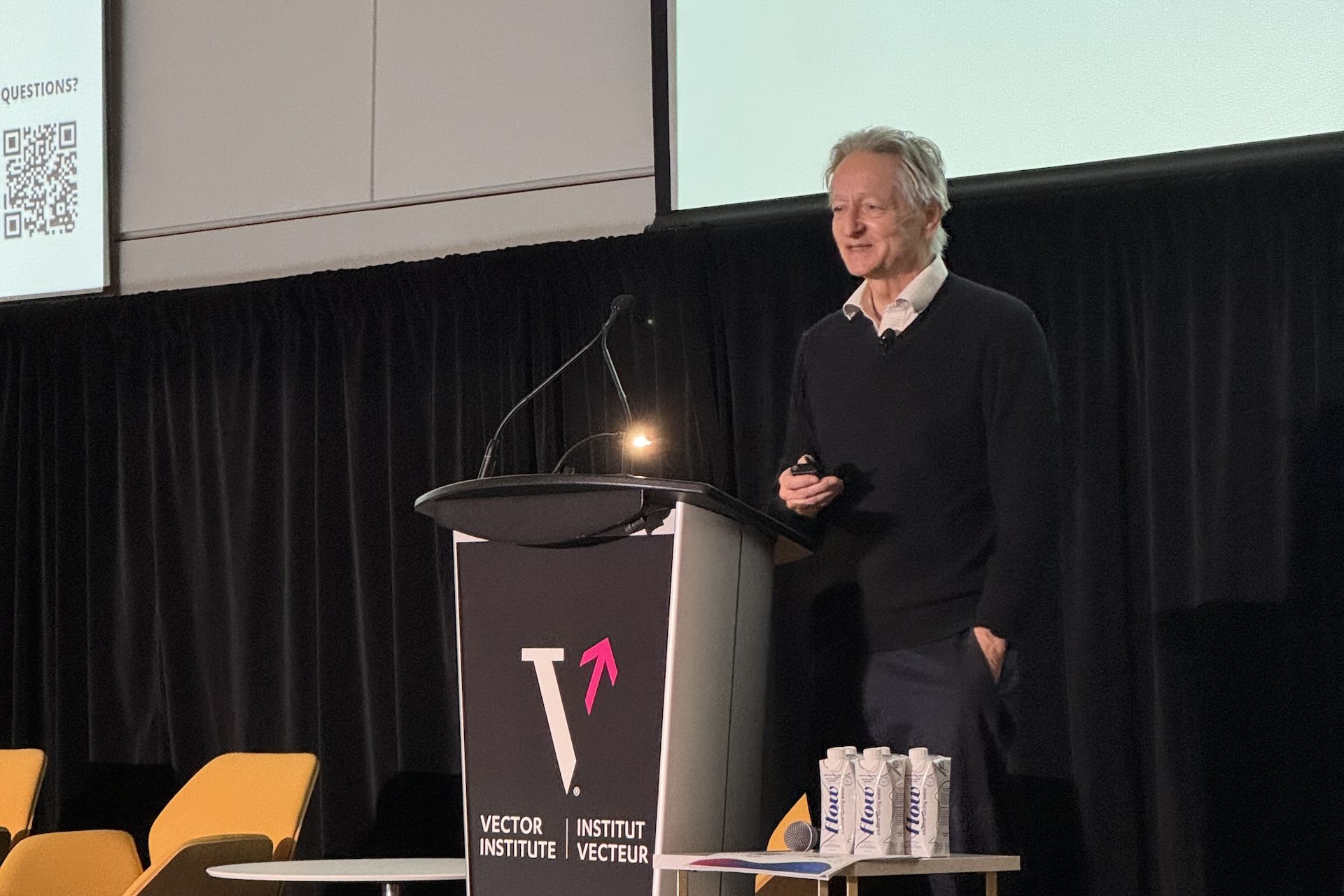 British-Canadian AI godfather Geoffrey Hinton at the Vector Institute’s Remarkable conference in Toronto on Feb. 9, 2024. Photo: Kylie Williams/Vector Institute

News
AI can’t be slowed down, Hinton says in call to ban open-source models
‘Open-sourcing big models is like being able to buy nuclear weapons at Radio Shack’
British-Canadian AI godfather Geoffrey Hinton at the Vector Institute’s Remarkable conference in Toronto on Feb. 9, 2024. Photo: Kylie Williams/Vector Institute
British-Canadian AI godfather Geoffrey Hinton—one of the most prominent voices warning about the unchecked advancement of the technology—said Friday that it’s no longer feasible to slow down global AI proliferation because there’s now too much economic incentive pushing people to speed up development.
“I don’t think we can solve it by slowing down, and that’s why I didn’t sign that petition that we should slow it down,” said Hinton, who unlike fellow Canadian AI godfather Yoshua Bengio, is not currently listed as a signatory on an open letter started last year calling for a six-month pause on giant AI experiments.
Speaking at an AI conference in Toronto hosted by the Vector Institute, Hinton said instead that a “huge effort” should be made to protect the technology from bad actors, and toward training artificial intelligence to be more benevolent.
In lieu of trying to slow the pace of AI research, Hinton urged regulators to focus on closing off source code of large-language models, to guard from the potential “existential threat” of AI falling into the wrong hands.
Related Articles



“Open-sourcing big models is like being able to buy nuclear weapons at Radio Shack,” said Hinton. “Bad actors can then fine-tune them for all sorts of bad things.”
Hinton has previously raised concerns that bad actors and politicians like Vladmir Putin will forge ahead on dangerous AI tools to accrue more power. His comments come amid broader worries that countries who fall behind on AI could become vulnerable or dependent on others for resources required for its development.
The push for AI sovereignty: Nvidia CEO Jensen Huang said in Canada last week that demand for computing power is being driven by governments trying to secure “sovereign AI capabilities” for domestic researchers and startups. The chip giant signed a letter of intent with Canada’s federal government to explore ways to improve the nation’s AI capacity.
“It’s a good time for Canada to up its game,” Keith Strier, Nvidia’s vice-president of AI initiatives, said in conversation with Vector’s president and CEO Tony Gaffney Thursday. The two reminisced over when Canada—the first country to deploy a national strategy for AI in 2017—was the epicentre of modern artificial intelligence.
Canada can’t afford to leave that reputation in the past, said Strier. “Pretty much across the world … this has become a national priority,” he said, advocating for AI sovereignty—systems in which countries rely on domestic talent, data and infrastructure for their own AI developments.
“Am I correct in saying that if we don’t get that right, we may be using talent from elsewhere and challenged to retain the talent we have here?” said Gaffney. “We would be using other countries’ data—what they choose to share with us—and we would be dependent on their products and solutions?
“That sounds like something we have to absolutely ensure does not happen.”



Loading...
Thanks for sharing!
You have shared 5 articles this month and reached the maximum amount of shares available.
CloseThis account has reached its share limit.
If you would like to purchase a sharing license please contact The Logic support at [email protected].
CloseGift the full article!
You have gifted 0 article(s) this month and have 5 remaining.
Recipients will be able to read the full text of the article after submitting their email address. They will not have access to other articles or subscriber benefits.
Photo: Kylie Williams/Vector Institute
Most Popular This Week




In-depth, agenda-setting reporting
Great journalism delivered straight to your inbox.
Commentary
Carmichael: Canadian ignorance about India is a strategic weakness
Briefing
Aritzia shares pop after earnings rise 204%
First Nation in Alberta goes to court over fast-tracked oil pipeline
Chinese EV maker Geely Auto Group to launch in Canadian market in 2027
Best business newsletter in Canada
Get up to speed in minutes with insights and analysis on the most important stories of the day, every weekday.
Exclusive events
See the bigger picture with reporters and industry experts in subscriber-exclusive events.
Membership in The Logic Council
Membership provides access to our popular Slack channel, participation in subscriber surveys and invitations to exclusive events with our journalists and special guests.





