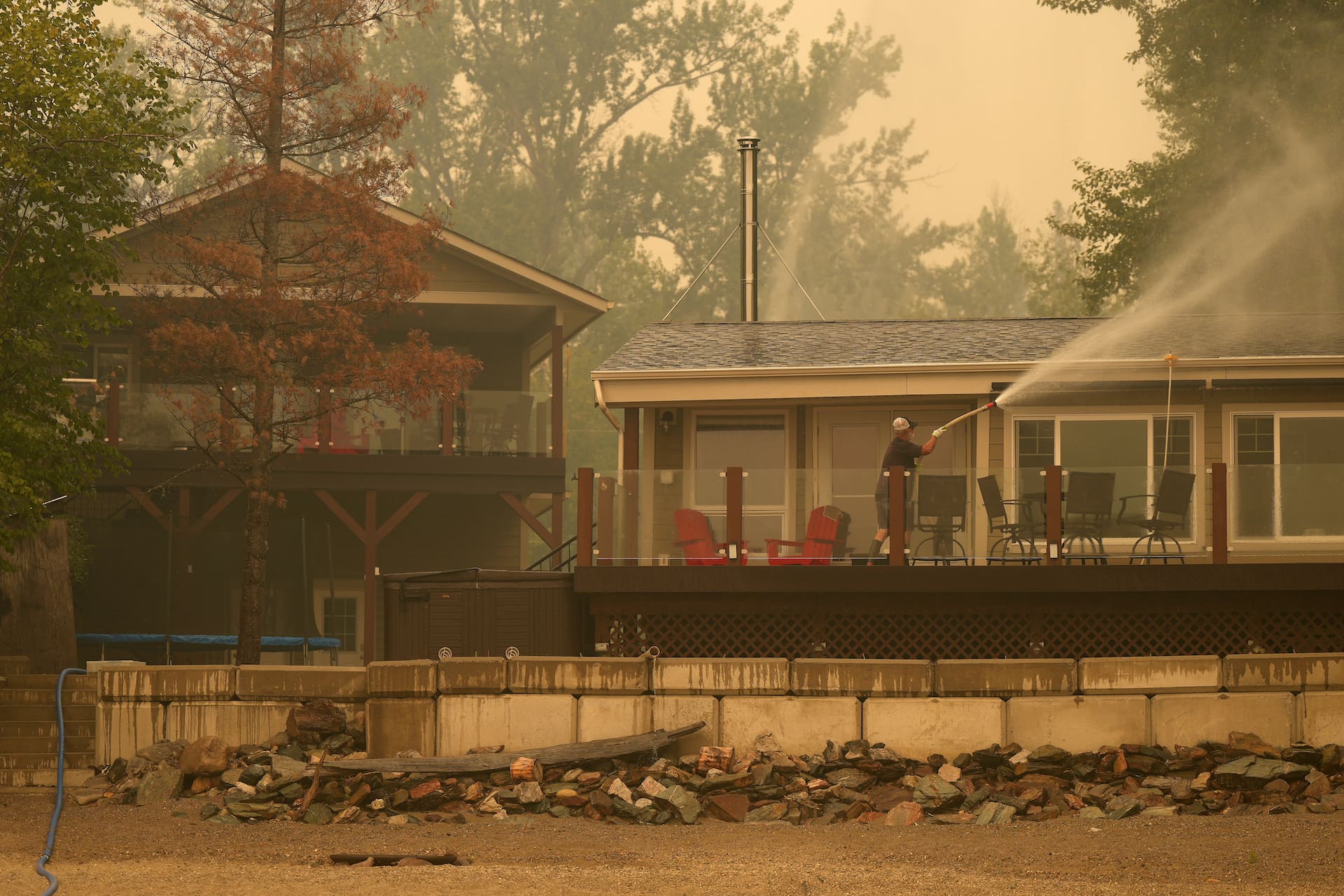
CALGARY — Wildfires continue to rage across British Columbia and the Northwest Territories, forcing tens of thousands of people from their homes and shutting down key trade corridors.
The blazes are expected to cause a whopping economic toll that could dampen consumer confidence, stifle GDP growth and overwhelm the insurance industry. But there is another, more pernicious aspect to the carnage: wildfires, with their incredible destruction, are also a drag on Canada’s already lagging economic productivity.
Here’s what you need to know:
The ‘broken window’ theory: Economists have warned for years that Canada’s declining productivity has gradually eroded household living standards, as private sector investment has fallen behind other developed economies. Deputy Prime Minister Chrystia Freeland has called productivity the “Achilles heel” of Canada’s economic growth prospects.
While economic output—or GDP growth—is ultimately a measure of total value, productivity is a measure of efficiency, or output on a per-company or per-person level.
Dave Sawyer, principal economist at the Canadian Climate Institute, a research outfit partly funded by Environment and Climate Change Canada, said wildfires and other climate-related natural disasters hurt productivity because they force businesses and people to spend money inefficiently. Damage to homes, vehicles, public infrastructure and storefronts channel money toward repairing things that were already purchased rather than efficiency-improving investments like electric vehicles, software or energy-efficient furnaces.
“The big business impacts and supply chain impacts [of wildfires] are quite large, because it’s such an integrated economy,” Sawyer said. “So when you start shutting businesses down, that has broad-based productivity impacts across the economy, like a pinball effect.”
Proof of insurance, please: Those pinball effects include things like lower incomes for displaced workers or higher costs for services like insurance. Climate change has been wreaking havoc on insurance agencies in particular, which are struggling to balance their policies with increasingly large payouts for environmental damages.
Every home insurance policy in Canada includes wildfire coverage and it’s widespread in business policies as well, said Craig Stewart, vice-president of federal issues and climate change at the Insurance Bureau of Canada. But premiums have risen up to 15 per cent in some places.
“Insurers are taking a harder look at communities that don’t have fire hydrants, for instance, or don’t have well-trained fire responders in place,” Stewart said. Subdivisions in the Halifax area that were recently threatened by a wildfire had no hydrants, he pointed out. “In this day and age, that’s simply unacceptable.”
Such areas might see even higher premiums or “a restriction in product,” he said.
After years of huge losses, the industry all but abandoned fire-prone areas in California in 2020. And one of the world’s largest insurers, Lloyd’s of London, dramatically reduced its exposure to the Canadian market after absorbing £2.9 billion in global losses from climate change in 2018 and 2019.
Costs mounting: Meanwhile, the overall economic cost of fires and floods continue to climb. The Canadian Climate Institute estimates that climate change will slow Canada’s economic growth by $25 billion every year by 2025, or roughly half of predicted annual GDP growth.
In a June research blog post, Oxford Economics estimated that Canadian GDP would take a 0.6 per cent hit in the third quarter of this year due to wildfires. That’s 0.2 per cent more than the economic toll of blazes that ravaged Fort McMurray in 2016.