About 80 per cent of respondents to The Logic’s July subscriber survey say Canadian tech firms have a responsibility to support foreign talent they hire. The finding comes after the federal government unveiled its new Tech Talent Strategy.
Skip to content
 The Logic’s subscribers were split about whether Ottawa’s new tech talent strategy will effectively address labour gaps in the innovation economy. Photo: Adrian Lang/Pexels

Subscriber Survey
Tech firms must take steps to support foreign hires, most subscribers say
The Logic’s survey results come on heels of Ottawa’s new tech talent strategy
The Logic’s subscribers were split about whether Ottawa’s new tech talent strategy will effectively address labour gaps in the innovation economy. Photo: Adrian Lang/Pexels
About 80 per cent of respondents to The Logic’s July subscriber survey say Canadian tech firms have a responsibility to support foreign talent they hire. The finding comes after the federal government unveiled its new Tech Talent Strategy.
The strategy, announced last month by Sean Fraser, the immigration minister at the time, includes allowing foreign workers with H-1B specialty-occupation visas from the U.S. to be eligible for three-year open work permits in Canada. Immigration, Refugees and Citizenship Canada began accepting applications earlier this month, and hit its cap of 10,000 just two days after.
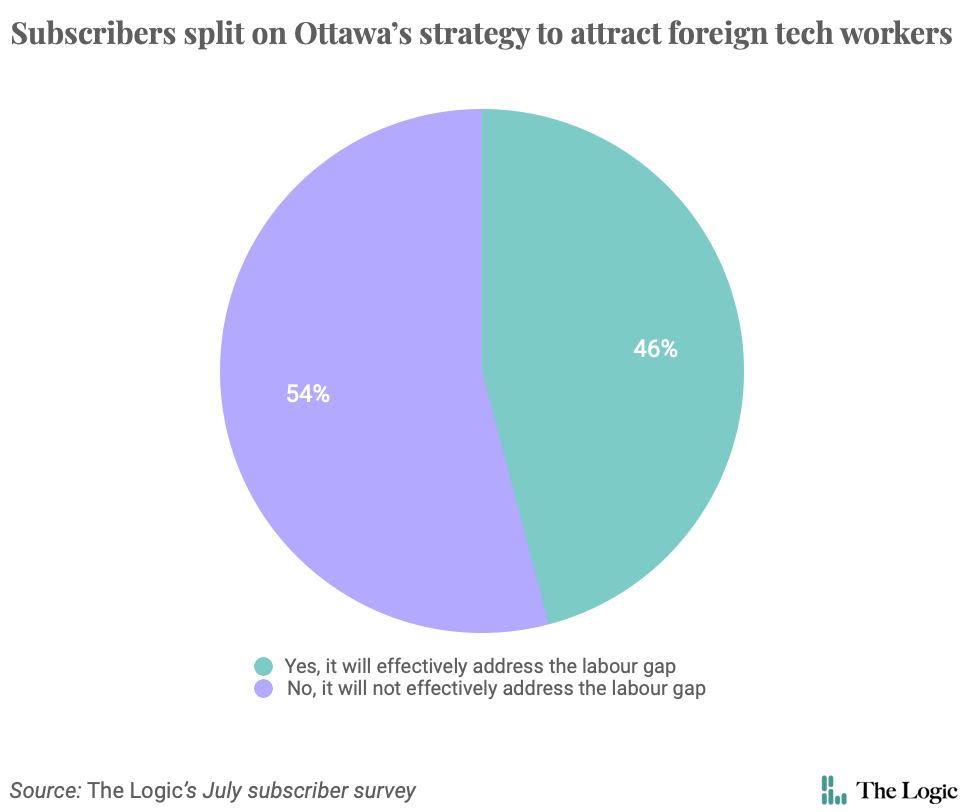
Ottawa is also considering creating a stream for employers to recruit workers from anywhere in the world without having to prove the role couldn’t be filled domestically. When asked if these measures and the wider strategy would effectively address labour gaps in Canada’s innovation economy, subscribers were split—46 per cent said it would, and 54 per cent said it wouldn’t.
“It’s certainly a step in the right direction. Drawing people is important as there’s a labour shortage. Drawing talent is even more important, because there’s a skills/talent shortage,” one respondent said.
Related Articles


Others pointed out that issues like access to health care and housing need to be dealt with to better support potential immigrant workers in Canada.
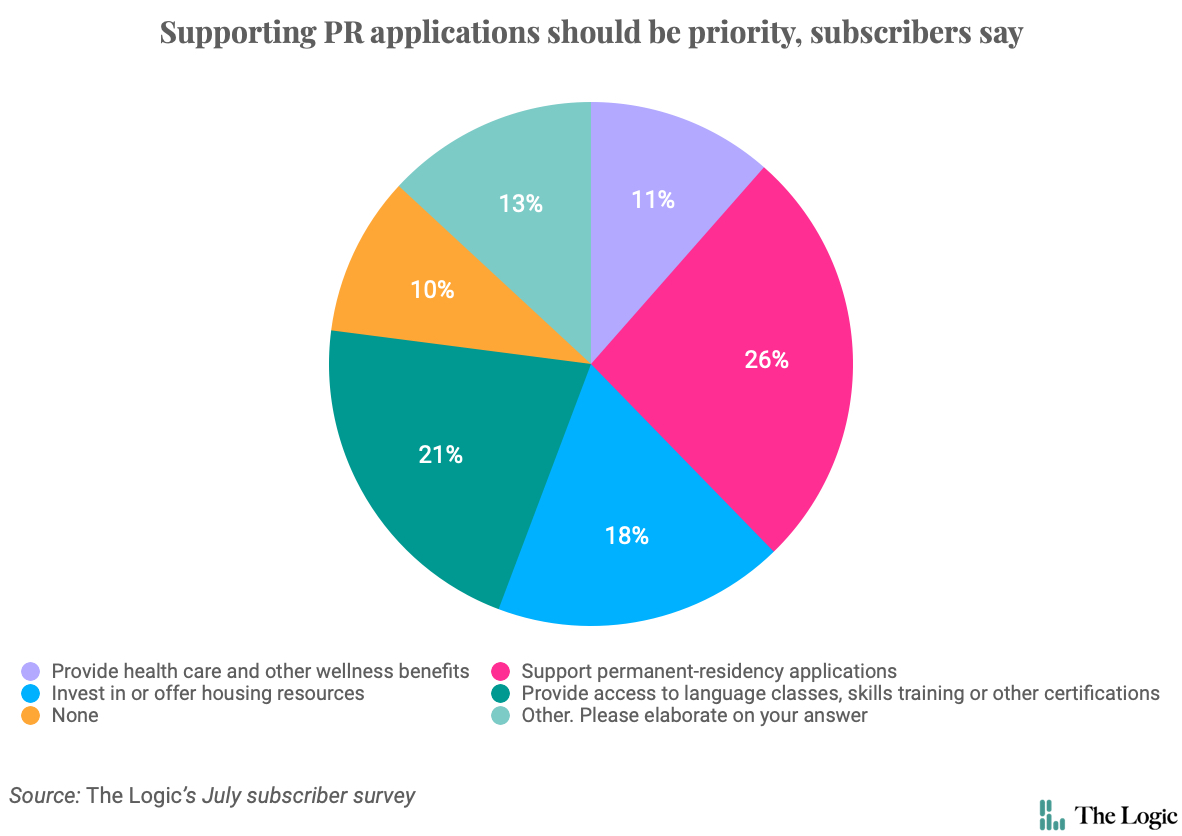
Eighteen per cent of survey respondents said housing help should be businesses’ top priority when it comes to supporting foreign workers, while 11 per cent said businesses should prioritize health-care or wellness benefits.
Business leaders have been vocal about cost-of-living issues as Canada is preparing to increase immigration to 500,000 people a year by 2025. CIBC CEO Victor Dodig, for example, has warned of a potential crisis if policymakers don’t adequately address housing supply and affordability issues for newcomers.
Most respondents (26 per cent) said employers should prioritize supporting foreign hires’ permanent-residency applications.
“People become indentured to their employer without permanent residency options, and while that may be acceptable in the short term, it quickly can become a very oppressive burden for both,” a respondent said.
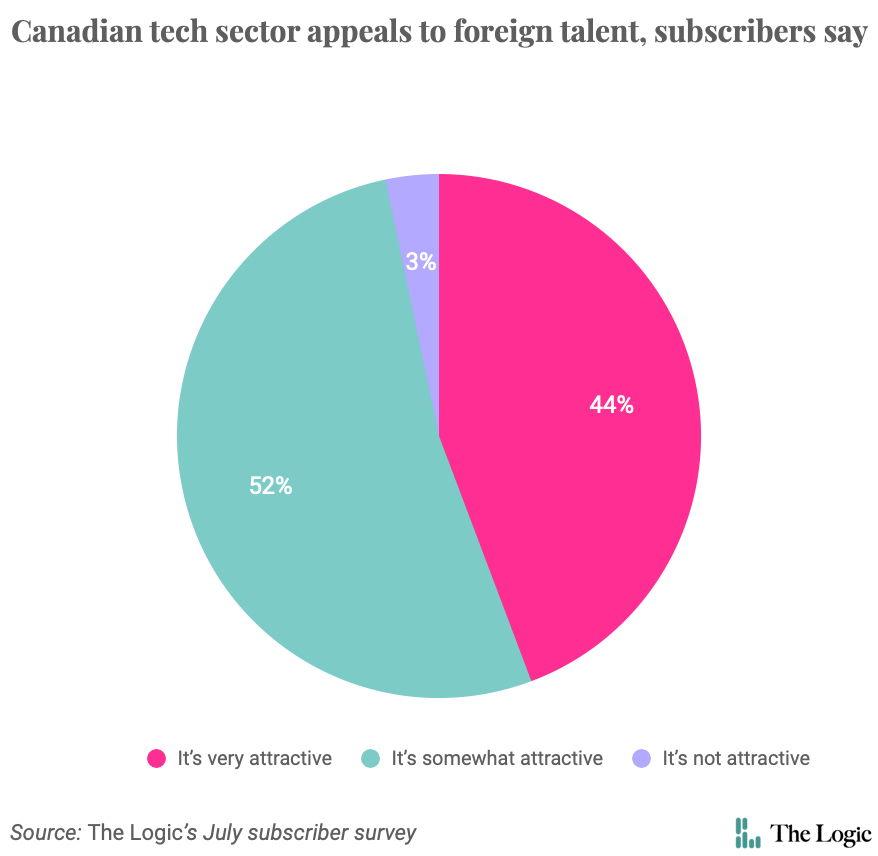
Forty-four per cent of respondents said Canada’s tech sector is “very attractive” to foreign workers, and 52 per cent said it’s “somewhat attractive.”
Paying a competitive salary was a recurring comment in participants’ answers.
Many indicated the pay discrepancy between tech salaries in the U.S. and Canada could be a significant determining factor for foreign talent.
“There are lots of good companies to work for and a highly educated population, however, wages and career progression opportunities are limited in Canada compared to the United States and other highly attractive technology sector hubs,” one subscriber said.
Another said even though housing affordability is a “significant” issue, Canada is “an attractive destination for foreign workers because of low crime and gun violence, free health care, and a safe/secure place to raise a family.”
Even after months of layoffs, over 65 per cent of subscribers said they think the tech sector is ready for more hiring.
Some experts have said the Canadian tech industry is still seeing long-term growth, and critical roles need to be filled.
“There is an incredible dearth of talent in the pipeline,” a subscriber wrote. “[Companies] are begging for qualified workers.”
A number of participants suggested that progress in artificial intelligence may impact hiring and cause employers to rethink roles, too. “AI-boosted productivity is probably a better investment right now,” a respondent said.
Methodology
The Logic emailed subscribers a private link to an online survey on July 19 and the survey closed July 24. Respondents’ identities were kept anonymous. Subscribers were first asked, “How attractive do you think Canada’s tech sector is for foreign workers?” and could answer, “It’s very attractive,” “It’s somewhat attractive,” or “It’s not attractive.” They were then asked, “The federal government’s new tech talent attraction strategy includes a new work-permit program for H-1B holders in the U.S. and one that would allow in-demand professionals to come to Canada without a job offer. Do you think it will effectively address labour gaps in Canada’s innovation economy?” and could select “Yes” or “No.” Next, they were asked, “Do Canadian tech firms have a responsibility to support immigrant talent they’ve hired?” and could choose “Yes” or “No.” They were also asked, “What step should businesses prioritize to support foreign workers?” and could select: “Provide health care and other wellness benefits,” “Support permanent-residency applications,” “Invest in or offer housing resources,” “Provide access to language classes, skills training or other certifications,” “None,” or “Other. Please elaborate on your answer.” Finally, respondents were asked, “Do you think the tech sector is ready for more hiring after months of layoffs?” and could select “Yes” or “No.”



Loading...
Thanks for sharing!
You have shared 5 articles this month and reached the maximum amount of shares available.
CloseThis account has reached its share limit.
If you would like to purchase a sharing license please contact The Logic support at [email protected].
CloseGift the full article!
You have gifted 0 article(s) this month and have 5 remaining.
Recipients will be able to read the full text of the article after submitting their email address. They will not have access to other articles or subscriber benefits.
Photo: Adrian Lang/Pexels
Most Popular This Week




In-depth, agenda-setting reporting
Great journalism delivered straight to your inbox.
News
Tech firms want AI models to create better versions of themselves
Briefing
Dozens of Canadian researchers join chorus of scientists calling for a global AI oversight
TC Energy strikes deal with Indigenous groups for ownership stake in Coastal GasLink pipeline
Canada’s Tailscale taps Google Moonshot alum to lead sovereign AI push
Best business newsletter in Canada
Get up to speed in minutes with insights and analysis on the most important stories of the day, every weekday.
Exclusive events
See the bigger picture with reporters and industry experts in subscriber-exclusive events.
Membership in The Logic Council
Membership provides access to our popular Slack channel, participation in subscriber surveys and invitations to exclusive events with our journalists and special guests.