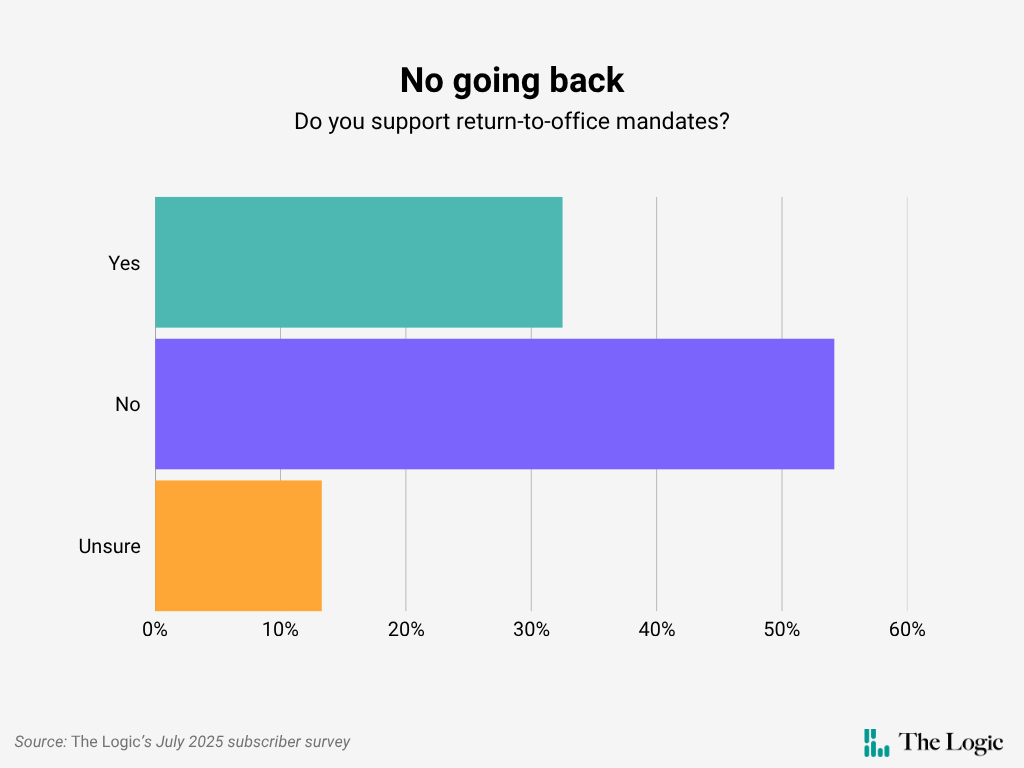
Fifty-four per cent of respondents to The Logic’s latest subscriber survey don’t support return-to-office mandates, and think remote work positively impacts their organization’s productivity—but not company culture.
Skip to content


Subscriber Survey
Most of you don’t like the latest return-to-office push
A renewed effort to get people back to the office risks reducing productivity, according to The Logic’s latest subscriber survey
Ninety-two per cent of respondents to The Logic’s latest survey have workplaces that allow a degree of remote work, though the number of days permitted varies greatly Photo: Darren Calabrese/The Logic
Fifty-four per cent of respondents to The Logic’s latest subscriber survey don’t support return-to-office mandates, and think remote work positively impacts their organization’s productivity—but not company culture.
Return-to-office mandates are on the rise across Canada, with big banks like BMO, RBC and Scotiabank all requiring employees to be in-office four days per week starting this fall. Dell, Amazon and Toronto-based investment firm Canaccord have all issued five-day-per-week mandates, although smaller companies are apparently less likely to follow suit.
Related Articles


Most of the people we surveyed are not fans of these efforts—54 per cent don’t support return-to-office mandates, and many respondents said blanket requirements would fall short if not tailored to the needs of the organization and specific roles. One respondent said such requirements “focus on presenteeism over productivity,” while another said it’s “inconsiderate to force people to commute or change their living conditions, especially for employees with young children or caregivers for aging parents.”
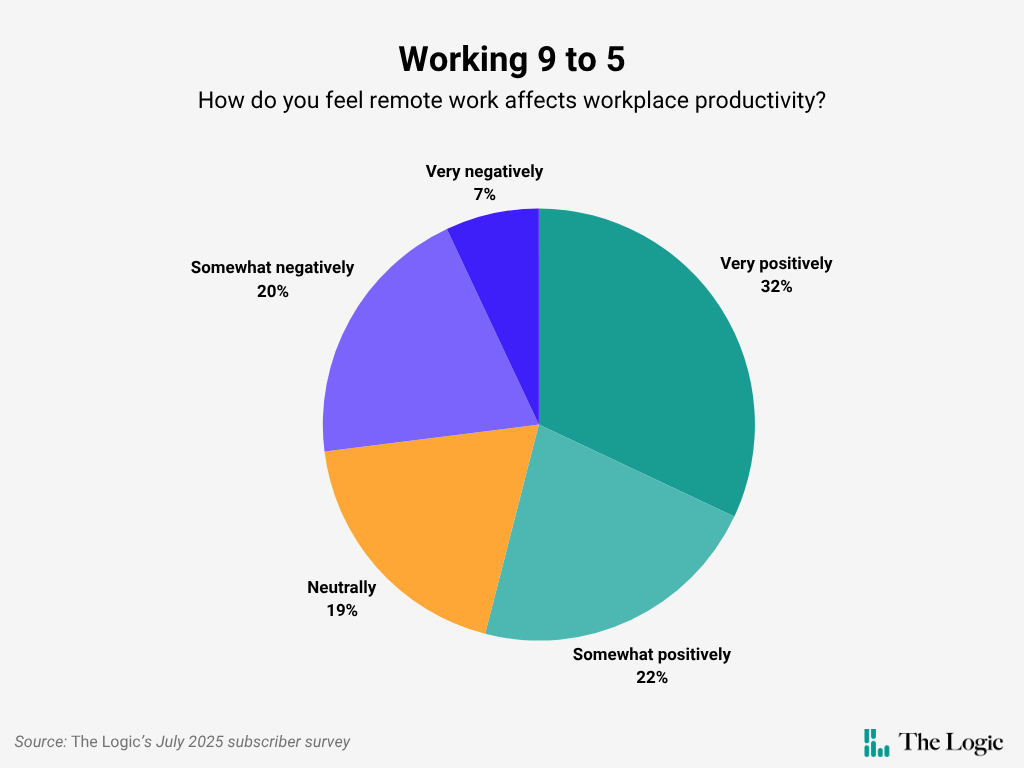
Over half of the respondents said remote work makes their workplace more productive, citing reduced commuting times and costs and, in some cases, fewer distractions. But 51 per cent also said work-from-home takes a toll on workplace culture, citing decreased opportunities for camaraderie: “I still remember those days back in the ’70s and ’80s when we’d all stop work and head out for lunch,” one subscriber said.
“Connection between people is best built through in-person interactions, and connection is where company culture is created and perpetuated,” another respondent said. “In a remote work environment, it takes a lot more intention and effort to build and maintain culture than it does where people regularly see each other face to face.”
Ninety-two per cent of respondents have workplaces that allow remote work, and the number of days respondents spent in-office on average varied greatly. Around a quarter of respondents spent three or four days a week in the office, while another quarter were fully remote. Only 12 per cent spent their full work week in-office, compared to one-tenth in our October 2023 subscriber survey.
In an ideal world, 23 per cent of respondents said they would spend 2 days per week in the office— but, overall, readers were evenly split on that too. Not everyone buys that work-from-home increases workplace output, though—33 per cent of respondents support return-to-office mandates.
“Canada’s productivity is down because people are at home getting distracted,” one respondent claimed. “We need a focused economy and right now, as a nation, we have to get back to work; we can balance life later when we are ‘richer.’”
Several respondents acknowledged their location preference was a reflection of the era they started work in, and said mandates could work if they were implemented properly: “It is disheartening to see workers who come to work, only to spend their days on video calls they could have taken remotely.”
“People are happier, but less connected and engaged with the broader mission,” another reader said of remote work. “They focus on their tasks and roles instead of the organization’s success, which is fine as long as management can connect and co-ordinate those tasks into a functioning business.”



Loading...
Thanks for sharing!
You have shared 5 articles this month and reached the maximum amount of shares available.
CloseThis account has reached its share limit.
If you would like to purchase a sharing license please contact The Logic support at [email protected].
CloseGift the full article!
You have gifted 0 article(s) this month and have 5 remaining.
Recipients will be able to read the full text of the article after submitting their email address. They will not have access to other articles or subscriber benefits.
Photo: Darren Calabrese/The Logic
Most Popular This Week




In-depth, agenda-setting reporting
Great journalism delivered straight to your inbox.
Commentary
Carmichael: Canadian ignorance about India is a strategic weakness
Briefing
Aritzia shares pop after earnings rise 204%
First Nation in Alberta goes to court over fast-tracked oil pipeline
Chinese EV maker Geely Auto Group to launch in Canadian market in 2027
Best business newsletter in Canada
Get up to speed in minutes with insights and analysis on the most important stories of the day, every weekday.
Exclusive events
See the bigger picture with reporters and industry experts in subscriber-exclusive events.
Membership in The Logic Council
Membership provides access to our popular Slack channel, participation in subscriber surveys and invitations to exclusive events with our journalists and special guests.