More than 40 per cent of respondents to The Logic’s November subscriber survey are concerned about their job security amid a time of great transition and change in the workplace.
Skip to content
 Nearly six out of 10 respondents said they work in hybrid arrangements, while 30 per cent said they’re remote-only. Photo: Unsplash/Yasmina H


Subscriber Survey
Over a third of respondents concerned about job security: Survey
Workload, impact of the downturn were top two sources of stress
Nearly six out of 10 respondents said they work in hybrid arrangements, while 30 per cent said they’re remote-only. Photo: Unsplash/Yasmina H
More than 40 per cent of respondents to The Logic’s November subscriber survey are concerned about their job security amid a time of great transition and change in the workplace.
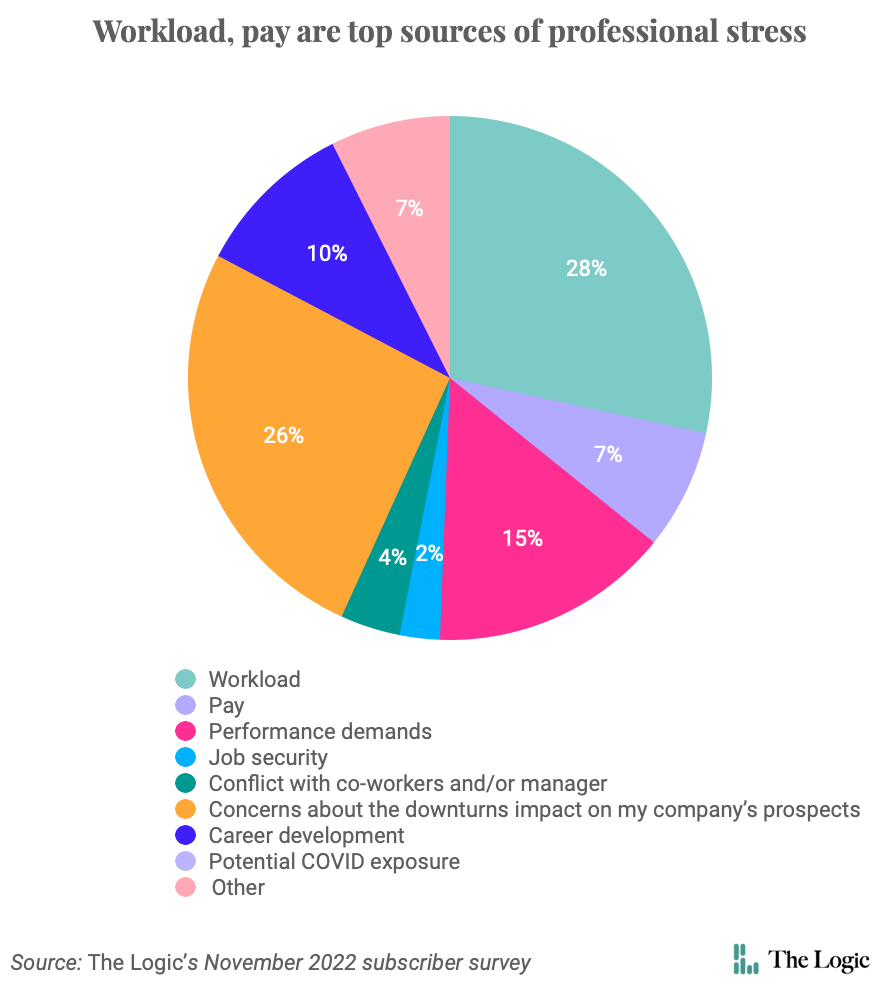
The economic downturn’s impact on company prospects was a commonly cited worry. Just over a quarter of respondents identified it as their chief source of stress in their professional lives from a list of workplace concerns.
The last two years have been a tumultuous time for employees in all sectors, especially business and technology. For months, tech companies across Canada have been laying off staff—in some cases by the hundred.
The job cuts are happening on a global scale, too, as employers around the world prepare for a recession. All told, the business environment has left some workers uncertain about the future of work at their companies.
Related Articles

“[I’m] concerned in that I am a contractor, not a full employee,” wrote one subscriber, noting that the chance they’ll lose their job is “unlikely but always there.”
Workload ranked highest among sources of stress, at about 28 per cent. It was particularly high among those working in hybrid arrangements, which allow for both in-person and remote work.
The results signal a sense of fatigue as the first full year back in office for many following pandemic lockdowns comes to a close, while a major hiring boom in the tech sector grinds to a halt. Over the last two years, many workers have joined companies that did not have traditional workspaces, or were transitioning back to them.
Fifty-seven per cent of respondents said they work in hybrid arrangements; 30 per cent said they work fully remotely; and 10 per cent are fully in person. Generally, all three groups said they were satisfied with their respective working arrangements. No respondents in the hybrid camp answered “Not at all satisfied,” while only one person each in the fully remote and fully hybrid groups did so. Hybrid workers, though, had the most to say about their work circumstances.
“The company I work for moved offices during the pandemic. The office is brighter, has better air, and is more spacious than the previous office,” said one.
Another wrote, “I would prefer two days a week or fewer—we are currently three days.”
One subscriber working in a hybrid arrangement added that they found their office to be very unpleasant to work in, saying the space is “very dated.”
In a response that reflects the difficulty caused by recent workplace upheaval, almost half of survey participants said they were only sometimes (39 per cent) or never (nine per cent) satisfied with their work-life balance. Others have found themselves questioning what purpose they serve at a company.
“They don’t need me,” wrote one subscriber. “I have too little work and have basically been told to stay out of the way.”
More than 20 per cent of survey respondents said they planned to leave their jobs within the next year—and they won’t be alone. In the second quarter of 2022, as the so-called Great Resignation beat on, Statistics Canada reported over one million job vacancies across the country.
Though some employees aren’t actively looking to leave their positions, others said they would depart for a better opportunity. An economy where jobs keep popping up even as others disappear will have that effect. In the words of one subscriber, “It’s complicated.”
Methodology
The Logic emailed subscribers a private link to an online survey on Nov. 14 and the survey closed Nov. 16. Respondents’ identities were kept anonymous. Subscribers were asked, “Which of these best describes your work situation?” and could select: “Fully remote,” “Fully in person,” “Hybrid,” or “Other.” They were then asked, “How satisfied are you with your organization’s work arrangements?” and could answer: “Very satisfied,” “Somewhat satisfied,” or “Not at all satisfied.” Answers to this question were filtered depending on what type of work arrangement the respondent had selected. Next, they were asked, “How concerned are you about your personal job security?” and could answer: “Very concerned,” “Somewhat concerned,” or “Not concerned at all.” They were also asked, “How often do you feel like you’re satisfied with your work-life balance?” and could select: “All of the time,” “Most of the time,” “Sometimes,” or “Never.” After that, respondents were asked to select the main source of stress in their professional life, and could select from the following options: “Workload,” “Pay,” “Performance demands,” “Job security,” “Conflict with co-workers and/or manager,” “Concerns about the downturns impacts on their company’s prospects,” “Career development,” “Potential COVID-19 exposure,” or “Other.” Finally, respondents were asked, “When do you expect to leave your current job?” and could select: “Within the next six months,” “Within the next year,” “More than a year from now,” or “I do not expect to leave my current job.”



Loading...
Thanks for sharing!
You have shared 5 articles this month and reached the maximum amount of shares available.
CloseThis account has reached its share limit.
If you would like to purchase a sharing license please contact The Logic support at [email protected].
CloseGift the full article!
You have gifted 0 article(s) this month and have 5 remaining.
Recipients will be able to read the full text of the article after submitting their email address. They will not have access to other articles or subscriber benefits.
Photo: Unsplash/Yasmina H
Most Popular This Week




In-depth, agenda-setting reporting
Great journalism delivered straight to your inbox.
News
A tech firm born from post-Brexit trade chaos sets its sights on Canada
Briefing
Aritzia shares pop after earnings rise 204%
First Nation in Alberta goes to court over fast-tracked oil pipeline
Chinese EV maker Geely Auto Group to launch in Canadian market in 2027
Best business newsletter in Canada
Get up to speed in minutes with insights and analysis on the most important stories of the day, every weekday.
Exclusive events
See the bigger picture with reporters and industry experts in subscriber-exclusive events.
Membership in The Logic Council
Membership provides access to our popular Slack channel, participation in subscriber surveys and invitations to exclusive events with our journalists and special guests.





