One-third of respondents to The Logic’s subscriber survey said they were ordering grocery deliveries less often than last year, as the food e-commerce market faces a potential slowdown at a time of loosening pandemic restrictions and rising food prices.
Skip to content




Subscriber Survey
‘It’s way too expensive to justify’: 33% of subscribers say they’re ordering grocery deliveries less often
One-third of respondents to The Logic’s subscriber survey said they were ordering grocery deliveries less often than last year. Photo: Voila | Handout
One-third of respondents to The Logic’s subscriber survey said they were ordering grocery deliveries less often than last year, as the food e-commerce market faces a potential slowdown at a time of loosening pandemic restrictions and rising food prices.
Only about 13 per cent of respondents said they increased their frequency of grocery deliveries. Another 25 per cent said it’s stayed about the same and 29 per cent never had groceries delivered at all.
Many consumers moved to grocery delivery during the COVID-19 pandemic. It was a boon for existing delivery apps like San Francisco-based Instacart, which filed to go public this year, and led to the growth of delivery options at Canadian grocers. Sobeys launched its online grocery-delivery platform Voilà in the Greater Toronto Area in the summer of 2020, and the convenience-store chain Couche-Tard has invested in the 15-minute-delivery startup Food Rocket.
As restrictions lift, the sector’s future depends on whether customers’ shift to e-commerce will stick. Startups in the space have had mixed success so far. Toronto’s GoodGood, a variety-store concept promising 30- to 60-minute delivery, is eyeing a national rollout, while Ninja Delivery, which offers 10-minute shipments, recently closed stores and laid off its employees as it prepared for a potential acquisition. And Freshlocal, a Burnaby, B.C.-based company that operates a grocery-delivery and software business, filed for bankruptcy in May.
The Logic’s survey also found that almost half of respondents said they believed the market for grocery-delivery services is oversaturated, while about 24 per cent said it’s healthy the way it is and 27 per cent said there’s room for growth.
Methodology
The Logic emailed subscribers a private link to an online survey on June 7 and the survey closed June 9. Respondents’ identities were kept anonymous and duplicates were removed as needed. Subscribers were asked, “How do you assess the choices available for grocery deliveries?” and could select: “Too many services,” “Just enough services” or “Not enough services.” They were then asked, “How do you view the prospects for the grocery-delivery sector?” and could select: “The market is oversaturated,” “It’s healthy the way it is right now” or “There’s room for growth.” Subscribers were also asked, “How often are you ordering from grocery e-commerce services in 2022 so far compared to last year?” and could select: “More often,” “About the same,” “Less often” or “I’ve never had groceries delivered.” They were asked “How do you currently prefer to shop for groceries or food?” and could answer “Order delivery via a third-party app or website,” “Through a grocery store’s own delivery or pick-up service,” “Shop in a brick-and-mortar grocery store” or “Other.” Lastly, subscribers were asked, “What is, or would be, the most important factor for you when deciding whether to use a grocery-delivery service or app?” Their choices were: “It’s cheaper than alternatives,” “The speed of delivery,” “Platform is easy to use,” “Access to different stores,” “Food selection,” “Reputation as an ethical company,” “Other” or “I wouldn’t use a grocery-delivery service or app.”
In a separate question, respondents were split on whether there were “too many” or “just enough” services, with 41 per cent choosing each option.
Some respondents said their households switched to online delivery during the pandemic and never stopped. Others said the rising price of ordering groceries, along with additional fees, has made them reverse course. “It’s getting too expensive to continue with the added costs of grocery delivery,” one said.
Another respondent said they had used a meal-kit delivery service during the pandemic to learn to cook, “but now it is way too expensive to justify.”
Statistics Canada reported that Canadians paid 9.7 per cent more for food bought from stores in April compared with a year earlier, which it attributed to Russia’s invasion of Ukraine, poor weather in some regions and rising fuel costs.
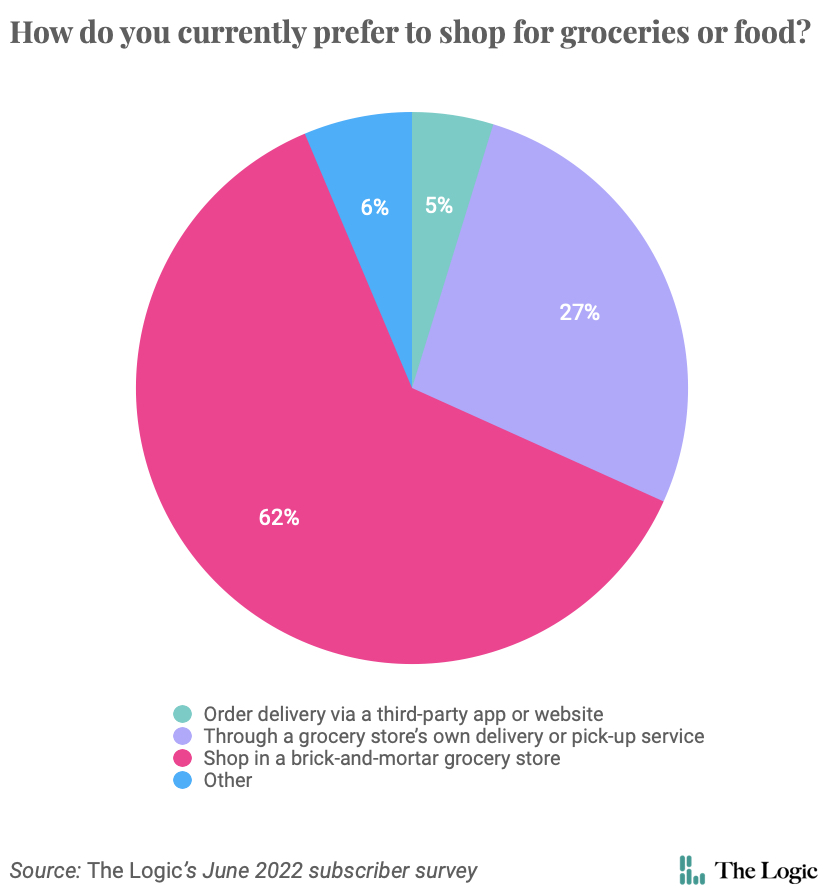
The Logic’s survey found that respondents still vastly preferred the in-store experience. About 62 per cent of respondents said they preferred to shop at brick-and-mortar stores, while 27 per cent said they preferred a grocery store’s own service and about five per cent said they’d rather shop via a third-party app or website. In a store, “pricing is usually better and quality choice is up to me, not an employee,” one reader said.
Another subscriber said they preferred delivery services offered by grocery stores themselves instead of third-party apps that deliver from several different stores.
“The middleman approach suffers significantly in terms of quality control for the consumer,” they said, adding: “I’ve gotten terrible produce through these services.”
The subscriber said they had increased orders from Walmart’s grocery-delivery service instead.
“I hate the fact that I’m spending so much at Walmart, but it’s just so convenient and saves so much time to order my food on my phone in the evenings and being able to do a quick pickup the next day.”
But another reader liked the choices that third-party services gave them, like “canned staples from a lower-end chain, quality food elsewhere.”
Thirty per cent of respondents said food selection is the most important reason in using a grocery-delivery app, while 19 per cent said the platform’s ease of use is most important. Another 13 per cent cited the cost of the service.
One reader who chose the selection of food available as being most important said, “If we can get what we want and the platform is easy to use, that is even better. Speed would come next.”
Thirteen per cent said they would never use grocery-delivery services, while 11 per cent stated a different reason, such as overall convenience, the quality of the food or the volume of single-use plastics.
One reader expressed skepticism that apps can replace the in-store experience, saying they would have to be “incapacitated and without options” to opt for delivery because they prefer to look at the options for fresh produce and meat themselves.
“None of this stuff is standardized,” the subscriber wrote.
Another reader said the time saved is worth it. “The app experience is easy enough. Not having to waste hours shopping is the real win.”



Loading...
Thanks for sharing!
You have shared 5 articles this month and reached the maximum amount of shares available.
CloseThis account has reached its share limit.
If you would like to purchase a sharing license please contact The Logic support at [email protected].
CloseGift the full article!
You have gifted 0 article(s) this month and have 5 remaining.
Recipients will be able to read the full text of the article after submitting their email address. They will not have access to other articles or subscriber benefits.
Photo: Voila | Handout
Most Popular This Week




In-depth, agenda-setting reporting
Great journalism delivered straight to your inbox.
News
A tech firm born from post-Brexit trade chaos sets its sights on Canada
Briefing
Dozens of Canadian researchers join chorus of scientists calling for a global AI oversight
TC Energy strikes deal with Indigenous groups for ownership stake in Coastal GasLink pipeline
Canada’s Tailscale taps Google Moonshot alum to lead sovereign AI push
Best business newsletter in Canada
Get up to speed in minutes with insights and analysis on the most important stories of the day, every weekday.
Exclusive events
See the bigger picture with reporters and industry experts in subscriber-exclusive events.
Membership in The Logic Council
Membership provides access to our popular Slack channel, participation in subscriber surveys and invitations to exclusive events with our journalists and special guests.