Skip to content

Canada's Business and Tech Newsroom

  • Professional Subscription
  • Partnerships & Advertising
  • Licensing & Syndication
Log In Subscribe
Welcome,
  • My Account
  • Log Out
  • Business
  • Tech
  • National
  • The Big Read
  • Briefings
  • Commentary
Search
Log In Subscribe
Welcome,
  • My Account
  • Log Out
Subscriber Survey

The Air Canada strike raises difficult questions about labour relations

Respondents to The Logic’s latest subscriber survey are divided on Canadian labour relations, with 42 per cent saying employers have too much power, while 40 per cent said the same about unions.

Subscriber Survey

The Air Canada strike raises difficult questions about labour relations

Respondents to The Logic survey were split on whether unions or employers hold the power, but most agree something has to change

By Brendan Sinclair
A man in a blue shirt holding a bullhorn raises a fist in the air. A crowd of people surrounding him hold signs with union slogans on them, many raising their fists as well.
Twenty per cent of survey respondents said the government should not be able to issue back-to-work orders for strikes. Photo: Nick Lachance/Toronto Star via Getty Images
Aug 29, 2025
A A
A Small A Medium A Large
Share

Gift

Share

Respondents to The Logic’s latest subscriber survey are divided on Canadian labour relations, with 42 per cent saying employers have too much power, while 40 per cent said the same about unions.

The issue has come to the fore with this month’s Air Canada flight attendants strike, when union leadership defied a federal back-to-work order aimed at ending the impasse. The standoff didn’t last long, as the airline and its employees reached a tentative agreement that ended the strike within days.

Related Articles

A blue and white Amazon sign with wording and both French and English appears in the foreground; in the background is a large, grey warehouse-style building with a blue awning and Amazon's smile-shaped arrow logo near the roofline.

Amazon open to talks with feds after shock Quebec exit

By Laura Osman
A Brightdrop electric delivery vehicle at an indoor event. Two people in black, wearing masks, are standing on the left.

Canadian union talks put Detroit’s EV strategy to the test

By Anita Balakrishnan

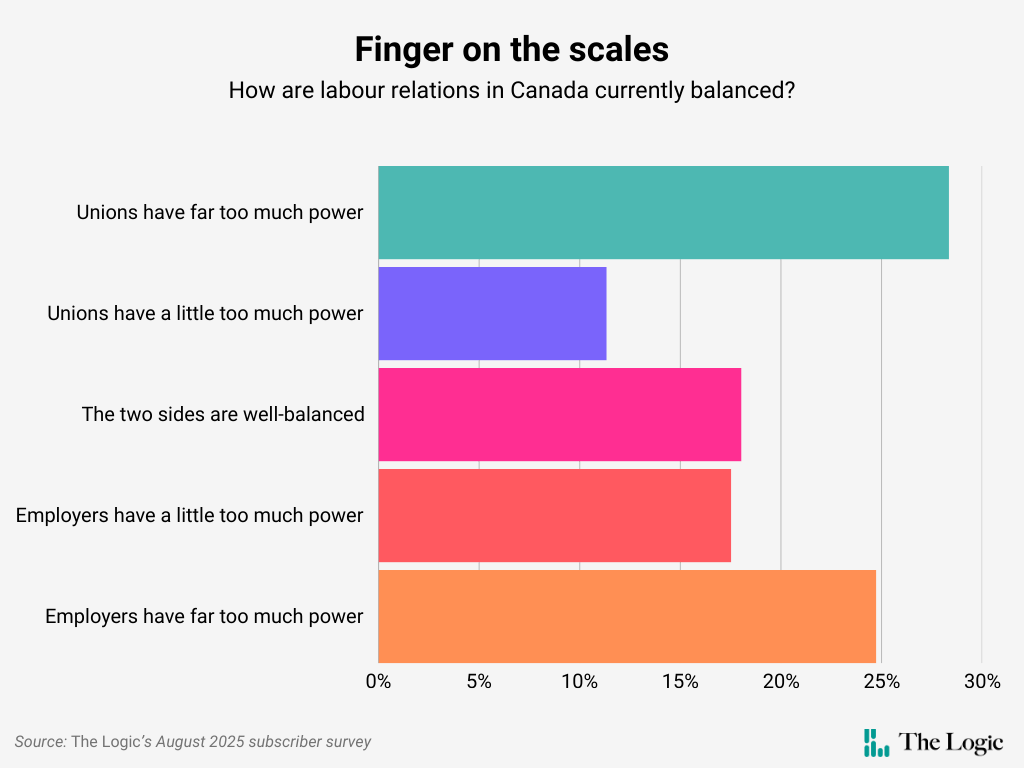
While respondents to The Logic’s survey were split in their response to the strike and their assessment of labour relations more generally, their responses were polarized. Twenty-eight per cent of readers said Canadian labour relations were balanced “far too much” in favour of unions—the top response—but in second place were the 25 per cent who said the same was true for employers.

A chart headlined "Finger on the scales" asking, "How are labour relations in Canada currently balanced?" About 28 per cent said "Unions have far too much power." 11 per cent said "Unions have a little too much power." 18 per cent said "The two sides are well-balanced." 18 per cent said "The two sides are well-balanced." Almost 18 per cent said "Employers have a little too much power." 25 per cent said "Employers have far too much power."

There was slightly more agreement on the question of whether the government favours unions or employers, with 54 per cent saying Ottawa is “very” or “somewhat” pro-employer, more than twice the amount who believed the government is “very” or “somewhat” pro-union.

The return-to-work orders were cited by many who said the government is pro-employer, but several respondents characterized those actions as “pro-public.” Another said those high-profile orders were offset by recent Canada Labour Code changes placing prohibitions on hiring replacement workers during a strike or lockout.

Only 20 per cent of respondents said the government should not be able to issue back-to-work orders for strikes, slightly more than the 16 per cent giving unqualified approval to the idea. Nearly 63 per cent said the merit of such an order would depend on the circumstances. Some readers said such orders are justified when a strike impacts the economy, involves essential services, or when there is no significant competition to step in.

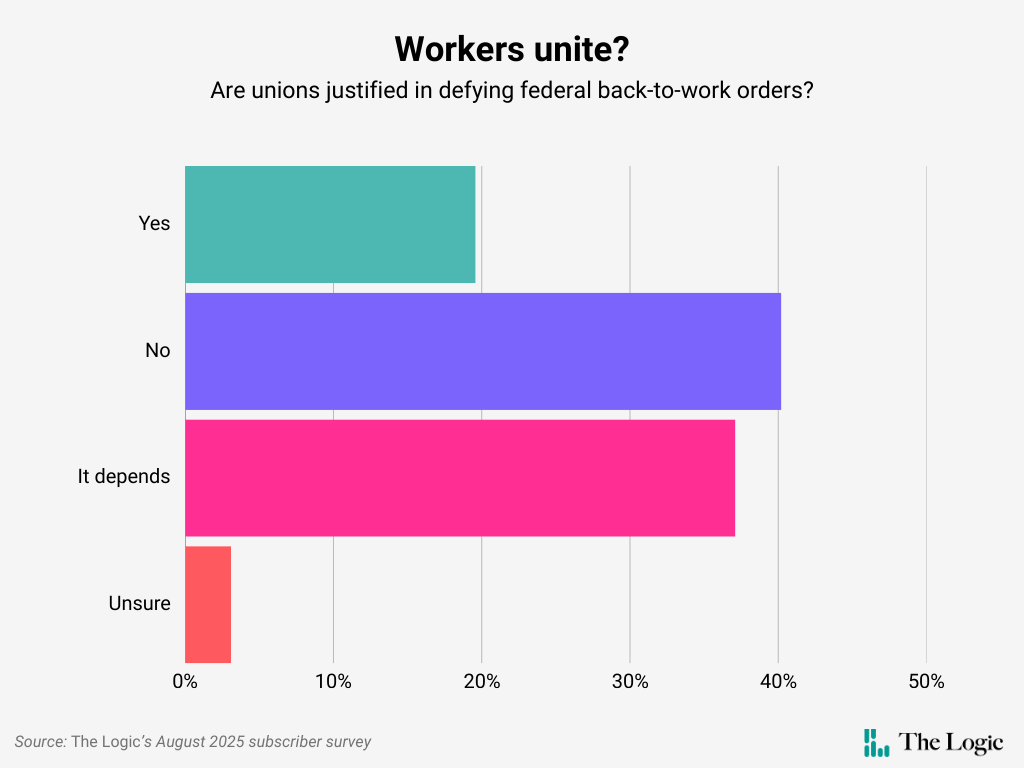
A chart headline "Workers unite?" showing responses to the question, "Are unions justified in defying federal back-to-work orders?" About 20 per cent say yes, 40 per cent say no, 37 per cent say it depends on the circumstances, and 3 per cent are unsure.

Twenty per cent of respondents also said unions are justified in refusing back-to-work orders, while 37 per cent said it depended on the circumstances. Some of the relevant considerations included whether the government was too quick to make its order, or if the companies didn’t bargain in good faith. Forty per cent of respondents said unions were not justified in refusing, with many pointing to the rule of law—but some said there’s merit in considering the conditions that made unions willing to defy such orders.

“The law is the law,” one reader said, “but this defiance is an indicator of desperation. It’s worth assessing the playing field.”

Many respondents expressed a desire for greater collaboration between unions and employers to avoid disruptions. Other suggestions included a waiting period before the government can pursue a back-to-work order and a requirement to disclose each party’s best offers in the case of a strike. Several readers suggested adopting a system more like that of Germany, where employee representatives hold seats on the board of directors.

“The real problem isn’t only with unions or management, it’s with how businesses view workers as a whole,” one respondent said. “Until workers are treated as partners in growth rather than as costs to be minimized, labour relations will remain broken, and Canada’s GDP will continue to suffer.”


#National #Subscriber Survey #unions

Loading...

Thanks for sharing!

You have shared 5 articles this month and reached the maximum amount of shares available.

Close
This account has reached its share limit.

If you would like to purchase a sharing license please contact The Logic support at [email protected].

Close
Want to share this article?

Upgrade to all-access now

Close
Gift the full article!

You have gifted 0 article(s) this month and have 5 remaining.

Copy link and gift
Copy Link
Email to a friend
Send Email
Gift on Social Media

Recipients will be able to read the full text of the article after submitting their email address. They will not have access to other articles or subscriber benefits.

A man in a blue shirt holding a bullhorn raises a fist in the air. A crowd of people surrounding him hold signs with union slogans on them, many raising their fists as well.

Photo: Nick Lachance/Toronto Star via Getty Images

A chart headlined "Finger on the scales" asking, "How are labour relations in Canada currently balanced?" About 28 per cent said "Unions have far too much power." 11 per cent said "Unions have a little too much power." 18 per cent said "The two sides are well-balanced." 18 per cent said "The two sides are well-balanced." Almost 18 per cent said "Employers have a little too much power." 25 per cent said "Employers have far too much power."

A chart headline "Workers unite?" showing responses to the question, "Are unions justified in defying federal back-to-work orders?" About 20 per cent say yes, 40 per cent say no, 37 per cent say it depends on the circumstances, and 3 per cent are unsure.

Most Popular This Week

News

Bay Street backs Canada’s AI strategy, but warns the devil is in the details

By Anita Balakrishnan and Chaimae Chouiekh
A diptych showing Mark Carney on the left, and CIBC CEO Harry Culham on the right.
News

Diversifying trade requires banks to take bigger risks, official advised Carney before CIBC meeting

By Joanna Smith
The image shows the inside of Toronto Stadium on a sunny day. The rows of seats are empty; an empty green field is visible.
News

Toronto and Vancouver aren’t getting a World Cup bookings boom

By Chaimae Chouiekh
A yellow ambulance is pictured outside of a hospital in Montreal. A red sign in the foreground reads, “Urgence / Emergency.”
Commentary: Quebec Ink

Quebec just found out what not having digital sovereignty really means

By Martin Patriquin

In-depth, agenda-setting reporting

Great journalism delivered straight to your inbox.

News

Crypto firms are paying stablecoin rewards despite a looming federal ban

By Claire Brownell

Briefing

Canada to publish list of imports at risk of being made with forced labour

By Joanna Smith   |   Jun 12, 2026

TMX Group acquires RAFI Indices for $683M

By Anita Balakrishnan   |   Jun 12, 2026

Ikea invests in Toronto food startup NS/TX Industries’ US$10.5M fundraise

By Catherine McIntyre   |   Jun 12, 2026

Best business newsletter in Canada

Get up to speed in minutes with insights and analysis on the most important stories of the day, every weekday.

Exclusive events

See the bigger picture with reporters and industry experts in subscriber-exclusive events.

Membership in The Logic Council

Membership provides access to our popular Slack channel, participation in subscriber surveys and invitations to exclusive events with our journalists and special guests.


Recent Popular Stories

Commentary: Quebec Ink

Quebec just found out what not having digital sovereignty really means

By Martin Patriquin   |   Jun 8, 2026
A yellow ambulance is pictured outside of a hospital in Montreal. A red sign in the foreground reads, “Urgence / Emergency.”
News

OMERS investment chief departs for Singapore’s Temasek

By Chaimae Chouiekh   |   Jun 10, 2026
News

Diversifying trade requires banks to take bigger risks, official advised Carney before CIBC meeting

By Joanna Smith   |   Jun 9, 2026
A diptych showing Mark Carney on the left, and CIBC CEO Harry Culham on the right.
News

Canada’s surprise plan to buy Saab command jets leaves competitors seeking answers

By David Reevely   |   May 29, 2026
A closeup of a scale model of a jet covered in pixellated camouflage, with sensor equipment attached to the top of its fuselage. There are civilians and uniformed military personnel milling in the background.
The Big Read

We found every data centre in Canada

By Murad Hemmadi, David Reevely, Aleksandra Sagan, Chaimae Chouiekh, Martin Patriquin and Catherine McIntyre   |   Apr 8, 2026
Four vertical slices of aerial view photos. From left, a building in downtown Toronto housing several data centres, a picture of the Albertan wilderness where the proposed Wonder Valley data centre would go, a lit-up QScale data centre in Quebec, and a data centre at a Hydro-Quebec dam.
News

Toronto and Vancouver aren’t getting a World Cup bookings boom

By Chaimae Chouiekh   |   Jun 8, 2026
The image shows the inside of Toronto Stadium on a sunny day. The rows of seats are empty; an empty green field is visible.

Canada's most influential executives and policymakers are reading The Logic

  • CPP Investments
  • Sun Life Financial
  • C100
  • Amazon
  • Telus
  • Mastercard
  • bdc
  • Shopify
  • Rogers
  • RBC
  • General Motors
  • MaRS
  • Government of Canada
  • Uber
  • Loblaw Companies Limited
logic-logo

Canada's Business and Tech Newsroom

100% human-crafted journalism

Newsroom

  • News Tips
  • AI Policy
  • Editorial Disclosures
  • Story Pitches

Company

  • About Us
  • Terms of Service
  • Privacy Statement
  • Corporate Information

Contact

  • Contact Us
  • Advertise
  • FAQs
  • Work at The Logic

© 2026 The Logic Inc. All Rights Reserved.

Trusted by leaders

Error

Account creation failed.

Please email us at [email protected].

Create Account

[wppb-register form_name=”cozmo-registration-form-for-modal”]

I do have an account
Login
or

[wppb-login]

I don’t have an account