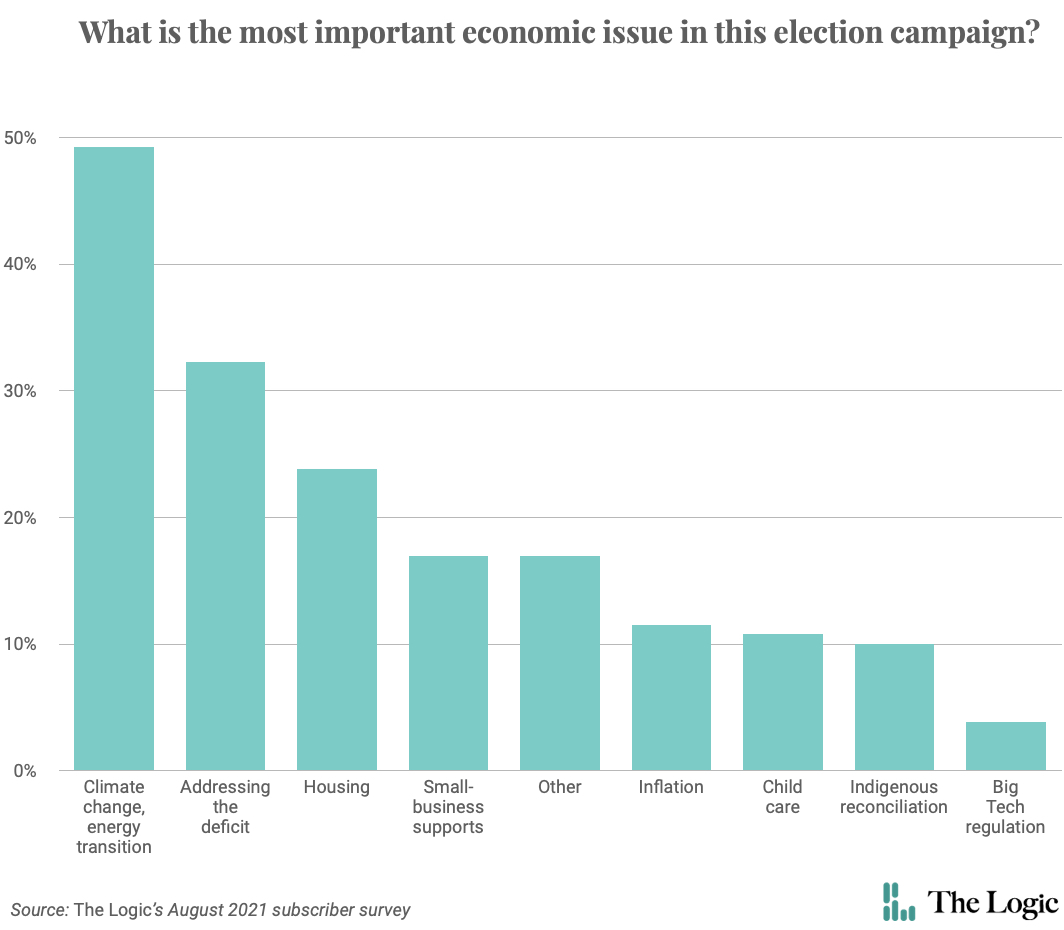
Most subscribers say tackling climate change and the energy transition is the top economic issue in the 2021 federal election campaign, according to The Logic’s latest subscriber survey.
Skip to content



Subscriber Survey
Addressing climate change and energy transition is top economic issue in 2021 election, subscribers say
COVID-19- and Elections Canada-related signs at the Edmonton Expo Centre in August 2021. Photo: Artur Widak/NurPhoto
Most subscribers say tackling climate change and the energy transition is the top economic issue in the 2021 federal election campaign, according to The Logic’s latest subscriber survey.
Forty-nine per cent of subscribers said climate change is the most important issue for the country’s economy. Thirty-two per cent said tackling the deficit is the top priority, while 24 per cent said it’s housing.
“I’d like more on climate change and how we can manage our water resources so we don’t repeat the short-term, extractive way we managed our energy resources over most of my lifetime,” one subscriber wrote.
Methodology
The Logic emailed subscribers a private link to an online survey on Aug. 24, and the survey closed Aug. 26. Respondents’ identities were kept anonymous and duplicates were removed as needed. Subscribers were asked what they think is the most important economic issue in this election campaign: “What do you think is the most important economic issue in this election campaign?” Their choices were: “Addressing the deficit,” “Inflation,” “Housing,” “Child care,” “Small-business supports,” “Big Tech regulation,” “Climate change and the energy transition” and “Indigenous reconciliation.” They were also asked which political party has the strongest plan for promoting Canadian innovation: “Regardless of how you might vote, which party do you think has the strongest plan and team for promoting Canadian innovation?” Their choices were: “The Liberal Party under Justin Trudeau,” “The Conservative Party under Erin O’Toole,” “The New Democratic Party under Jagmeet Singh,”The Bloc Québécois under Yves-François Blanchet,” “The Green Party under Annamie Paul,” “I don’t know” or “None of the above.”
With climate change concerns rising across the globe, Canada’s political parties have put forth their strategies to combat them. The federal Liberals said they’d make oil and gas companies set five-year targets meant to make their operations carbon-neutral by 2050. They also said they’d spend $2 billion to help Alberta, Saskatchewan and Newfoundland and Labrador in their energy transition. The Conservatives are also promising ways to cut emissions, though they have a lesser target. The NDP is targeting a reduction of 50 per cent in emissions by 2030 and achieving net-zero emissions by 2050.
As for the Green Party, their plan is to “electrify everything,” install renewables everywhere, and invest in cleantech innovation. The Bloc Québécois have pledged to put “an end to oil.”
Asked what parties should be discussing in the election campaign, subscribers wrote that there are many issues yet to be covered. “The policy tools that encourage innovation—going beyond platitudes [need to be discussed]. For example, carbon pricing is now starting to encourage low-carbon innovation in Canada, and there’s many similar environmental and innovation connections that could be made,” wrote one subscriber.
Another subscriber said current climate-change plans are not addressing the crisis effectively, and that parties should address “what they plan to do about this.”
One respondent also noted how climate-change concerns are linked to improving the Canadian economy: “This issue is closely tied to the question of how we transition to a sustainable economy based on cleantech.”
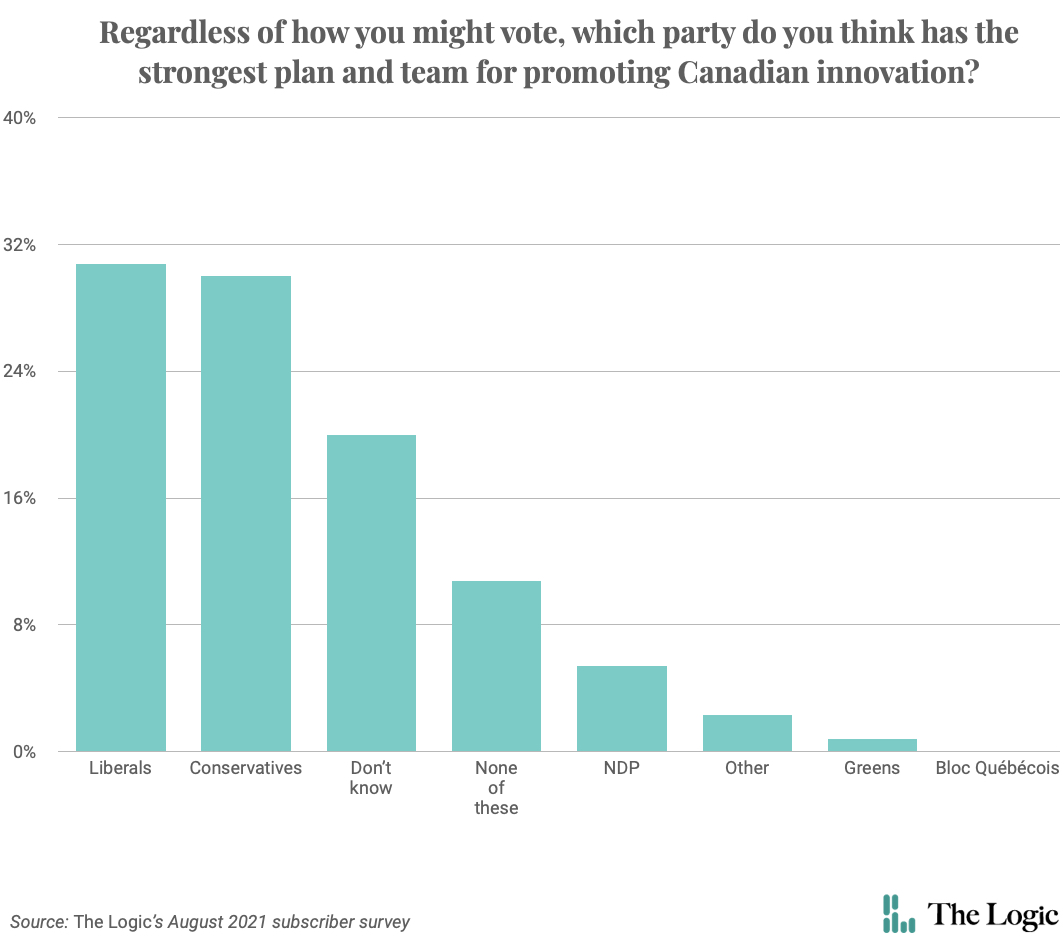
When it comes to who has the best plan and team for promoting Canadian innovation, about 31 per cent of respondents said the Liberal Party is strongest, while the Conservative Party came in a close second at 30 per cent. Twenty per cent were undecided, and 11 percent said none of the major parties had strong plans.
Many subscribers said they were unsure which federal party they’d vote for, at 29 per cent. However, 30 per cent said they would vote for the Liberals. About 22 per cent chose the Conservative Party, and nearly 12 per cent said they’d vote for the NDP.
As Canadians get ready to head to the polls amid the pandemic, 61 per cent of subscribers said they’re optimistic about the country’s economic recovery, about 22 percentage points less than in July. Meanwhile, about 28 per cent of respondents said they were pessimistic about the recovery, and those who said they were neither optimistic or pessimistic increased about seven percentage points to 10 per cent. Almost one per cent said they weren’t sure, a decrease from nearly three per cent in July.
“Our economy was strong beforehand and I believe that gives us the foundation to build on for recovery,” a subscriber wrote.



Loading...
Thanks for sharing!
You have shared 5 articles this month and reached the maximum amount of shares available.
CloseThis account has reached its share limit.
If you would like to purchase a sharing license please contact The Logic support at [email protected].
CloseGift the full article!
You have gifted 0 article(s) this month and have 5 remaining.
Recipients will be able to read the full text of the article after submitting their email address. They will not have access to other articles or subscriber benefits.
Photo: Artur Widak/NurPhoto
Most Popular This Week




In-depth, agenda-setting reporting
Great journalism delivered straight to your inbox.
News
Adam Waterous proposes massive crude exports to Asia by rail through northern B.C.
Briefing
Rivals may be ‘horrified’ to realize how exposed their investments are to AI, Aviva CIO warns
Shopify, Sequoia co-lead US$200M investment in online-selling platform Whop
Amid revenue gains, 1Password bets on tools to protect data from AI agents
Best business newsletter in Canada
Get up to speed in minutes with insights and analysis on the most important stories of the day, every weekday.
Exclusive events
See the bigger picture with reporters and industry experts in subscriber-exclusive events.
Membership in The Logic Council
Membership provides access to our popular Slack channel, participation in subscriber surveys and invitations to exclusive events with our journalists and special guests.







