More than half of respondents in The Logic’s survey said Canadian policymakers haven’t handled inflation effectively, ahead of the Bank of Canada’s highly anticipated interest-rate decision on Wednesday.
Skip to content


Subscriber Survey
54% of subscribers say Canadian policymakers aren’t handling inflation effectively: Survey
A truck drives by a gas station in Montreal in October 2021. Photo: Paul Chiasson/The Canadian Press
More than half of respondents in The Logic’s survey said Canadian policymakers haven’t handled inflation effectively, ahead of the Bank of Canada’s highly anticipated interest-rate decision on Wednesday.
Economists expect that Canada’s central bank will start raising rates as inflation has hit multi-decade highs in recent months. The consumer price index rose 5.1 per cent year over year in January, the highest reading since 1991, according to Statistics Canada.
Methodology
The Logic emailed subscribers a private link to an online survey on Feb. 18 and the survey closed Feb. 23. Respondents’ identities were kept anonymous and duplicates were removed as needed. Subscribers were asked, “Are you worried about inflation?” and could select: “Yes,” “No,” “Somewhat” or “Not sure.” They were then asked, “What area is of most concern for you when it comes to rising inflation?” and their choices were: “Food prices,” “Gas prices,” “Housing prices,” “Impact on investments,” “Business spending” or “Other.” Subscribers were also asked, “Do you plan to seek a raise or look for a new job this year as a result of rising prices?” and they could select: “Yes,” “No,” or “Maybe.” They were asked “How would you assess Canadian policymakers’ handling of inflation?” and could select: “It has not been effective,” “It has been somewhat effective,” “It has been effective” or “It has been very effective.” Lastly, subscribers were asked, “Has your organization adjusted its business spending because of inflation?” Their choices were: “Yes,” “No” or “Not sure.”
Fifty-four per cent of subscribers said they believe policymakers have not been handling inflation effectively, while 35 per cent said policymakers have been somewhat effective, and the remaining 11 per cent said they have been effective.
“They seem to be caught by surprise,” one subscriber wrote.
Another respondent said it “would be a mistake to leap into intervention [with] so many up [and] down inflation indicators pointing in different directions and different effect sizes over differing periods of time.”
Although the Conservatives have put much of the blame on the Liberals’ pandemic-related aid and spending, Canada isn’t the only country grappling with higher prices. The U.S. annual inflation rate hit a 40-year high of 7.5 per cent in January, while the eurozone’s reached 5.1 per cent.
“It’s a global problem; I don’t think it can be fixed at the Canadian level,” a subscriber said.
Sixty-three per cent of subscribers said they are worried about inflation. Twenty-seven per cent responded they are somewhat worried, while nearly 10 per cent said they are not worried.
“I experienced it in the [1970s] in Canada, and my parents experienced it in the ‘20s and ‘40s in Europe. The past two generations have no idea of the ravages of inflation, and our … leaders have no idea how to prevent it, much less manage it,” wrote a subscriber.
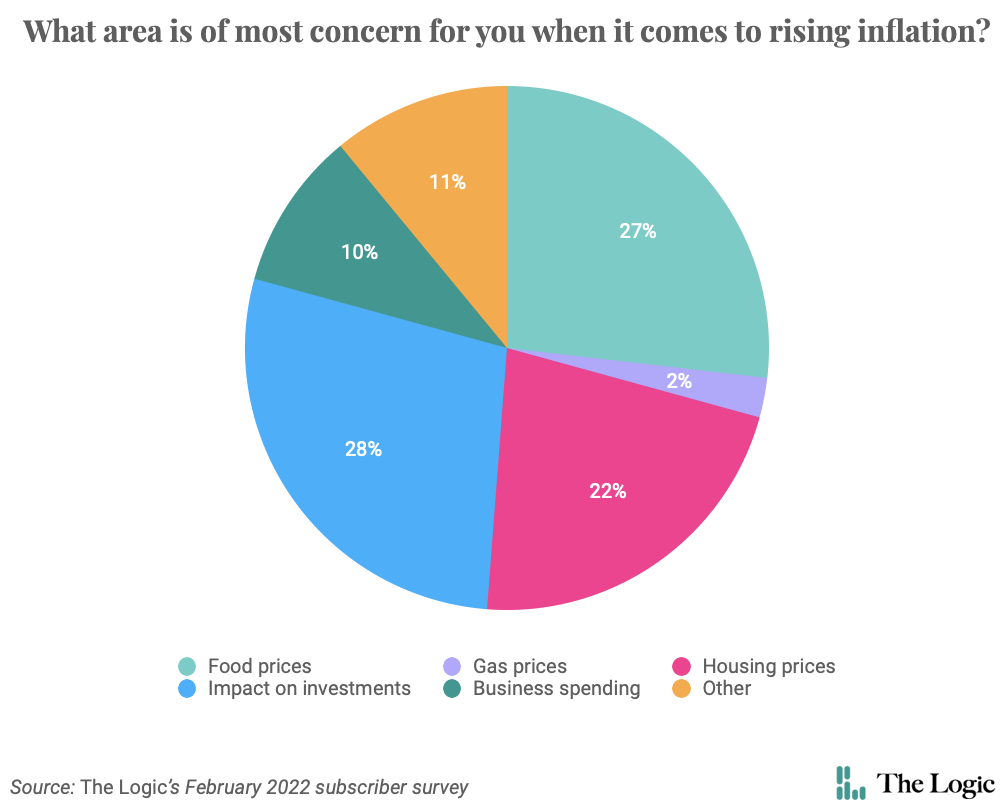
When asked what respondents are most concerned about when it comes to rising inflation, a majority said the impact on investments at 28 per cent, with food prices and housing prices trailing close behind at 27 and 22 per cent, respectively.
“I’m on a fixed income as a retiree. I wonder how [inflation] will impact my revenues and, also, my investments which are designed to assure my retirement,” wrote one subscriber.
In Canada, shelter costs rose 6.2 per cent on a year-over-year basis in January, the fastest they have risen since February 1990. Food expenses increased by 6.5 per cent, the biggest yearly increase since May 2009. Gasoline costs rose 31.7 per cent year over year, though this represented a drop from December 2021.
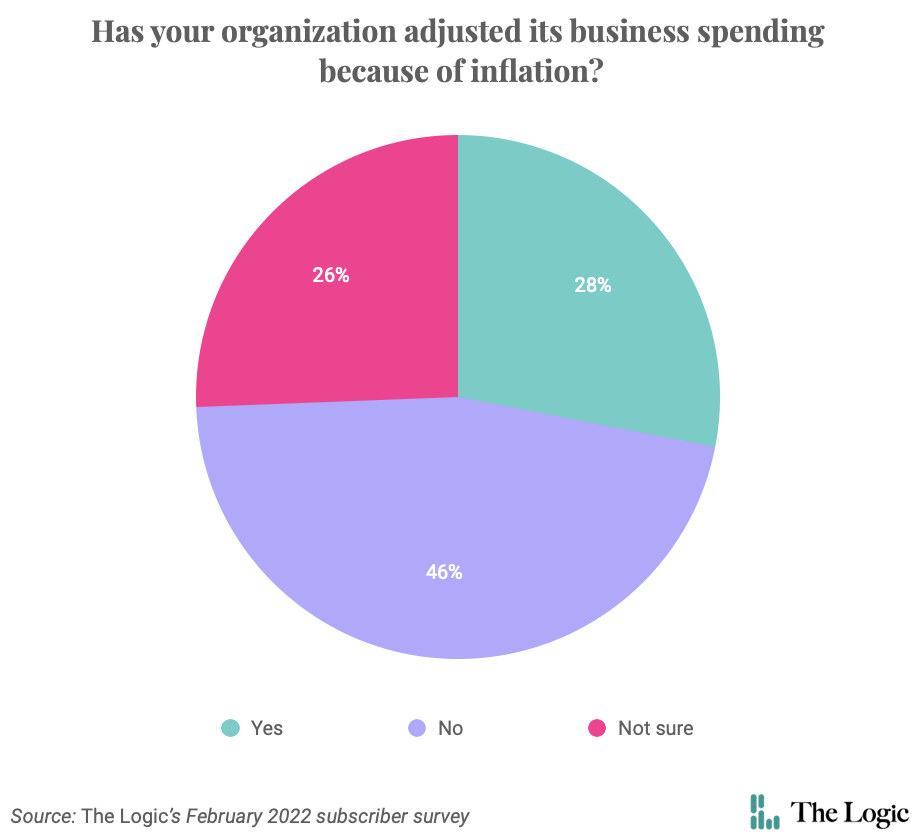
While soaring inflation has some worried, 46 per cent of respondents said their organization has not adjusted its business spending. Twenty-eight per cent said their company has made adjustments, while 26 per cent said they are not sure.
One respondent said their company has raised product prices to compensate for the increased costs of their suppliers.
Another subscriber said that while his organization hasn’t made a specific adjustment, it’s “monitoring spending needs as they arise.”
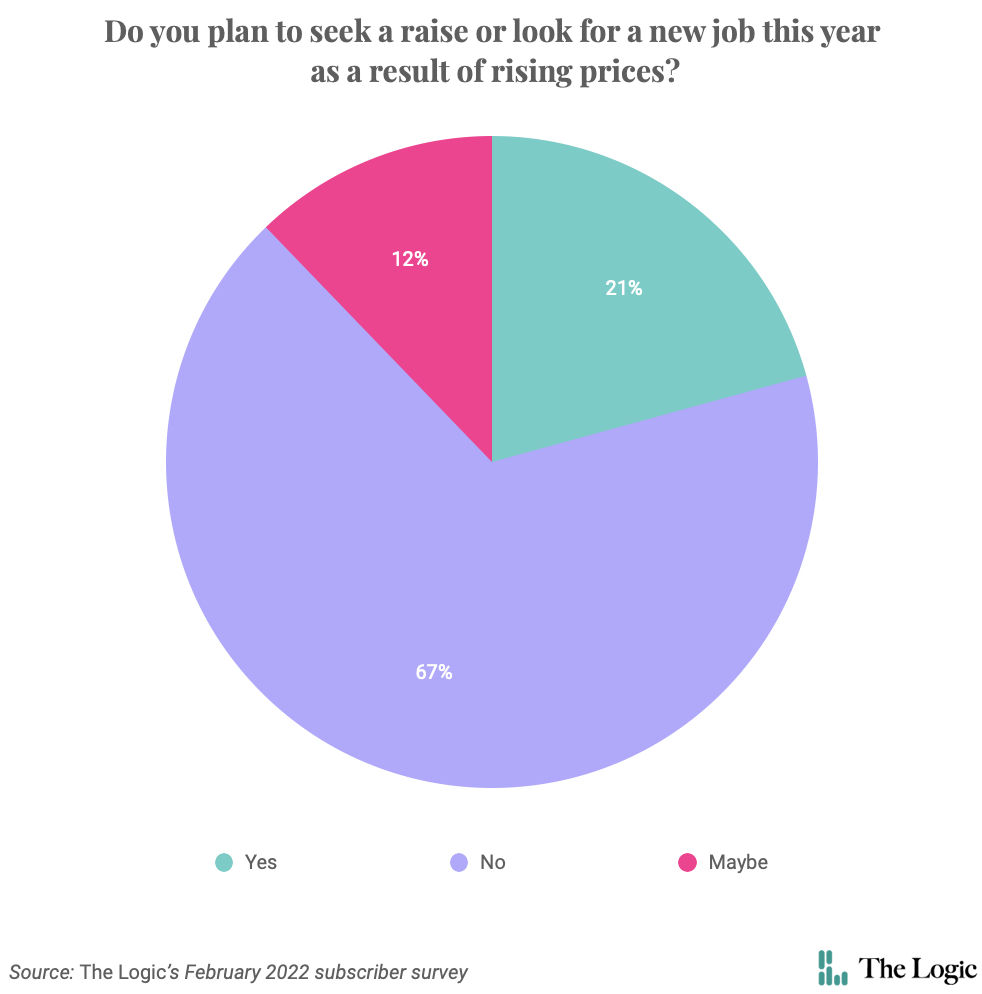
Despite facing a wide range of rising expenses, only 21 per cent of subscribers said they are planning to seek a raise or look for a new job this year and 12 per cent responded maybe.
“I am hoping for a wage increase of at least half [of the five per cent inflation rate] to try and keep up,” said a respondent, who said they were planning to ask for a raise or look for a new job.
Nearly 70 per cent of respondents said they’ll stay put, with many citing that they already have a stable job, or are retired or self-employed.



Loading...
Thanks for sharing!
You have shared 5 articles this month and reached the maximum amount of shares available.
CloseThis account has reached its share limit.
If you would like to purchase a sharing license please contact The Logic support at [email protected].
CloseGift the full article!
You have gifted 0 article(s) this month and have 5 remaining.
Recipients will be able to read the full text of the article after submitting their email address. They will not have access to other articles or subscriber benefits.
Photo: Paul Chiasson/The Canadian Press
Most Popular This Week




In-depth, agenda-setting reporting
Great journalism delivered straight to your inbox.
News
Adam Waterous proposes massive crude exports to Asia by rail through northern B.C.
Briefing
Rivals may be ‘horrified’ to realize how exposed their investments are to AI, Aviva CIO warns
Shopify, Sequoia co-lead US$200M investment in online-selling platform Whop
Amid revenue gains, 1Password bets on tools to protect data from AI agents
Best business newsletter in Canada
Get up to speed in minutes with insights and analysis on the most important stories of the day, every weekday.
Exclusive events
See the bigger picture with reporters and industry experts in subscriber-exclusive events.
Membership in The Logic Council
Membership provides access to our popular Slack channel, participation in subscriber surveys and invitations to exclusive events with our journalists and special guests.







