MONTREAL — I’ve always assumed Canadian tech was Liberal. This is almost certainly Justin Trudeau’s fault. The current prime minister has long had a yen for techy buzzwords, both as a brand-building device and a way to differentiate himself from his stodgy, oil-drenched Conservative opposition.
Skip to content

Commentary: Quebec Ink
Whomever you vote for, tech wins
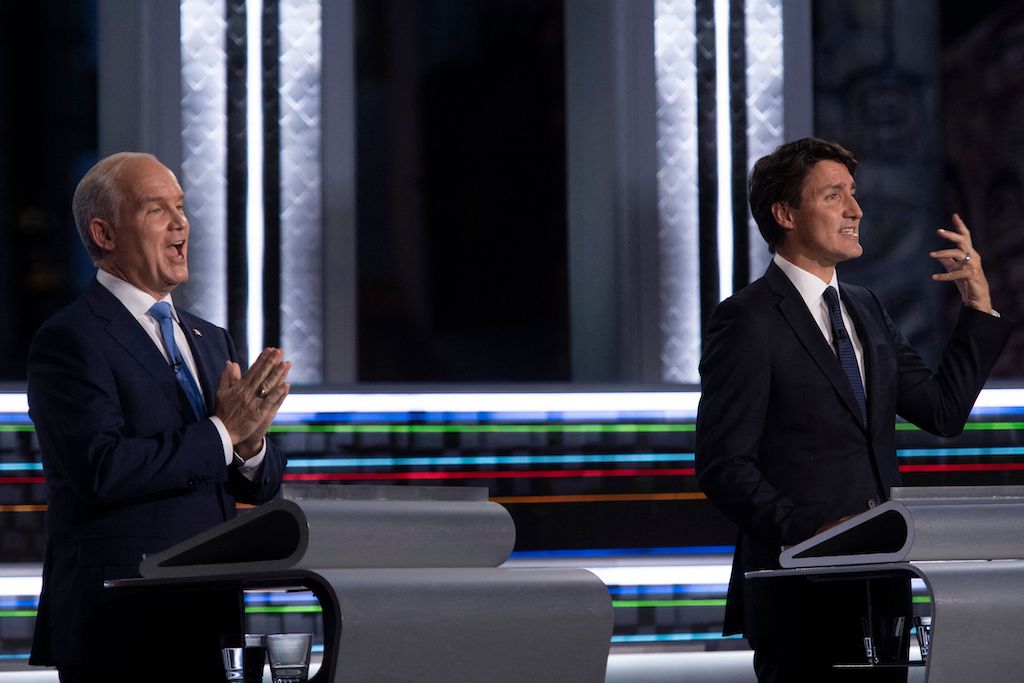
Prime Minister and Liberal Leader Justin Trudeau,right, and Conservative Leader Erin O'Toole, left, try to get their points across during the federal election French-language leaders debate Gatineau, Que., on Sept. 8. Photo: Justin Tang/POOL/AFP via Getty Images
MONTREAL — I’ve always assumed Canadian tech was Liberal. This is almost certainly Justin Trudeau’s fault. The current prime minister has long had a yen for techy buzzwords, both as a brand-building device and a way to differentiate himself from his stodgy, oil-drenched Conservative opposition.
There were endless cleantech paeans in Liberal platforms and speeches. There were supercluster initiatives and AI strategies and digital-strategy tables. There were visits to Google and deals with Netflix. And there was Trudeau and Shopify CEO Tobi Lütke on stage together at a Shopify grip and grin, just two amateur snowboarders waxing earnest about Canada’s awesome tech scene.
Talking Point
Given the Liberals’ aggressive courtship of tech, you’d think the industry would be raring to repay the favour. Yet in having become so big and powerful, tech has rendered itself above partisan politics. In this sense, it really doesn’t matter who wins the election.
Though the Liberals have since taken a harsher tone toward U.S. tech giants, it nonetheless stood to reason that the domestic industry would reward all that attention by voting Liberal. So I called up some sources in the province’s tech sector to ask, politely enough, about the size of their Liberal lawn signs. Their answers surprised me. In short: as far as their bread and butter is concerned, they don’t care who wins the next election. “Both Liberals and Conservatives are essentially pro-tech,” said one biggie here in Montreal. “Are they really that differentiated?”
Another fellow said he didn’t care who won, just as long as the winner “stays out of the way and helps when asked.” A third also shrugged his shoulders. “This just isn’t a hot-button election for me,” he said. (These guys—yes, they are all guys, which remains a problem—spoke on the condition of anonymity so as to avoid potential friction in the delivery of that support.)
Part of this agnosticism stems from a quirk of Quebec. The tech sector here, which employs 143,000 people, is heavily dependent on immigration—which is largely the provincial government’s purview. The same goes for language issues. You can bet that when Quebec’s premier threatens to cut immigration and enforce French on the (very English) business of tech, it is of monumentally more importance to the industry here than whatever supercluster Trudeau might be hocking.
More broadly, though, tech types don’t really care who will win the next election because the government mechanics behind the steady shovelling of money into the sector are bureaucrat-driven, decidedly pan-partisan—and therefore immune to the words and whims of any individual prime minister. Indeed, a look at the Liberal and Conservative platforms shows a similar tendency for flag-waving blarney (Countrywide broadband! Protecting Canadian IP! Our very own DARPA!) serving as a backdrop for the mother of all bumper stickers: making Google, Facebook and other Big Tech boogeymen pay.
“What Ottawa and various pundits call ‘innovation’ or ‘industrial strategy’ is just a collection of granting programs that are all pretty much the same and have been around for decades, plus or minus a partisan touch here and there,” Jim Balsillie, former BlackBerry co-CEO and current Council of Canadian Innovators chair, told me last week. “I suspect there would be a bit of a freakout if the NDP wins because they seem to be anti-business or anti-rich, but they aren’t going to win—and it’s not clear that Ottawa bureaucracy would actually let them have at it if they ever did. Our civil servants have more power than they advertise.”
The AI sector might be the best example of this approach. As McGill University researcher Ana Brandusescu pointed out in a report published in March, the sector promises “economic growth, military advantage and streamlining labour functions through automation.” As such, it is catnip for governments of varying sizes and colours. According to Brandusescu’s research, the federal government has doled out over $1.1 billion in grants and contributions to the sector between September 2007 and June 2020, a period during which both Conservatives and Liberals were in power. An additional $1.2 billion of planned government investments have been publicly announced for Quebec from both the federal and provincial governments, according to Brandusescu’s research. There is also nearly a billion in public and private investments from Montréal International, an economic-development organization.
Nearly half of that $1.1 billion went to Quebec, and the flow of capital has been a reputational boon for Montreal. Of course, the motivation behind these dollars is the potential massive payoff: though critics are skeptical of the numbers, the federal government projects the Quebec-based Scale AI supercluster alone will create an estimated 16,000 jobs and add $16.5 billion to the GDP over 10 years.
The end result is akin to what Amazon types refer to as a “flywheel.” The government push to make Canada’s AI sector a global player has created a self-perpetuating entity: the more fuel it ingests, the more it requires, and so it gobbles up public dollars and academic resources at universities and research institutes. Almost 72 per cent of federal grants and contributions from stakeholder groups for AI went to for-profit organizations. It’s a relationship some see as necessary. Brandusescu, however, thinks the flow of these investment dollars fundamentally undermines the politicians’ applause lines about “making Big Tech pay.”
Her research also goes a long way in explaining the tech sector’s general nonchalance when it comes to the election. Any politician threatening to turn off the taps, or even dial them back, would be accused of undermining Canada’s chance to be a global player in the economy of the not-so-distant future. “For me, it’s not a partisan angle. Because of that relationship between government and industry, the funding will forever be on the agenda,” Brandusescu told me. “Everyone wants to fund tech.”
The sector’s size and power have elevated it above the messy, distasteful partisanship of the politicians who court it. Trudeau might love tech. How telling that it doesn’t have to love him back.



Loading...
Thanks for sharing!
You have shared 5 articles this month and reached the maximum amount of shares available.
CloseThis account has reached its share limit.
If you would like to purchase a sharing license please contact The Logic support at [email protected].
CloseGift the full article!
You have gifted 0 article(s) this month and have 5 remaining.
Recipients will be able to read the full text of the article after submitting their email address. They will not have access to other articles or subscriber benefits.
Photo: Justin Tang/POOL/AFP via Getty Images
Most Popular This Week




In-depth, agenda-setting reporting
Great journalism delivered straight to your inbox.
The Big Read
Alberta’s referendum is just the start of the turmoil
Briefing
EverWind plans $10B data centre and wind development in Nova Scotia
Canada ready to force Stelco to sell its Canadian operations, Joly says
Feds plan a 60 MW defence-oriented data centre for Ottawa
Best business newsletter in Canada
Get up to speed in minutes with insights and analysis on the most important stories of the day, every weekday.
Exclusive events
See the bigger picture with reporters and industry experts in subscriber-exclusive events.
Membership in The Logic Council
Membership provides access to our popular Slack channel, participation in subscriber surveys and invitations to exclusive events with our journalists and special guests.






