MONTREAL — Fifteen years ago, I wrote a story about corruption in Quebec for Maclean’s magazine. The province was in a rough spot at the time. Montreal, its biggest city, was a cocktail of mob threats, cash-stuffed envelopes and crumbling infrastructure. It cost 30 per cent more to build a stretch of highway in Quebec than anywhere else in Canada, thanks to an oligopoly of powerful construction firms bidding on public contracts. The governing Quebec Liberal Party, meanwhile, was itself “rife with collusion, graft and barely concealed favouritism,” I wrote at the time.
Skip to content

Commentary: Quebec Ink
Is Quebec still Canada’s ‘most corrupt province?’
Mob threats, cash-stuffed envelopes and crumbling infrastructure used to be a Quebec specialty. Now, a new kind of corruption is leaking out.
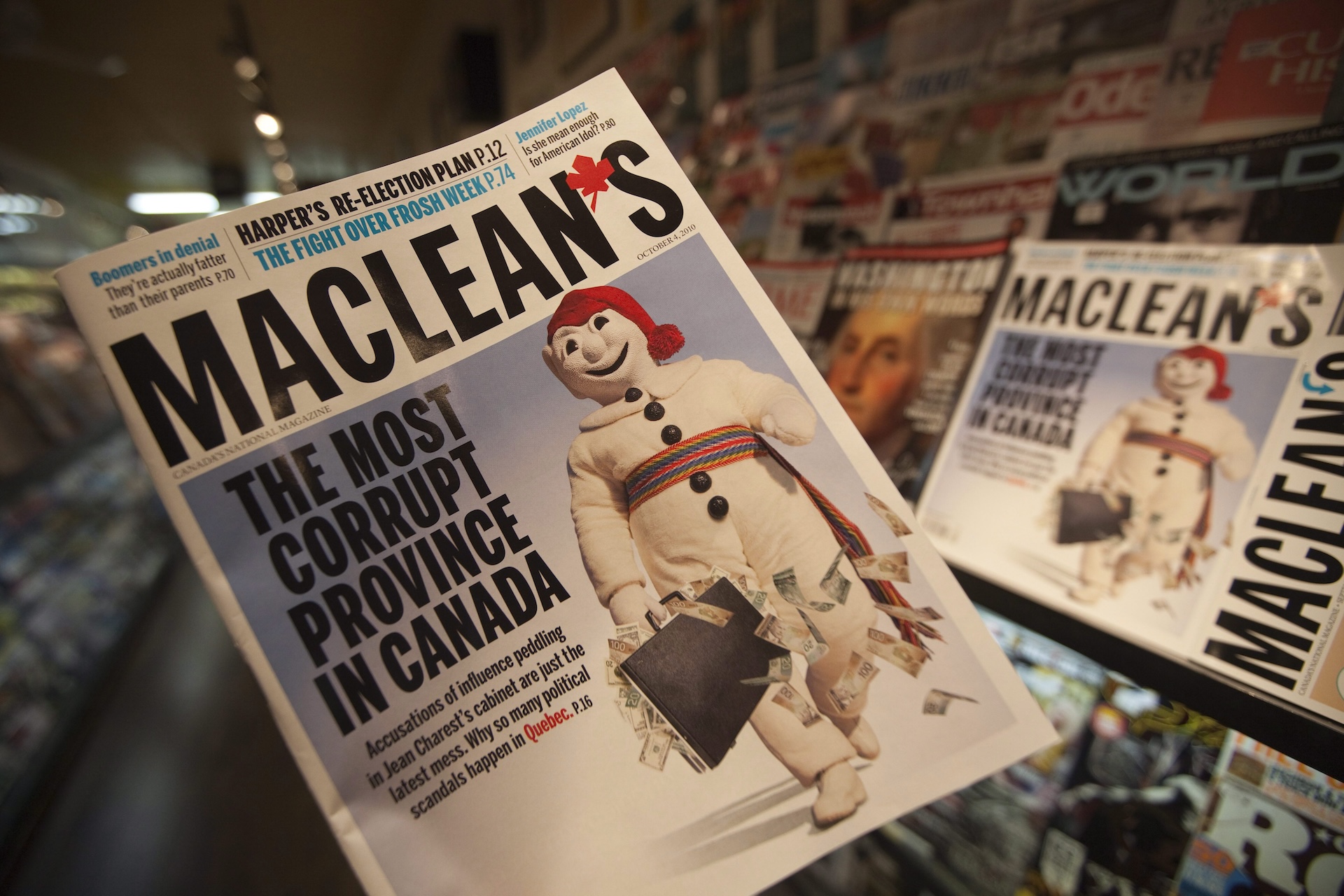
The October 2010 edition of Maclean’s magazine. Shortly after publication, the Quebec government called a news conference to denounce the magazine and demand an apology. Photo: The Canadian Press/Jonathan Hayward
MONTREAL — Fifteen years ago, I wrote a story about corruption in Quebec for Maclean’s magazine. The province was in a rough spot at the time. Montreal, its biggest city, was a cocktail of mob threats, cash-stuffed envelopes and crumbling infrastructure. It cost 30 per cent more to build a stretch of highway in Quebec than anywhere else in Canada, thanks to an oligopoly of powerful construction firms bidding on public contracts. The governing Quebec Liberal Party, meanwhile, was itself “rife with collusion, graft and barely concealed favouritism,” I wrote at the time.
The problem was far bigger than just the party, however. For over four decades, I argued, Quebecers were essentially voting on one issue: whether a political party intended to foist another independence referendum on the electorate or not. It led to an entrenchment of the political class, rendering it sclerotic, inward-looking and vulnerable to corruption.
The nature of corruption in Quebec back then was complex, and the story I reported reflected that nuance. On the cover, Maclean’s editors were less subtle: “THE MOST CORRUPT PROVINCE IN CANADA,” read the headline alongside a picture of Bonhomme Carnaval, that beloved snow-coloured mascot, carrying a cash-hemorrhaging briefcase.
Related Articles


Quebec lost its mind. I was accused of practicing terrible journalism and, worse, being a Torontonian. The Canadian parliament formally expressed its profound sadness at the magazine. Many of Quebec’s political leaders draped themselves in the Fleurdelisé, then lined up to tee off.
One politician, notably, did not. In fact, he took my calls. During the summer of 2011, we dined at Bonaparte in Old Montreal and, later, chatted in the office of his home in Montreal’s Outremont neighbourhood, home to a large swath of Quebec-bred bourgeoisie.
The politician agreed that Quebecers were prisoners of the national question and its chief wardens, the federalist Quebec Liberal Party and the separatist Parti Québécois. Quebec, he said, was “mired in stagnation” as a result. Corruption had bloomed under both, he said. His solution: a third party, one focused on economic development, less government intervention and the retirement of the aforementioned national question.
That politician was François Legault. Seven years later, his Coalition Avenir Québec formed a government on this very platform.
If time is humanity’s best punchline, then consider yourself amused. Earlier this year, Legault’s seventh in power, he became engulfed in a scandal of his own, involving the effort to digitize the province’s vehicle licensing authority. This humdrum-sounding task, named SAAQclic, has become a dumpster fire, if only because its estimated $1.1 billion budget is more than double the initial estimate, and because its rollout caused a data breach potentially affecting all of the province’s 5.5 million drivers. The SAAQclic website remains buggy and crash-prone to this day.
A cabinet minister has been sacked as a result of the scandal. The province’s anti-corruption squad is investigating, as is a commission of inquiry. The latter’s findings so far have all markings of a good old government boondogle, oddly similar to what another inquiry dug up on the governing Liberals a political generation ago: contracts awarded to former colleagues of an executive overseeing SAAQclic; outside consultants like SAP and an IBM subsidiary charging the government more than four times the going rate; and a powerful civil servant, himself a confidant of Legault, well aware of the cost overruns three long years ago—but seemingly choosing to stay quiet.
In short, the Quebec of today has a familiar smell.
I’ll admit, a touchdown dance is tempting. Yet if Quebecers can take comfort in anything, it’s the following: things aren’t as bad this time around. Yes, the SAAQclic fiasco looks gangrenous, but at least the gangrene doesn’t seem to have spread to the political parties themselves.
In the bad old days, a crucial part of the corruption was a money-harvesting cocktail circuit and a wholescale subverting of the province’s political donation law by some of the biggest companies in the province, to the benefit of both the Liberal Party and the Parti Québécois. As bad as SAAQclic is, it isn’t that.
The SAAQclic fiasco has instead underlined the extent to which François Legault’s government has fallen short of those lofty goals he once espoused.
Less government intervention? Legault’s Coalition Avenir Québec now brags about how much it intervenes governmentally.
More productivity? Those billions of government dollars have overwhelmingly gone to low-productivity industries, like forestry and textiles, according to a 2023 report from Centre sur la productivité et la prospérité, a think tank affiliated with HEC Montréal. One result: the government will likely fall short of its own GDP growth projections by 40 per cent, according to a Desjardins estimate.
Sound fiscal management? S&P Global downgraded Quebec’s credit rating in April, less than a month after the government tabled a record $13.6-billion deficit.
Finally, Legault is terrifically unpopular, to the benefit of the Liberal Party and the Parti Québécois. This likely means the next election, just over a year away, will be fought by two old parties over the knife-edge of Quebec separation. Nostalgia can be fun, but it can also be hell to live through.
Martin Patriquin is The Logic’s Quebec correspondent. He joined in 2019 after 10 years as Quebec bureau chief for Maclean’s. A National Magazine Award and SABEW winner, he has written for The New York Times, The Guardian, The Walrus, Vice, BuzzFeed and The Globe and Mail, among others. He is also a panellist on CBC’s “Power & Politics.”



Loading...
Thanks for sharing!
You have shared 5 articles this month and reached the maximum amount of shares available.
CloseThis account has reached its share limit.
If you would like to purchase a sharing license please contact The Logic support at [email protected].
CloseGift the full article!
You have gifted 0 article(s) this month and have 5 remaining.
Recipients will be able to read the full text of the article after submitting their email address. They will not have access to other articles or subscriber benefits.
Photo: The Canadian Press/Jonathan Hayward
Most Popular This Week




In-depth, agenda-setting reporting
Great journalism delivered straight to your inbox.
Commentary
Carmichael: Canadian ignorance about India is a strategic weakness
Briefing
Aritzia shares pop after earnings rise 204%
First Nation in Alberta goes to court over fast-tracked oil pipeline
Chinese EV maker Geely Auto Group to launch in Canadian market in 2027
Best business newsletter in Canada
Get up to speed in minutes with insights and analysis on the most important stories of the day, every weekday.
Exclusive events
See the bigger picture with reporters and industry experts in subscriber-exclusive events.
Membership in The Logic Council
Membership provides access to our popular Slack channel, participation in subscriber surveys and invitations to exclusive events with our journalists and special guests.





