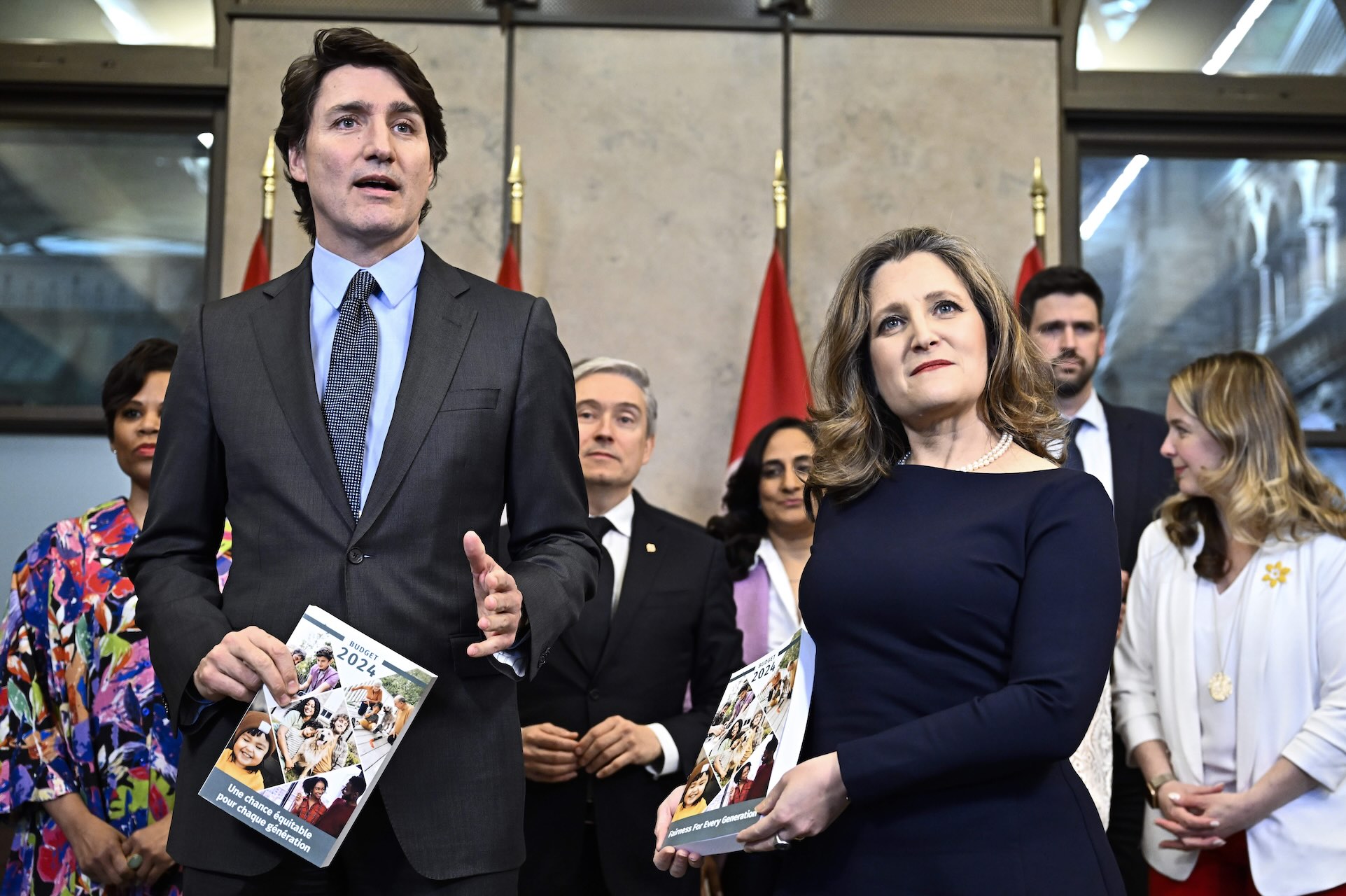
Some federal Liberals think communications will save them. That’s the notion The Globe and Mail has been reporting, via some unnamed character assassins who say Finance Minister Chrystia Freeland’s communications skills are the reason the budget didn’t reverse the party’s terrible poll numbers.
Separately, former cabinet minister Marco Mendicino told “The Herle Burly” podcast that the Liberal Party he serves has struggled to articulate a vision that is “clear and that is relatable to the average Canadian.”
Messaging matters, but it’s only part of it. Credibility is at least as important, and probably moreso. Prime Minister Justin Trudeau’s government wants to be seen as fiscally responsible even though its emphasis has been on spending throughout its time in power. Trudeau might have changed, but if he has, he will have to prove it.
Consider the Bank of Canada, which appears to have survived one of the most trying periods in its history. It did so by demonstrating contrition and humility; getting back to basics and vowing to do whatever it took to arrest inflation; and adopting an enhanced level of transparency.
For the first time in a while, there’s little drama ahead of a Bank of Canada policy decision. Almost everyone who pays attention to these things thinks governor Tiff Macklem will cut the benchmark rate on Wednesday because he has been clear about what would be required to do so. It’s easy to see his conditions have been met.
After cutting interest rates in June for the first time as governor, Macklem said the central bank is inclined to keep going, provided data continue to show that inflation is drifting back to the two per cent target. He offered a checklist of the items he and his deputies will be watching most closely: the balance between supply and demand; inflation expectations; wage growth; and corporate pricing behaviour.
The most important of those items might be the first one. Statistics Canada reported Friday that retail sales dropped 0.8 per cent in May, and based on preliminary data, fell another 0.3 per cent in June.
It’s the latest evidence that higher-for-longer interest rates, combined with the post-pandemic surge in prices, are squeezing demand. The jobless rate jumped to 6.4 per cent, compared with a 2019 average of 5.7 per cent. The Bank of Canada’s quarterly survey of businesses reports that managers see weak demand, and as a result few companies are planning to do much investment over the next 12 months.
Remember, the central bank is as concerned about inflation dropping below its target as it is about price pressures exceeding two per cent. Interest rate changes take time to work, so policymakers must anticipate where the economy is headed. Canada’s economy appears to be headed for a soft patch that will further widen the gap between supply and demand.
The central bank’s business outlook survey also showed that fewer companies anticipate making outsized price changes. What’s more, executives’ own outlooks for where inflation is headed in two years dropped to 2.5 per cent, comfortably inside the Bank of Canada’s comfort zone of one to three per cent.
That’s three of four boxes checked. Wage growth is the wild card. In theory, if paychecks are growing faster than productivity, then wages could stoke cost pressures by squeezing companies’ margins, prompting employers to raise prices.
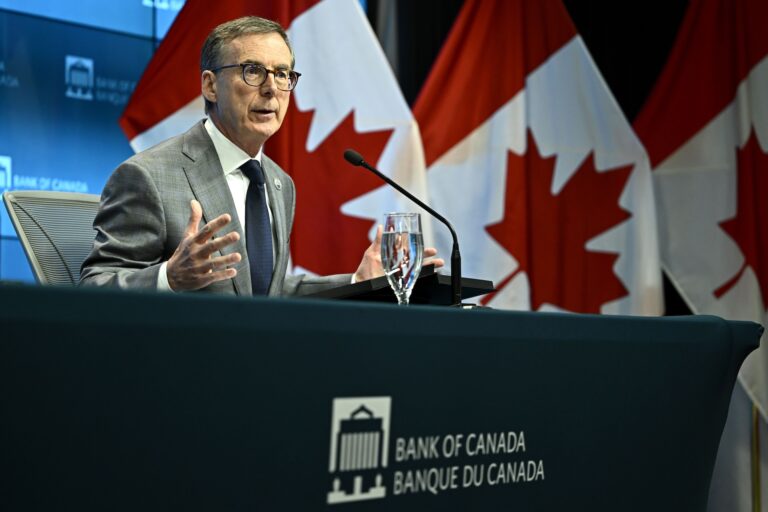
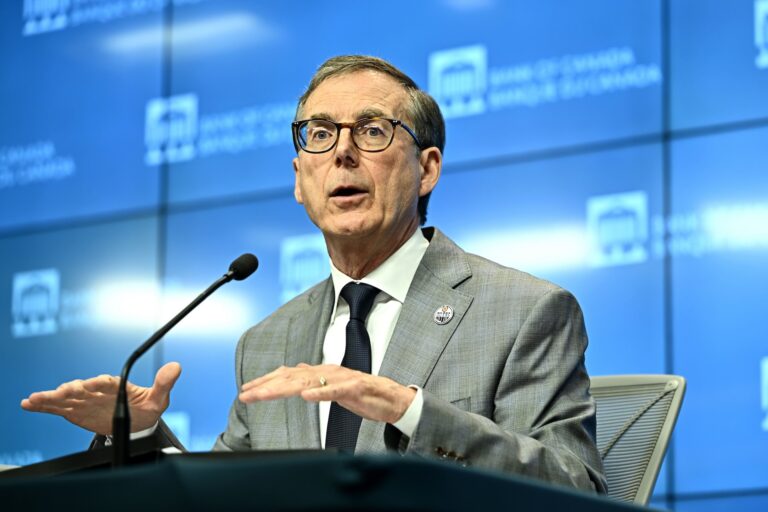
Governor of the Bank of Canada Tiff Macklem at a news conference on the Bank of Canada's rate announcement, in Ottawa, in June 2024. Photo: The Canadian Press/Justin Tang
Productivity growth is negative, so ideally, wage growth would be about the same as inflation, which currently is about 2.7 per cent, the year-over-year increase in the consumer price index. The Bank of Canada tracks seven gauges of wage growth on its website; three were tracking in excess of five per cent, while one was at 3.9 per cent and three others were around three per cent.
Wages will give the central bank something to think about, but the risk probably isn’t great enough to offset all the arrows pointing towards a second consecutive rate cut. Wages are a lagging indicator, meaning current rates are based on market conditions a year ago, when the jobless rate was around 5.5 per cent.
Of all those variables, the most pleasing for the Bank of Canada might be the survey results that suggest businesses see inflation heading back to something closer to two per cent. That’s a vote of confidence in Macklem, who stated clearly that he would drive inflation back to target and then went about the hard work of doing it.
He increased the benchmark borrowing rate to five per cent from almost zero, making him a target for everyone’s angst over the cost of living. But Macklem didn’t hide. In fact, he increased his public appearances by routinely doing a couple of media interviews each time he gave a speech. The objective was to generate confidence in what the central bank was doing by being as transparent as possible.
Contrast that with the most recent federal budget. The government badly wants some of the credit for slaying inflation. “With our fiscally responsible plan, our government is doing everything we can to support the Bank of Canada and to make it possible for the Bank of Canada to continue lowering interest rates,” Freeland said at an event in Markham, Ont., this week.
That message will meet resistance. Alongside its business outlook survey, the Bank of Canada also polls consumers. Eighteen per cent of respondents said “high government spending” was the most important factor affecting the central bank’s ability to control inflation, the most popular response. “Government spending and tax policies” tied with geopolitics as the main reason the economic outlook is difficult to predict.
Revenue was higher than expected this spring when Prime Minister Justin Trudeau’s government started work on the budget. The government decided to spend all of it, and then some. To keep the deficit from growing, the government raised capital gains taxes, delivering a blow to business confidence just as the economy was slowing.
The problem isn’t the messenger. It’s the message. If the government wants to be seen as fiscally responsible, it’s going to have to show people it’s serious—like the Bank of Canada did.
Kevin Carmichael is The Logic’s economics columnist and editor-at-large. He has spent more than two decades covering economics, business and finance for outlets including Bloomberg News, The Globe and Mail and the Financial Post, where he also served as editor-in-chief.