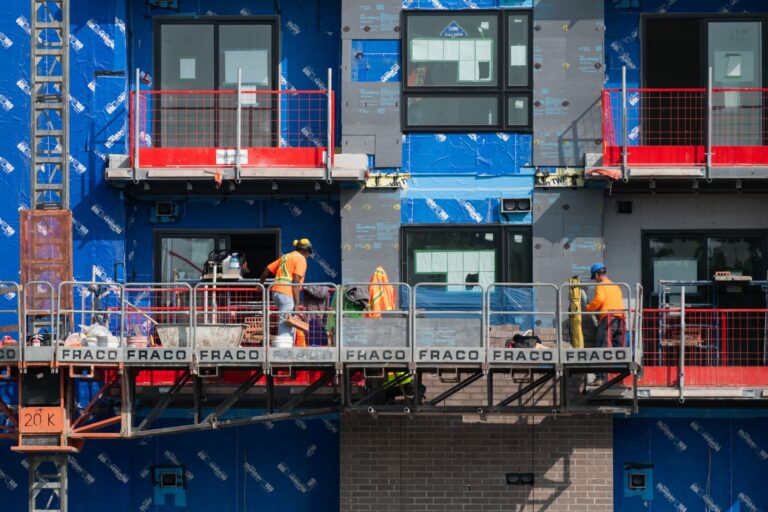
Canada’s housing market is such a mess it broke the most fundamental relationship in economics.
“Our supply curve in Canada is very inelastic,” said Michael Waters, chief executive of Ottawa-based Minto Group, one of the country’s biggest real estate developers. “It’s not responsive to demand.”
Canada is house mad. The home ownership rate is about 67 per cent, compared with about 66 per cent in the United States—where purchasing a house carries so much cultural significance it sits at the heart of the “American dream.”
The long period of low interest rates that followed the Great Recession stoked an epic housing boom in Vancouver, Toronto and other large cities. Record population growth in recent years has caused the boom to spread across the country, leading to what most everyone agrees is an affordability crisis.
Yet despite all that demand, the supply curve has barely moved. The record for housing starts in a single year is 273,203 units—set in 1976.
“The peak year of homebuilding in Canada was in the late ’70s,” Waters said. “That’s shocking.”
Builders got close in 2021, managing 271,198 starts, according to Canada Mortgage and Housing Corporation data. But housing starts fell off that pace in 2022, and slowed again in 2023. The annual average during Prime Minister Justin Trudeau’s time in government is about 229,000, compared with about 199,000 during Stephen Harper’s nine years in power. The average since 2000 is about 209,000.
Some policymakers wonder if part of the problem is a stubbornness on the part of developers to accept narrower profit margins or take bigger risks—a notion Waters rejects. His list of reasons for the inelastic supply is long, and will be familiar to anyone who has been watching the housing crisis evolve.
He starts with regulation, which he says has become slower, less predictable and more expensive to navigate. The pool of construction workers is shrinking as talent ages into retirement, making it physically impossible to keep up with demand.
Capital is scarce, while inflation and higher interest rates have made it difficult to make the math on new developments work. There are only a handful of large developers with both the scale and ambition to work in multiple provinces, making it difficult for the industry to achieve economies of scale.
Over-regulation, skilled-worker shortages and the limits imposed by our overreliance on smaller firms pop up in conversations about most facets of the Canadian economy. It was surprising to hear a big Canadian housing developer struggled to raise money, however. The industry has been benefiting from the mother of all tailwinds—and thanks to the extreme mismatch between the country’s housing stock and its growing population, you’d think Canadian real estate would be a good bet for investors looking for a relatively risk-free return.
What looks from 30,000 feet like a straightforward transaction proves messier on the ground. Simplistic models about housing assume the financial system will seamlessly shift an economy’s excess savings to the most productive uses. There are no publicly traded homebuilders in Canada. Pension funds like owning completed properties, but are less keen on financing construction because it’s so difficult to predict when projects will be completed, Waters said. And while Canada’s banks are great at selling government-backed mortgages, they are less creative when it comes to financing construction.
Minto Group CEO Michael Waters, at the company’s office in downtown Ottawa in July 2024. Photo: Ashley Fraser for The Logic
Take land. Minto and other developers regularly buy tracts of land for future development, then hold them as they wait for building permits to come through or for municipalities to build water systems and other infrastructure. Those “land banks” represent dead money on a developer’s balance sheet. In the U.S., investors often buy the land and then sell parcels to developers. Nothing like that exists in Canada, Waters said.
“To pioneer and innovate and come up with a new instrument when there is no demand for it, or uncertain demand, is typically not their M.O.,” Waters said of Bay Street.
Maybe the bankers have learned that if they wait long enough, governments will eventually put sacks of money on the table. That’s what Trudeau has done. Ahead of this year’s budget, the federal government rolled up previous announcements and added a bevy of new promises to create the closest thing Canada has had to a national housing plan in years. The various commitments promise tens of billions of spending, much of which will be contingent on provinces and municipalities making it easier for builders to get to work.
Waters is complimentary. He said the plan amounts to more than any previous federal government has done in recent memory. But some of those blindspots remain about how the housing market works.
To finance the newest spending, the government raised capital gains taxes, which, according to Waters, will make it harder for people like him to raise money from private sources. Another example is Trudeau’s decision to extend the temporary ban on foreign investment in Canadian housing. That threatens to turn unfinished condo developments in Toronto into stranded assets, said Waters, because those projects require a certain percentage of pre-sales in order to proceed. As a recent report by CIBC showed, current conditions risk an “economic lockdown” because condo owners are losing money on their investments, and costs are too high for developers to make money without more sales.
There’s another important problem with the federal housing plan. Trudeau promised his initiatives will result in 3.87 million new homes by 2031. That would require some 550,000 units per year, more than double the current one-year record.
It’s a level of ambition that strains credibility. If the federal government is serious, it will shift its focus to channelling more private capital to housing. History suggests it will need yet more leverage to bend Canada’s immovable supply curve.
Kevin Carmichael is The Logic’s economics columnist and editor-at-large. He has spent more than two decades covering economics, business and finance for outlets including Bloomberg News, The Globe and Mail and the Financial Post, where he also served as editor-in-chief.