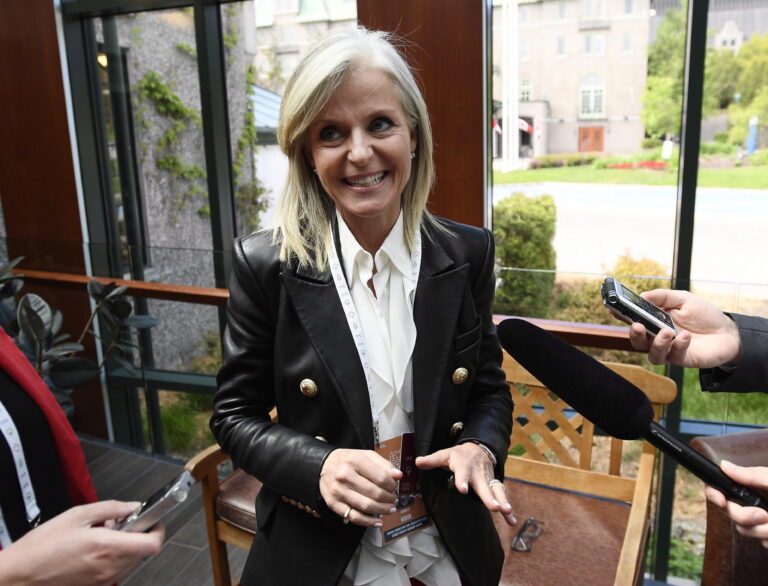
Business Development Bank of Canada chief executive Isabelle Hudon has had a lot to think about this fall.
The Crown lender celebrated its 80th anniversary this week, making it a natural time for its CEO to reflect, especially since climate change, artificial intelligence and Great Power rivalry have thrust us into a moment that echoes the transformative postwar period in which BDC was created.
Maybe the most substantial thing on Hudon’s mind is whether it’s time to send BDC’s venture arm to riskier frontiers. In this year’s budget, the federal government directed the bank to make bigger bets on Canadian startups and emerging industries.
“What areas should we play in that others are not?” Hudon asked rhetorically. She reckons she’s still a “few months” from having an answer.
Hudon’s leadership group is considering micro-credit, in which would-be entrepreneurs could access small loans of maybe $15,000 or $20,000. It might help arrest a troubling decline in business creation by making self-employment a more realistic option for individuals lacking a track record in business
But I want to focus on something else that popped up during a 50-minute interview with Hudon last week in an anteroom attached to her office at BDC’s Montreal headquarters. As of a week ago, she said she had met in person with 125 members of parliament, a demonstration of respect for the backbenches that exceeds anything I’ve encountered in my couple of decades watching economic policy get made.
Hudon, the daughter of former Quebec MP Jean-Guy Hudon, said she plans to introduce herself to the remaining 213 as soon as reasonably possible. When she scores a meeting with an MP, she takes with her a printed list of every company BDC backs in their riding. She makes sure the MP is aware of all the services BDC provides, and that they understand the bank generates revenue for the government, not the other way around.
At a time when the most popular political party in the country regularly expresses its desire to defund the Crown broadcaster, you can see why Hudon is making time for the backbenches. Given heightened levels of political polarization, anyone who cares about democratic institutions should hope the leaders of other Crown corporations are doing the same thing. Don’t let the cynics who are disenchanted with elites and gatekeepers define you—get out of the office and do it yourself.
“MPs are one group of stakeholders that need to understand what we do. I’m not putting the pressure on them. It was up to us to tell the story in an easy way for them to understand,” said Hudon. “Hopefully they appreciate a little bit more what we do.”
If politics are on Hudon’s mind, it’s not just because of the prospect of a change of government. The new marching orders the Liberals gave BDC this spring came as a surprise—not necessarily a bad one, but a surprise all the same.
Hudon insists that BDC had already raised its tolerance for risk. Its 2024 annual report shows that 87 per cent of its loan portfolio is rated below investment grade, compared with only 29 per cent at chartered banks. “This is not well known,” she said. “We’ve multiplied the conversations with the shareholder so this is well understood. Not to say that we cannot keep on doing more and better, but the risk profile is already highly risky.”
BDC was called the Industrial Development Bank when William Lyon Mackenzie King’s government created it in 1944. Its original mission was to help factories retool to meet the needs of a growing postwar economy. Over time, the bank was granted authority to lend to all types of businesses. In 1997, it declared its first dividend. In 2013, after it identified a lack of venture funding for Canadian tech startups, BDC Capital created funds focused on health care, information technology and clean energy.
Those milestones resonate today. Justin Trudeau’s government wants BDC to take on more risk because the government has reached the limits of its tolerance for deficit spending—but not of its desire to orchestrate an economic overhaul to rival the postwar industrial boom.
BDC can help with the shift to greener sources of energy, and it likely could help some promising AI companies get off the ground. It might even be able to right some historical wrongs by making a point of lending to Indigenous, Black, women and other traditionally underserved entrepreneurs.
But all that will come at a cost, one Ottawa hasn’t had to confront for a long time. BDC posted a four per cent return on equity in the fiscal year that ended March 31, below its forecast of 6.2 per cent. The lender still sent a dividend of $337 million to the government, a payment that would have been higher if not for a writedown in the value of its roughly $3-billion venture portfolio and an increase in provisions to cover potential bad loans amid weaker economic growth.
Hudon said both the writedown at BDC Capital and the larger loan provisions were the result of the bank taking greater risks. She’s not complaining, but the stains on the balance sheet are reminders that even BDC has limits.
“Where do we draw the line to keep the organization financially self-sustaining?” Hudon said. “I want to make sure that in 15 years, or in 20 years, the leaders that will be leading the bank will have the same privilege that I have, to have this autonomy to do more and better, not to wait for the government or the shareholder to recapitalize the bank.”
Kevin Carmichael is The Logic’s economics columnist and editor-at-large. He has spent more than two decades covering economics, business and finance for outlets including Bloomberg News, The Globe and Mail and the Financial Post, where he also served as editor-in-chief.