Former Bank of Canada governor David Dodge reckons Canadians can handle some hard truths about what it will take to resolve the productivity crisis.
Skip to content


Commentary
Carmichael: David Dodge has a remedy for the productivity crisis. It’s not sugar-coated
Canadians will face an economic challenge if you tell it like it is
David Dodge delivering a monetary policy report in Ottawa in January 2007, when he was governor of the Bank of Canada Photo: Tom Hanson/The Canadian Press
Former Bank of Canada governor David Dodge reckons Canadians can handle some hard truths about what it will take to resolve the productivity crisis.
“When we’ve had problems in the past, the governments have stood up and said, ‘We’ve got a problem and we’ve got to fix it,’” Dodge said at a virtual event hosted earlier this month by Bennett Jones, the law firm where Dodge now works as an adviser. “The Canadian population is actually incredibly sensible.”
Top of mind for Dodge was Jean Chrétien’s decision in the mid-1990s to confront a large budget deficit. “The public not only accepted it, but embraced it,” said Dodge, who as deputy finance minister played a central role in planning and implementing the massive spending cuts required to erase a deficit that appeared stuck at about five per cent of gross domestic product.
Chrétien’s government was successful in winning over the public, according to Dodge, because it “was quite clear about what it was that we had to do; quite clear that this was not going to be easy and that steps had to be taken.”
Canada has a new economic crisis of its own making. Dodge was reflecting on the deficit fight because he agrees with the current leaders of the Bank of Canada that it’s time to “break the glass” and do something drastic to address chronically weak productivity growth.
Related Articles

“To continuously improve our standards of living, the overriding goal of economic policy for Canada must be stronger growth in productivity,” Dodge and co-authors wrote in a report published this month by Bennett Jones.
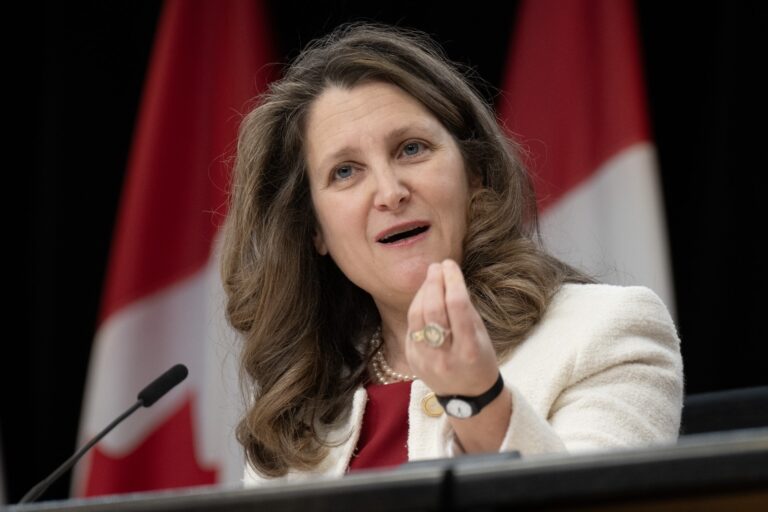
Canada’s current political leaders aren’t big on delivering hard truths. Finance Minister Chrystia Freeland’s budget was overt in its attempt to soothe the anxieties of millennials and Gen Z, pledging billions to build houses instead of helping youngsters understand that life is difficult.
Opposition Leader Pierre Poilievre’s 15-minute video on why his Conservatives oppose higher capital gains taxes ends with a promise to establish a committee to review tax policy within 60 days of becoming prime minister. It’s a good idea, but like Freeland, Poilievre isn’t ready to concede that righting Canada’s problems will be painful.
The International Monetary Fund’s recent report card on Canada’s economic performance said the country would benefit from a narrower deficit, and that it should aim to do so through “greater revenue mobilization,” such as raising the GST to create fiscal space for future downturns and unavoidable costs related to climate change, health care and defence. Poilievre isn’t talking about raising revenue. He says in the video that the mission of his tax committee will be to lower taxes on “work, hiring and making stuff.”
The deficit fight was about resiliency. Getting the fiscal house in order allowed Chrétien and his successor, Stephen Harper to cut taxes, among other things. More importantly, Harper and his successor, Justin Trudeau, were able to fight two epic catastrophes—the Great Recession and the COVID crisis, respectively—without totally wrecking the budget.
Same for productivity. There were roughly 29 centenarians per 100,000 persons in 2023, compared with about 11 in 2001, according to Statistics Canada. We’re living longer, yet we appear to want to keep spending like nothing has changed. The only way to do that will be to generate more wealth through productivity growth.
Dodge’s report lays the foundation for a debate for when politicians find the nerve to engage. In particular, he and his co-authors established three facts that should be helpful.
First, they showed that even though weaker productivity growth is a global phenomenon, Canada stands out because its inflation-adjusted economic growth per capita is significantly weaker than all of its peer countries, with the exception of the U.K. There could be larger forces at work, but we’re making the situation worse.
Second, they showed that output per worker fell from its longer-term trend around 2006, the year Harper’s Conservatives won the first of three consecutive elections. That should help depoliticize the issue. Trudeau hasn’t done anything to help productivity, but the problem didn’t start with him.
Third, Dodge joined Alberta Central chief economist Charles St-Arnaud in demonstrating that a big part of the problem is residential real estate—that is, it’s a black hole for investment. As a share of GDP, Canada’s gross national savings and investment are similar to other countries’. However, per person, we plow much more of that money into dwellings.
Australia shows where Canada could be if we weren’t so obsessed with buying houses. Australia’s GDP per capita increased 19.6 per cent between 2007 and 2023, compared with 6.8 per cent for Canada. Australia’s population grew faster than Canada’s over that period, but whereas Canada spent most of its savings on dwellings, Australia devoted a greater share to non-residential investment. That “robust performance and advantage over Canada” allowed Australia to exploit the China-led commodities boom to an extent that Canada couldn’t, the report said.
That last point will be hardest to stomach. Poilievre and the Liberals spend much of their time fighting over who could build more homes. It will take courage to suggest that the “Canadian dream” of home ownership is a root cause of the productivity nightmare.
Kevin Carmichael is The Logic’s economics columnist and editor-at-large. He has spent more than two decades covering economics, business and finance for outlets including Bloomberg News, The Globe and Mail and the Financial Post, where he also served as editor-in-chief.



Loading...
Thanks for sharing!
You have shared 5 articles this month and reached the maximum amount of shares available.
CloseThis account has reached its share limit.
If you would like to purchase a sharing license please contact The Logic support at [email protected].
CloseGift the full article!
You have gifted 0 article(s) this month and have 5 remaining.
Recipients will be able to read the full text of the article after submitting their email address. They will not have access to other articles or subscriber benefits.
Photo: Tom Hanson/The Canadian Press
Most Popular This Week




In-depth, agenda-setting reporting
Great journalism delivered straight to your inbox.
News
Tech firms want AI models to create better versions of themselves
Briefing
Lightspeed cuts 250 jobs through layoffs and attrition
Oil tycoon Adam Waterous aims to build new Canadian energy player with US$1B fund
Data centre infrastructure firms 3C and Datalec merge, plan Calgary expansion
Best business newsletter in Canada
Get up to speed in minutes with insights and analysis on the most important stories of the day, every weekday.
Exclusive events
See the bigger picture with reporters and industry experts in subscriber-exclusive events.
Membership in The Logic Council
Membership provides access to our popular Slack channel, participation in subscriber surveys and invitations to exclusive events with our journalists and special guests.