Commentary
Carmichael: Freeland’s fiscal update reveals campaign against gimmickry
Unlike previous financial plans, her final one was dominated by policies aimed at investment rather than stoking consumption

In her resignation letter as finance minister, Chrystia Freeland made it clear that the tax break wasn’t her idea. Photo: The Canadian Press/Justin Tang
OTTAWA — History is more dramatic after the fact. In real time, it moves slowly.
Cabinet ministers resign when they fall out of step with the boss. But they don’t quit the morning they are scheduled to table an important document in Parliament. The timing of Finance Minister Chrystia Freeland’s resignation was as shocking as anything else. It was dramatic. We’ll be talking about it for years to come.
But in the moment, things slowed down quickly and confusion took over.
The federal government needed several hours to confirm there would be a fall economic statement at all. Most of the dozens of reporters and analysts who had gathered to read the fiscal update under embargo gradually drifted away. The lonely staff at the cafeteria looked desolate, as their big pay day evaporated.
“No HST,” the cashier said as I purchased the lunch special, Greek chicken.
No one who gathered at the Diefenbaker Building on Sussex Drive needed reminding about the federal tax holiday, which the economic statement said will cost the treasury $1.6 billion, even though Freeland was struggling to keep spending aligned with her budget targets.
Related Articles

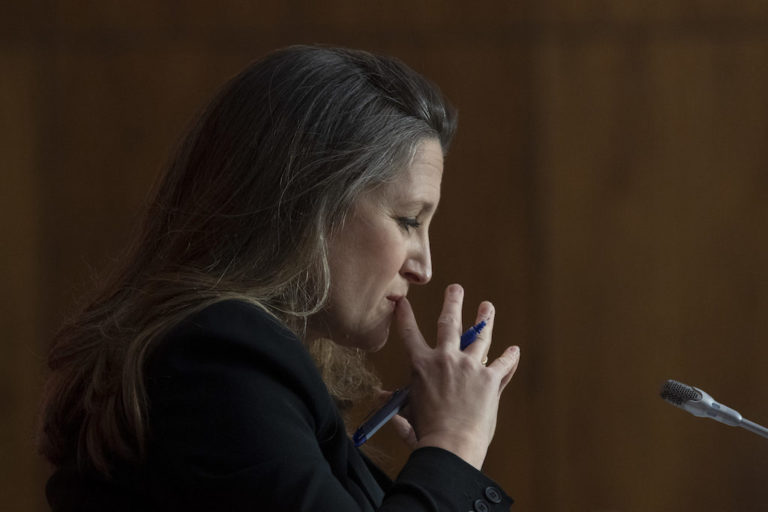
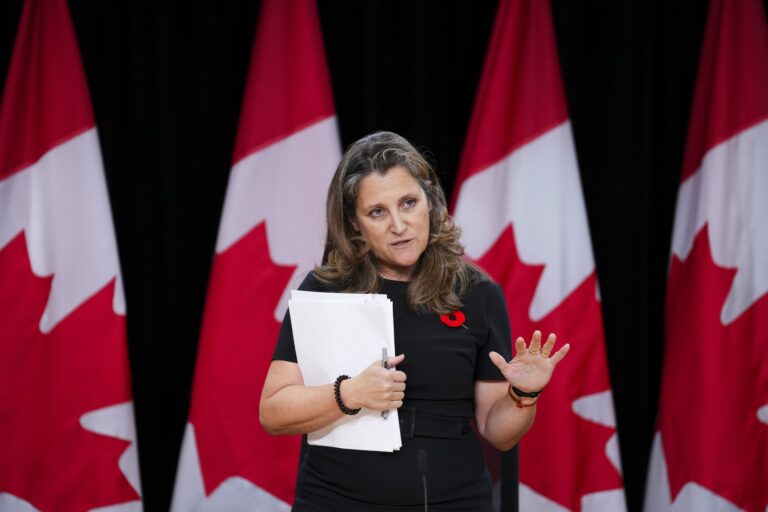
In her resignation letter, Freeland made it clear that the tax break wasn’t her idea. She stated the government should be preserving fiscal room to counter U.S. president-elect Donald Trump’s tariff threats, which presumably explains why the government’s pledge to send a $250 cheque to more than 18 million people this spring is absent from the economic statement.
Getting ready for Trump’s presidency, “means keeping our fiscal powder dry today, so we have the reserves we may need for the coming tariff war,” Freeland wrote. “That means eschewing costly political gimmicks, which we can ill afford and which make Canadians doubt that we recognize the gravity of the moment.”
The economic update was meant to show how the federal government was getting ready for Trump, who could push Canada into recession if he goes through with broad-based tariffs. It still might, as there are a series of measures that could encourage investment. That’s vital, as tariffs have given companies a new reason to keep their own powder dry. Policymakers will need to offset greater uncertainty by removing as many obstacles to investment as possible.
But for now, Freeland’s resignation adds to the uncertainty. If Freeland was a bulwark to a Prime Minister’s Office bent on “gimmicks,” what happens now that she’s gone? The deficit ballooned to $61.9 billion in the fiscal year that ended March 31, compared with a forecast of $40 billion.
Much of that was accounting related to Indigenous settlements. Still, the projected deficit for the current fiscal year is about $43 billion, outside the fiscal guardrails Freeland said would contain the government’s spending. The government’s credibility would have taken a hit even if the finance minister hadn’t quit.
There were already questions about whether Prime Minister Justin Trudeau’s unpopularity compromised Canada’s ability to confront the Trump administration. There will be more questions now, as he lost both his finance minister and housing minister on the same day. Sean Fraser’s departure had nothing to do with Freeland, but he was a front-line member of Trudeau’s team, charged with managing the multiple billions the federal government has budgeted to address the housing crisis. The government is weakened.
“Swapping the finance minister isn’t going to alleviate Canadians’ fatigue with the top,” pollster Kyla Ronellenfitsch wrote in her newsletter Monday.
Freeland’s decision to quit suggests a lack of confidence in where Trudeau intended to take the government, because the economic statement itself implied she was winning the campaign against gimmickry. Unlike previous financial plans, her final one was dominated by policies aimed at investment rather than stoking consumption.
The topline item was a $17.4-billion tax break on business investment. There were a number of other tax measures and funds that would encourage more companies to spend on research and development and more investors to bet on Canadian firms. There’s another $150 million for the innovation clusters; a pledge, backed by legislation, to enact open banking by early 2026; and a commitment to accelerate efforts to eliminate commercial barriers between the provinces, in part by publishing a list of all the things governments do to impede inter-provincial trade.
There’s more. But it feels premature to spend too much time on any of the items in the economic statement because it’s no longer clear they have a champion. Let’s see if Trudeau survives the week.
Canadian bond yields jumped on the news of Freeland’s departure, and then came back down over the day. That suggests traders are looking past today’s disruption and betting on a Conservative government that will “fix the budget.” Pierre Poilievre hasn’t said what that would look like, but it’s safe to guess it wouldn’t resemble the document that was tabled Monday, no matter how historic.
“Along with the rest of the Bank of Canada’s governing council, I want to thank Minister Freeland for her service to Canadians. It’s a tough job,” Bank of Canada governor Tiff Macklem said in a speech in Vancouver, while also stressing that the central bank operates independently from politics.
“We look forward to working with the next minister of finance, continuing to promote the economic and financial well-being of Canadians.”
Kevin Carmichael is The Logic’s economics columnist and editor-at-large. He has spent more than two decades covering economics, business and finance for outlets including Bloomberg News, The Globe and Mail and the Financial Post, where he also served as editor-in-chief.



Loading...
Thanks for sharing!
You have shared 5 articles this month and reached the maximum amount of shares available.
CloseThis account has reached its share limit.
If you would like to purchase a sharing license please contact The Logic support at [email protected].
CloseGift the full article!
You have gifted 0 article(s) this month and have 5 remaining.
Recipients will be able to read the full text of the article after submitting their email address. They will not have access to other articles or subscriber benefits.