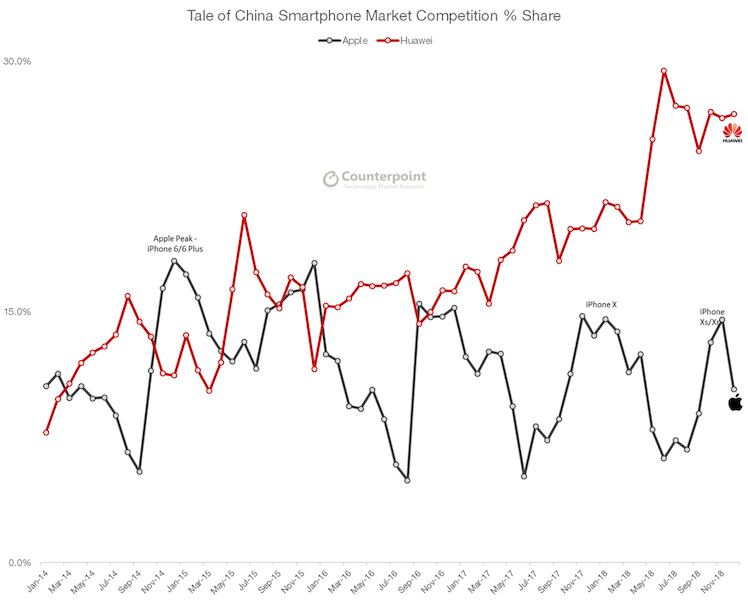
What happened: Apple announced late Wednesday that the number of iPhones sold has been essentially flat for 18 months. Apple has offset that trend with higher average iPhone sale prices.
Key quote: “While we anticipated some challenges in key emerging markets, we did not foresee the magnitude of the economic deceleration, particularly in Greater China.” — Tim Cook, Apple CEO, in his letter to investors last night.
The fallout: Apple stock plummeted 10 per cent overnight, falling to the fourth-biggest public company behind Amazon, Microsoft and Alphabet. You’ll recall that it was a trillion-dollar company by market cap as recently as August 2 of last year. At tonight’s close, Apple’s market cap had lost US$400 billion since its November 1 earnings report. That’s the equivalent of Facebook’s entire market cap in just the past two months alone.
The news sent shudders through global markets. The Dow declined 2.8 per cent down over 650 points, while the S&P 500 retreated 2.3 per cent. The Nasdaq plunged 2.8 per cent, putting it on track to close in a bear market.
Buffet’s US$4-billion blow: Berkshire Hathaway, Apple’s second-largest investor, owns about 252.5 million shares of Apple. The position makes up more than a quarter of Berkshire’s total portfolio, and is by far Warren Buffett’s largest holding. Thursday’s stock plunge cost Berkshire Hathaway US$4 billion.
Photo: (Credit: Neil Shah)
The most scathing critique came from Bloomberg tech columnist Shira Ovide: “This should have been absolutely predictable to anyone who was able to peer outside of Apple’s bubble. Executives have failed in their duty to warn investors ahead of time about all this, and reality is finally and all at once catching up to Apple.”
Why it matters: The long-term effects of the U.S.-China trade war are coming into focus. Apple is overly exposed to China’s market among the FAANG companies, but others—from FedEx to Starbucks and even Tiffany’s—are seeing a decrease in Chinese demand.
Canadian implications: Apple is Exhibit A on what happens when the world’s second-largest economy decides to shut you out, which may help explain why Canada has been slow to eject Huawei from Canadian 5G infrastructure projects. Better not to poke the bear. The bad news is that even if Canada were to keep its exports in good standing with China, we’ll inevitably be hit by the global fallout from a U.S. slowdown.
What’s bad for Apple is apparently good news for consumers according to Wired, which points out that what was, in 2015, a 24-month lifespan for smartphones has jumped to 35 months. It’s also good news for the environment, given that the manufacture of each Apple device also generates 90 pounds of carbon emissions on average.
In other Apple news: The company’s iPhone 7 and 8 models will be pulled from shelves in German stores after Qualcomm Inc. said on Thursday it had posted security bonds to enforce a court order banning the sale of those iPhone models in the country. Apple said it would appeal the decision.
Fun diversion: It’s hard to believe for those of us who grew up in the days of the Sony Walkman craze (do yourself a favour and click on that link), but according to Horace Dediu, an industry analyst, the Apple Watch is now a decidedly bigger business than the market-changing iPod ever was.